
Why Most Digital Marketing Budgets Get Wasted
Businesses spend an average of 9-12% of their total revenue on marketing. A significant portion of that goes to digital channels - social media, paid ads, email, and content. Yet most companies cannot tell you which dollar produced which customer.
The problem is not the channels. It is the lack of strategy connecting activity to revenue. Posting three times a week on Instagram, boosting a Facebook post occasionally, and running Google Ads with default settings is not a strategy. It is random activity disguised as marketing.
A real digital marketing strategy starts with your business goals, works backward to identify the right channels and tactics, and measures everything against revenue - not vanity metrics like followers or impressions.
The Digital Marketing Strategy Framework
Before spending a dollar on ads or creating a single post, answer these four questions:
- Who is your ideal customer? Define them specifically - job title, industry, company size, pain points, where they spend time online.
- What problem do you solve for them? Frame everything around their problem, not your product features.
- Where do they discover and research solutions? This determines which channels matter.
- What does your sales process look like? A $50 product and a $50,000 service require completely different marketing approaches.
Choosing the Right Channels
The biggest mistake businesses make is trying to be everywhere. You do not need a presence on every platform. You need a strong presence on the 2-3 channels where your customers actually are.
Channel selection guide
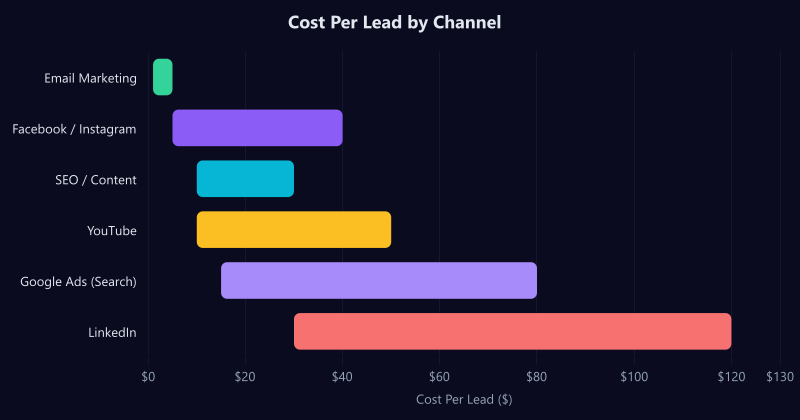
| Channel | Best for | Typical cost per lead | Content type |
|---|---|---|---|
| Google Ads (Search) | High-intent buyers actively searching | $15-80 | Text ads, landing pages |
| LinkedIn (Organic + Ads) | B2B, professional services, SaaS | $30-120 | Thought leadership, case studies |
| Facebook/Instagram Ads | B2C, local businesses, e-commerce | $5-40 | Visual content, video, stories |
| Email Marketing | Nurturing existing leads and customers | $1-5 | Newsletters, sequences, promotions |
| SEO/Content Marketing | Long-term organic traffic | $10-30 (over time) | Blog posts, guides, resources |
| YouTube | Education-heavy industries, tutorials | $10-50 | Video content, how-to guides |
The rule of two: Master two channels before adding a third. Spreading thin across six platforms means none of them work well.
Paid Advertising That Actually Converts
Paid ads can deliver leads fast, but only if the targeting, creative, and landing page work together. Most wasted ad spend comes from one of three problems: targeting the wrong audience, running weak creative, or sending traffic to a generic homepage.
Google Ads strategy
Google Search Ads capture people who are already looking for what you offer. This is the highest-intent traffic you can buy.
What works:
- Target specific, commercial-intent keywords ("AI chatbot development for e-commerce" not just "chatbot")
- Write ad copy that matches the search intent exactly
- Send clicks to a dedicated landing page, not your homepage
- Use negative keywords to block irrelevant searches (saves 20-40% of wasted spend)
- Start with a small daily budget ($20-50/day), test for 2-3 weeks, then scale what works
- Broad match keywords without negative keyword lists
- Sending all traffic to your homepage
- Not tracking conversions (you cannot optimize what you do not measure)
- Setting and forgetting - Google Ads needs weekly optimization
Facebook and Instagram Ads strategy
Meta Ads work differently from Google. People are not searching for your product. You are interrupting their scroll with something compelling enough to stop and engage.
The winning formula:
- Targeting: Use lookalike audiences based on your existing customers, not broad interest targeting
- Creative: Video outperforms static images 2-3x. Short-form video (15-30 seconds) works best
- Copy: Lead with the problem ("Tired of spending 3 hours a day on manual data entry?"), then present your solution
- Offer: Give them a reason to click now - assessment, limited consultation, downloadable resource
- Retargeting: Show different ads to people who visited your site but did not convert (retargeting audiences convert 3-5x higher than cold audiences)
LinkedIn Ads strategy
LinkedIn is expensive compared to other platforms ($5-15 per click), but for B2B companies, the targeting precision is unmatched. You can target by job title, company size, industry, seniority, and even specific companies.
Best-performing LinkedIn ad formats:
- Sponsored Content (single image or video): Thought leadership content that educates rather than sells
- Message Ads: Direct InMail campaigns to decision-makers (use sparingly - 1-2 touches, not 10)
- Document Ads: Carousel-style documents that users swipe through in-feed
Social Media Content That Builds Trust
Organic social media does not drive immediate sales for most businesses. What it does is build awareness, establish credibility, and stay top-of-mind so that when your audience is ready to buy, they think of you first.
The content mix
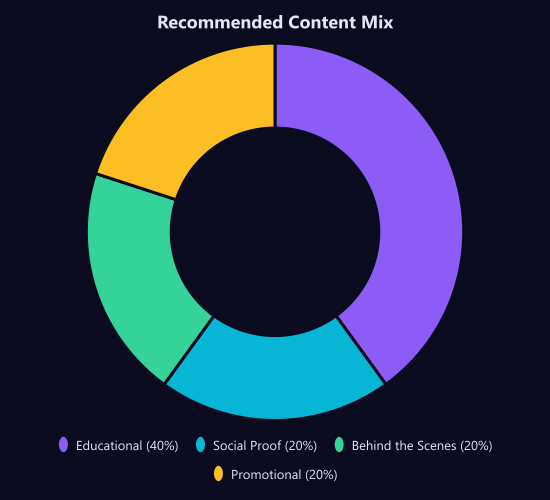
Not every post should be a sales pitch. Use this ratio as a starting point:
| Content type | Percentage | Examples |
|---|---|---|
| Educational | 40% | Tips, how-to posts, industry insights, data breakdowns |
| Social proof | 20% | Case studies, client results, testimonials, project showcases |
| Behind the scenes | 20% | Team culture, process insights, day-in-the-life, tools you use |
| Promotional | 20% | Service highlights, offers, calls-to-action, event announcements |
Platform-specific content guidelines
LinkedIn:
- Long-form text posts (150-300 words) with a strong opening hook
- Share original opinions and professional experiences
- Comment on industry trends with your own take
- Document carousels for step-by-step guides
- Reels (15-60 seconds) are the primary growth driver right now
- Carousel posts for educational content (swipeable tips)
- Stories for daily engagement and behind-the-scenes content
- Strong visual brand consistency across all posts
- Video content dominates the algorithm
- Community building through groups (more engagement than pages)
- Local businesses: focus on reviews, events, and community involvement
- Paid reach is essentially required - organic reach on Facebook pages is 2-5%
Want us to build your digital marketing strategy? Get a marketing growth plan - we will analyze your current presence and create a channel strategy that drives real business results.
Email Marketing: The Highest-ROI Channel
Email consistently delivers the highest ROI of any digital marketing channel - $36-42 for every $1 spent, depending on the study. Yet most businesses either ignore email or send the same generic newsletter to everyone.
Building an email strategy that works
Grow your list with value, not tricks:
- Offer genuinely useful lead magnets (calculators, templates, guides)
- Add contextual opt-in forms to high-traffic blog posts
- Use exit-intent popups with a specific offer (not "Subscribe to our newsletter")
- Never buy email lists - they destroy deliverability and violate regulations
- Where they signed up (which page, which offer)
- What they have engaged with (which emails opened, which links clicked)
- Where they are in the buying journey (new subscriber vs. qualified lead vs. customer)
- Welcome sequence (5-7 emails): Introduce your brand, deliver value, build trust, make a soft offer
- Nurture sequence: Ongoing educational content for leads who are not ready to buy yet
- Re-engagement sequence: Win back subscribers who have stopped opening emails
- Post-purchase sequence: Onboarding, cross-sell, review request
Email metrics that matter
| Metric | Good benchmark | What it tells you |
|---|---|---|
| Open rate | 25-35% | Subject line effectiveness and list health |
| Click rate | 3-7% | Content relevance and CTA strength |
| Unsubscribe rate | Under 0.5% | Content-audience fit |
| Revenue per email | Varies by industry | Actual business impact |
Measuring What Matters
The most common digital marketing mistake is tracking the wrong metrics. Followers, likes, and impressions feel good but do not pay bills. Track metrics that connect directly to revenue.
Metrics by funnel stage
Awareness (top of funnel):
- Reach and impressions (how many people see your content)
- Website traffic by source (where visitors come from)
- Brand search volume (are more people searching for your name?)
- Engagement rate (are people interacting with your content?)
- Email list growth rate
- Content downloads and resource signups
- Time on site and pages per session
- Cost per lead by channel
- Lead-to-customer conversion rate
- Customer acquisition cost (CAC)
- Return on ad spend (ROAS)
- Customer lifetime value (LTV)
- Repeat purchase rate
- Referral rate
- Net promoter score (NPS)
The dashboard you actually need
Set up a simple monthly dashboard that tracks:
- Total marketing spend by channel
- Leads generated by channel
- Cost per lead by channel
- Leads converted to customers
- Revenue attributed to marketing
Common Mistakes to Avoid
Chasing trends instead of strategy: Every week there is a new platform, format, or tactic. Stick with your strategy. Test new things deliberately, not impulsively.
Inconsistency: Posting every day for two weeks, then going silent for a month is worse than posting three times a week consistently. Consistency builds trust and algorithmic momentum.
Ignoring existing customers: Acquiring a new customer costs 5-7x more than retaining an existing one. Your email list and current customer base are your most valuable marketing assets.
Not testing: Every ad, email subject line, landing page, and CTA should be tested. Small improvements compound. A 10% improvement in click-through rate plus a 10% improvement in conversion rate equals a 21% increase in results.
Measuring too early: Digital marketing needs time to work. Paid ads need 2-4 weeks of data to optimize. Content marketing needs 3-6 months to gain traction. Pulling the plug after one week of disappointing results is the most expensive mistake in marketing.
Building Your 90-Day Action Plan
Here is a practical roadmap for getting started or resetting your digital marketing:
| Timeframe | Focus | Deliverables |
|---|---|---|
| Week 1-2 | Strategy and audit | Define ideal customer, audit current channels, set KPIs, choose 2 primary channels |
| Week 3-4 | Foundation | Set up tracking (GA4, conversion pixels), build/optimize landing pages, create content calendar |
| Week 5-8 | Execution | Launch paid campaigns with small budgets, begin consistent organic posting, set up email sequences |
| Week 9-12 | Optimization | Review performance data, double down on what works, cut what does not, plan next quarter |
Let us build a digital marketing strategy tailored to your business - we will audit your current channels, identify the highest-ROI opportunities, and give you a clear 90-day plan.
Frequently Asked Questions
Which social media platform is best for B2B? LinkedIn dominates for B2B lead generation and thought leadership content.
How often should I post on social media? Three to five times per week per platform is the sweet spot for most small businesses.
Is organic social media reach dead? Reduced, not dead. Consistent, valuable content still reaches your audience - especially on LinkedIn.
Should I hire a social media manager? If you spend 10+ hours weekly on social and your time is worth more elsewhere, yes.
How do I measure social media ROI? Track traffic, leads, and revenue from social using UTM parameters and Google Analytics.