
What Is Generative Engine Optimization (GEO)?
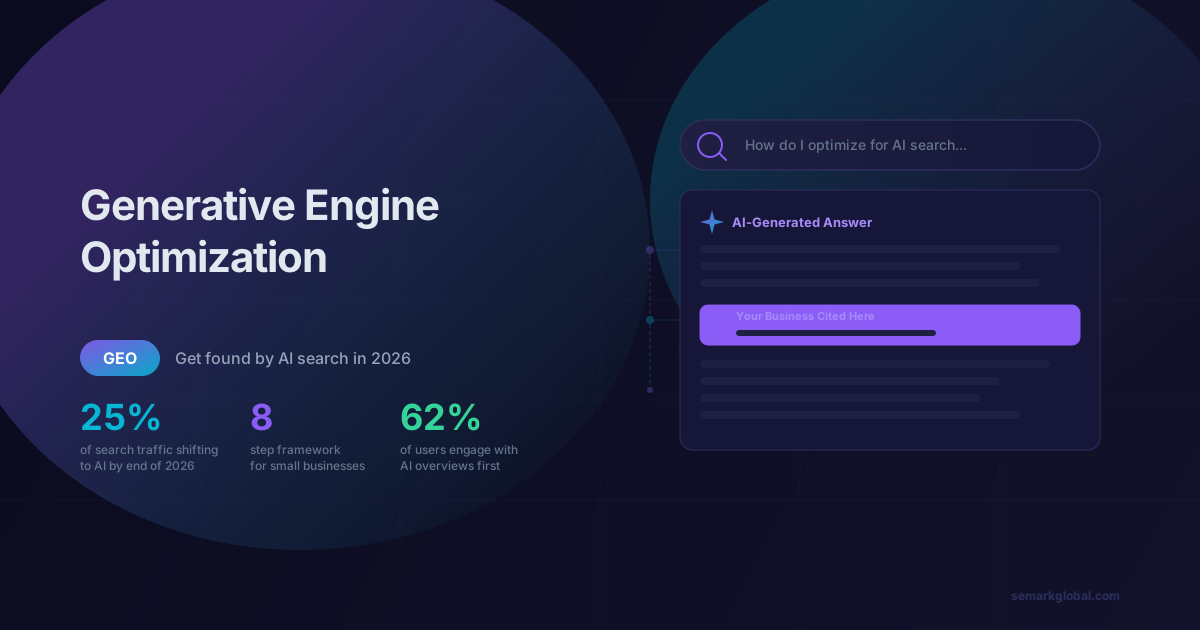
Generative Engine Optimization (GEO) is the practice of structuring your website content so that AI-powered search engines - including Google AI Overviews, ChatGPT, Perplexity, and Microsoft Copilot - can find, understand, and cite your business in their generated answers.
Traditional SEO focuses on ranking in a list of blue links. GEO focuses on getting your business mentioned inside the AI-generated answer itself - the block of text that appears before any links and that a growing number of users treat as the definitive response to their query.
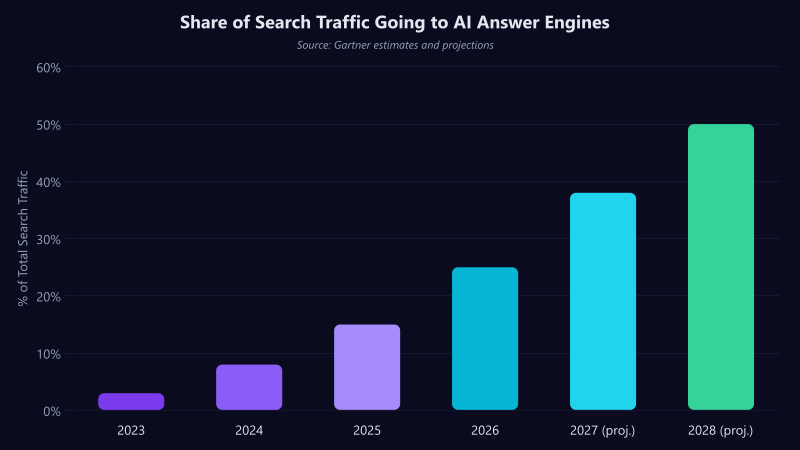
A growing share of web search traffic is shifting to AI-powered answer engines, and the trend is accelerating. For small businesses, this is not a future trend - it is happening right now. If your content is not structured for AI retrieval, you are becoming invisible to a rapidly growing segment of your potential customers.
Why GEO Matters for Small Businesses
Small businesses have always competed for visibility against larger companies with bigger budgets. AI search is reshaping that competition in ways that can work in your favor - or against you.
The shift in user behavior
When a potential customer searches "best digital marketing agency for restaurants in Chicago," here is what happens in 2026:
- Google AI Overview synthesizes an answer from multiple sources and displays it above all organic results. 62% of users interact with the AI overview before scrolling to traditional results.
- ChatGPT and Perplexity generate a narrative answer that names specific businesses, compares options, and provides recommendations - often without the user ever visiting a website.
- Microsoft Copilot pulls data from Bing's index and presents conversational answers inside the browser sidebar.
Why this favors prepared small businesses
Large companies often have sprawling, generic websites optimized for brand searches. AI answer engines favor specific, well-structured, authoritative content that directly answers questions - exactly what a focused small business can produce. A local bakery with a detailed page answering "What makes sourdough bread different from regular bread?" can get cited by ChatGPT ahead of a national chain with a generic product page.
The playing field is more level than ever, but only if you know how to play.
GEO vs. SEO: What Is Different?
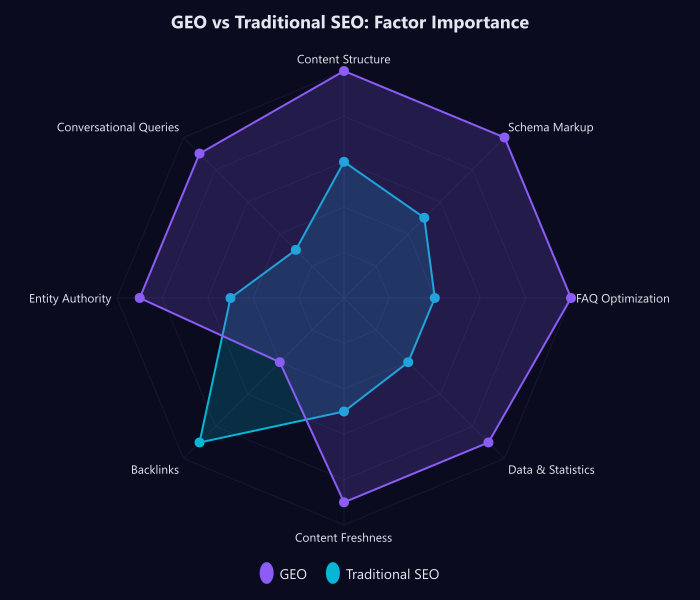
GEO and SEO are complementary strategies, not replacements for each other. Understanding the differences helps you prioritize your efforts.
| Factor | Traditional SEO | Generative Engine Optimization (GEO) |
|---|---|---|
| Goal | Rank high in a list of links | Get cited in AI-generated answers |
| Primary audience | Search engine crawlers and human readers | Large language models (LLMs) that synthesize answers |
| Content format | Keyword-optimized pages with meta tags | Clearly structured, fact-dense content with direct answers |
| Success metric | Click-through rate and ranking position | Citation frequency in AI answers and brand mentions |
| Key signals | Backlinks, domain authority, page speed | Factual accuracy, source authority, content structure, statistical evidence |
| Schema markup | Helpful for rich snippets | Critical for AI content extraction |
| Update frequency | Periodic updates | Frequent updates with current data and dates |
The 8-Step GEO Framework for Small Businesses
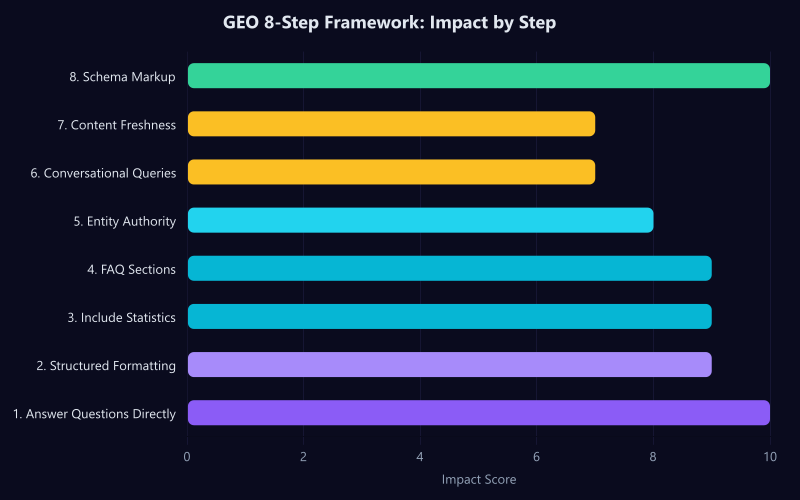
Here is a practical, step-by-step framework to make your small business visible in AI-generated search results. These steps are ordered by impact - start with Step 1 and work your way down.
Step 1: Answer Questions Directly and Immediately
AI answer engines are fundamentally question-answering systems. They scan your content looking for clear, direct answers to the questions users ask.
The rule: Start every major section of your content with a direct, concise answer in the first one to two sentences. Then elaborate with details, examples, and evidence.
Wrong approach:
"When it comes to digital marketing, there are many factors that businesses should consider. The landscape has evolved significantly over the years, and understanding the nuances is critical for success..."
Right approach:
"Digital marketing for small businesses typically costs between $2,000 and $10,000 per month, depending on the channels used and the aggressiveness of the strategy. Here is how that breaks down by channel..."
The direct answer is what AI systems extract. The elaboration builds authority and keeps human readers engaged.
Step 2: Use Structured, Hierarchical Content Formatting
Large language models parse well-organized content far more effectively than unstructured prose. Structure is not just good UX - it is a GEO ranking factor.
Apply these formatting practices to every page:
- Use descriptive H2 and H3 headings that contain the question or topic being addressed. Headings like "How Much Does SEO Cost for a Small Business?" are extractable. Headings like "The Cost Question" are not.
- Use bullet points and numbered lists for any content that involves steps, features, comparisons, or options. AI systems extract list items with high accuracy.
- Use tables for comparative data. When comparing pricing tiers, service features, or tool options, a table is 3x more likely to be cited by AI systems than the same information in paragraph form.
- Use bold text for key terms and data points. This signals importance to both human readers and AI parsers.
- Keep paragraphs to 3-4 sentences maximum. Dense walls of text are harder for AI systems to segment and extract from.
Step 3: Include Specific Statistics, Data, and Numbers
AI answer engines strongly favor content that contains specific, verifiable data points. Vague claims are ignored; precise numbers get cited.
Weak (will not be cited):
"Our clients see significant improvements in their marketing results."
Strong (likely to be cited):
"Our clients see an average 43% increase in qualified leads within the first 90 days of campaign launch, based on data from 127 client engagements between 2024 and 2026."
Where to find data for your content:
- Your own business metrics - response times, customer satisfaction scores, project completion rates, cost savings delivered
- Industry reports - cite sources like HubSpot State of Marketing, Google Economic Impact Report, Statista, or industry-specific publications
- Government data - SBA statistics, Census Bureau business data, BLS employment data
- Survey results - conduct your own surveys of clients or industry peers, even small sample sizes (50+) add unique value
Frequently Asked Questions
What is Generative Engine Optimization? Optimizing your content to appear in AI-generated search results from ChatGPT, Perplexity, and Google AI Overviews.
Is GEO different from SEO? GEO builds on SEO fundamentals but adds strategies specifically for AI-powered search engine citations.
Do I need to choose between SEO and GEO? No. GEO complements traditional SEO. Most GEO best practices improve your regular search rankings too.
How do I know if AI search is citing my content? Search your brand and topics in ChatGPT, Perplexity, and Google AI Overviews to check for mentions.
Is GEO worth investing in for small businesses? Yes. AI search usage is growing rapidly, and early optimization gives you a competitive advantage.