
You need marketing help. The question is whether to hire a team or bring in an agency. The decision usually comes down to cost, and the real numbers surprise most business owners because they underestimate the fully-loaded expense of in-house hires.
Short answer: A three-person in-house marketing team costs roughly $327,000 per year when you factor in salaries, benefits, tools, training, and recruiting. An agency retainer delivering comparable services runs $60,000 to $180,000 per year. The trade-off is control versus cost efficiency.
The True Cost of In-House
Salaries are just the starting point. The fully loaded cost of an in-house marketer is typically 1.3 to 1.5 times the base salary. A $100,000 salary becomes $130,000 to $150,000 when you include benefits, payroll taxes, equipment, tools, training, and management time.
For a basic three-person team covering strategy, content, and paid advertising:
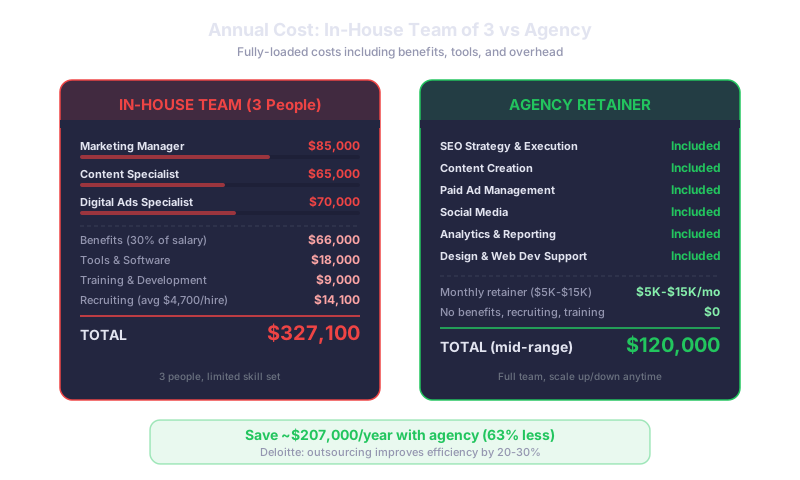
A marketing manager at $85,000, a content specialist at $65,000, and a digital ads specialist at $70,000 total $220,000 in base salaries. Add 30% for benefits and taxes ($66,000), tools and software subscriptions ($18,000 per year for CRM, analytics, design tools, and ad platforms), training and professional development ($9,000), and recruiting costs at roughly $4,700 per hire ($14,100 for three positions). The total comes to approximately $327,100 per year.
And that still gives you only three people with a limited skill set. You are missing design, web development, SEO expertise, email marketing, and social media management unless those three people can do everything.
What an Agency Retainer Covers
Agencies typically cost $5,000 to $15,000 per month, or $60,000 to $180,000 per year, depending on scope. For a mid-range retainer of $10,000 per month ($120,000 per year), you typically get access to a full team: strategist, content creators, SEO specialist, paid ad manager, social media manager, designer, and developer support.
There are no benefits to pay, no recruiting costs, no training expenses, and no software subscriptions for you to manage. The agency covers their own tools and overhead.
A 2025 Deloitte report found that outsourcing improves efficiency by 20-30%. That efficiency comes from agencies having established processes, specialized tools, and team members who focus on one discipline instead of juggling everything.
When In-House Makes More Sense
Agencies are not always the right answer. In-house makes more sense when your marketing needs are highly specialized to your industry and require deep institutional knowledge, when you need someone available for real-time, daily content creation, when your monthly marketing budget exceeds $30,000 and you can build a team of five or more specialists, or when regulatory requirements demand tight control over all communications.
When an Agency Wins
An agency is the better choice when your budget is under $300,000 per year for marketing talent, when you need a range of skills (SEO, paid ads, content, design, development) that would require four to six hires in-house, when you want the ability to scale up or down based on seasonal needs, or when you need to launch quickly without months of recruiting and onboarding.
The Hybrid Approach
Many businesses find the sweet spot with one in-house marketing manager who owns strategy and brand voice, paired with an agency that handles execution across channels. This gives you internal knowledge plus external expertise at a fraction of a full team's cost.
What This Means for Your Business
Do the math for your specific situation. Add up what you would pay for the in-house roles you need, multiply salaries by 1.4 for fully loaded cost, add tool subscriptions, and compare that to agency retainer quotes. For most small and mid-size businesses spending under $300,000 per year on marketing, the agency model delivers more capability per dollar.
Related reads:
- Digital Marketing Agency vs In-House Team: Which Is Right for Your Business?
- Freelancer vs Agency for Your Website: Pros, Cons, and Real Costs
- Our Services
Wondering which model fits your business? We offer flexible retainers that give you a full marketing team without the overhead. See our pricing.