
In the largest open retail-forecasting contest ever run - real Walmart sales data, close to 6,000 teams - only 7.5% managed to beat a simple exponential-smoothing benchmark that fits inside a spreadsheet (Makridakis, Spiliotis & Assimakopoulos, International Journal of Forecasting, 2022). Machine learning did eventually win that contest. But the gap between "ML can win" and "ML will win for you" is where most small-business forecasting money gets wasted.
Short answer: Machine learning beats a spreadsheet forecast when you have many related products, a long clean sales history, and known drivers like price, promotions, and holidays - the conditions that let a model learn patterns a simple average can't. For a single product with short or erratic history, a plain exponential-smoothing or moving-average model is usually just as accurate and far cheaper. Start with the simple baseline; only move to ML when it measurably beats it.
For years, machine learning lost to simple math
It is tempting to assume newer and more complex means more accurate. Forecasting research says otherwise. In a 2018 study using 1,045 monthly series from the M3 competition, standard statistical methods beat popular machine-learning methods on accuracy - the ML methods were, in the authors' words, "dominated across both accuracy measures used and for all forecasting horizons examined," while "their computational requirements are considerably greater than those of statistical methods" (Makridakis, Spiliotis & Assimakopoulos, PLOS ONE, 2018).
The pattern held at scale. In the M4 competition (100,000 series, 2018), six pure machine-learning entries performed poorly - only one was more accurate than a basic naive benchmark, and 12 of the 17 most accurate methods were combinations of mostly statistical models (Makridakis et al., 2018). The winning entry was a hybrid that blended statistics with ML, not pure ML.
What changed - and when ML actually wins
Then came M5 in 2020, built on Walmart's daily product sales. It was the first M competition where all the top methods were pure machine learning and beat every statistical benchmark and their combinations (Makridakis et al., 2022). Every one of the top 50 teams used gradient-boosted trees (LightGBM).
Why the reversal? M5 gave ML the conditions it needs: thousands of related products, years of daily data, and explanatory variables - price, promotions, day of week, holidays, store location. A single spreadsheet model looks only at one product's own past. A model trained across thousands of products can borrow patterns - how a price cut lifts this category, how a holiday moves this region - and apply them to items with thin histories. That cross-learning is the edge.
The caution comes from the same contest: even in the competition ML was built to win, the simple exponential-smoothing baseline still beat 92.5% of all entrants (Makridakis et al., 2022). Your real competitor isn't a fancy model. It's a good simple one.
What ML actually needs before it's worth it
Demand forecasting isn't magic; it's pattern-matching, and it needs enough pattern to match. Three practical requirements:
- Many related series, not one. ML's advantage comes from learning across products, stores, or regions at once. Forecasting a single SKU rarely justifies it.
- Enough clean history. Roughly two-plus years of consistent sales data lets a model separate trend, seasonality, and noise. Six months of messy data won't.
- Real drivers you can feed it. Price changes, promotions, and a holiday calendar are what let ML outperform a moving average. Without them, you have built a slower version of the same forecast.
As the authors of the standard forecasting textbook put it, using a simple average of forecasts "has proven hard to beat" (Hyndman & Athanasopoulos, Forecasting: Principles and Practice, 3rd ed.). Complexity is a cost, not a feature.
So should a small business bother?
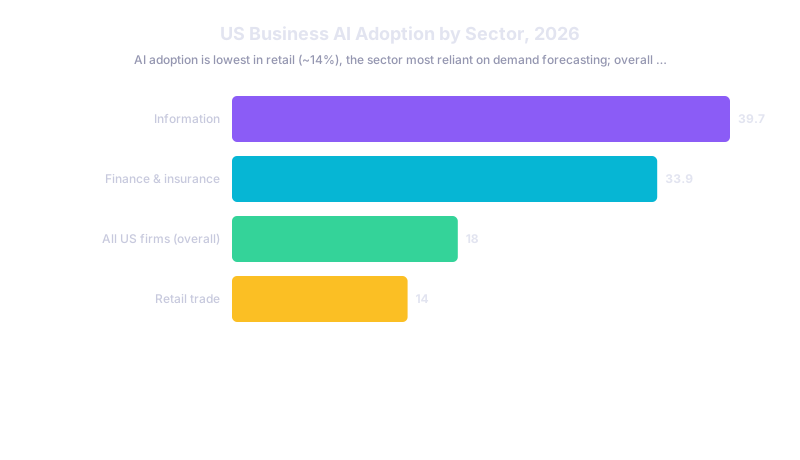
Most still haven't. Between December 2025 and May 2026, overall US business AI use held between 17% and 20%, and in retail trade only about 14% of businesses reported using AI - versus 33.9% in finance and insurance and 39.7% in information (US Census Bureau, 2026). Adoption rises sharply with size: 37% of firms with 250 or more employees use AI, against under 20% of firms with four or fewer employees (US Census Bureau, 2026).
Part of that gap is rational. When companies do adopt AI, the payoff usually shows up as efficiency rather than a revenue jump - and a better forecast pays off the same quiet way: less cash tied up in overstock, fewer stockouts, less expedited shipping, not a magic sales lift. That is the honest case for forecasting, and it is a good one.
What This Means for Your Business
Do this in order. First, build the boring baseline - a moving-average or exponential-smoothing forecast in your spreadsheet or inventory tool - and measure its error honestly for a few months. That number is your bar. Second, ask whether you actually have ML's preconditions: many related products, two-plus years of clean history, and real drivers like price and promotions. If you sell a handful of items or your data is thin, spend your money on cleaner data and a solid baseline, not a model. Third, pilot machine learning only where it can measurably clear the baseline you set - and keep the baseline running as your safety net.
For most small operators, the winning move isn't the fanciest algorithm. It is a good simple forecast, better data, and the discipline to upgrade only when the numbers say so. If you want help deciding whether your sales data can support a real forecasting model - or whether a spreadsheet will do - talk to Semark's team or see our AI and machine learning services. It is especially worth a look if you run an ecommerce or restaurant operation, where overstock and waste hit the bottom line directly.


