You have probably tried ChatGPT and gotten results that were either too generic, too long, or completely off-target. That is not a technology problem. It is a prompting problem. The difference between a vague response and a genuinely useful one comes down to how you structure your request.
Short answer: Small businesses that use structured prompts reclaim 10 to 15 hours per week on tasks like email drafting, content creation, customer responses, and planning. The key is giving ChatGPT a role, context, specific task, output format, and constraints.
Why Most Prompts Fail
By July 2025, ChatGPT had 700 million users sending 18 billion messages per week (MasterOfCode). Most of those messages are vague. "Write me a marketing email" gets you a generic marketing email. "Write me a social media post" gets you something that sounds like every other social media post.
The fix is structure. Small businesses using structured prompt frameworks reclaim 10 to 15 hours weekly (GodOfPrompt). Email drafting prompts alone cut writing time by 50 to 80 percent. Gelato reports that businesses see 30 to 45 percent overall productivity gains and $75,000+ in annual savings potential from effective prompt use.
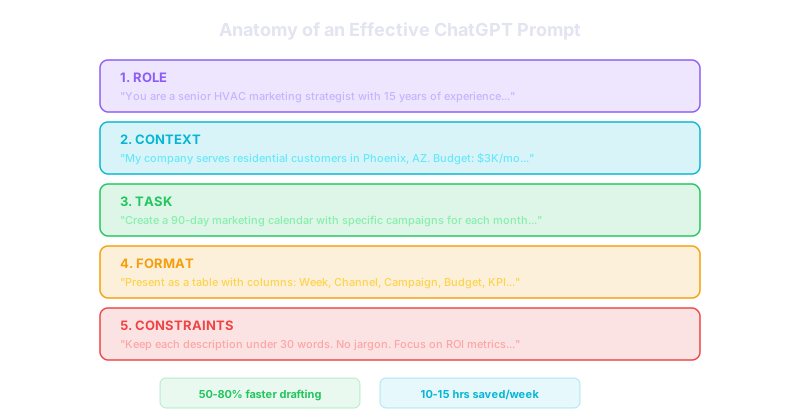
The Five-Part Prompt Formula
Every effective prompt includes five elements. Skip any of them and your output quality drops.
Role: Tell ChatGPT who it is. "You are a marketing strategist who specializes in local home services businesses" produces vastly different output than no role at all.
Context: Give it your specific situation. Your industry, business size, target customer, location, and any constraints that matter.
Task: Be precise about what you want. "Create a 5-email welcome sequence for new HVAC maintenance plan subscribers" is specific. "Write some emails" is not.
Format: Specify the output structure. Table, bullet list, numbered steps, email template with subject line, or whatever format you will actually use.
Constraints: Set limits. Word count, tone, things to avoid, and any rules your business follows.
Prompts for the Five Most Common Small Business Tasks
Here are tested prompt templates you can adapt right now:
Customer email responses: "You are a customer service specialist for a [type] business. A customer emailed about [issue]. Draft a response that acknowledges their concern, explains [solution], and offers [next step]. Keep it under 150 words, warm but professional."
Social media content: "You are a social media manager for a local [business type] in [city]. Create 5 social media posts promoting [service/offer]. Each post should be under 100 words, include a call to action, and use a conversational tone. Avoid hashtag stuffing."
Job descriptions: "You are an HR specialist. Write a job posting for a [role] at a [business type]. Include responsibilities, qualifications, compensation range of [range], and company culture highlights. Format with clear sections and bullet points."
Weekly planning: "You are a business operations consultant. I run a [business type] with [number] employees. My top priorities this week are [list]. Create a daily task schedule for Monday through Friday that allocates time for these priorities plus routine operations."
Review responses: "You are the owner of a [business type]. A customer left a [star] review saying [paste review]. Draft a response that thanks them, addresses their specific feedback, and demonstrates that you value their experience. Keep it under 80 words."
OpenAI's Official Small Business Prompt Pack
OpenAI Academy released a Small Business Prompt Pack specifically designed for common business workflows. It covers customer communication, content planning, data analysis, and operations. If you have not seen it, search for "OpenAI Academy small business" to access their curated templates.
Mistakes That Waste Your Time
The most common prompt mistakes are being too vague, not providing context, asking for too much in a single prompt, and accepting the first output without iterating. Treat ChatGPT like a capable employee who needs clear instructions, not a mind reader.
If the first response is close but not right, tell it what to fix. "Make it shorter," "Use a more casual tone," or "Replace the generic examples with ones specific to plumbing businesses" will refine the output quickly.
What This Means for Your Business
The businesses getting the most out of AI tools are not using magic prompts. They are using structured ones. Pick one repetitive task this week, build a prompt using the five-part formula, and test it. Once you see how much time it saves, you will naturally expand to other tasks.
Related reads:
- Best AI Tools for Small Business in 2026
- Simple AI Automations Any Small Business Can Set Up Today
- AI vs Hiring an Employee: When to Automate and When to Hire
Want help building AI workflows for your business? We help small businesses identify the right AI tools and set them up properly. Talk to our team