
Your product photos get them to stop scrolling. Your description is what gets them to click "Add to Cart." Most ecommerce stores treat product descriptions as an afterthought, copying manufacturer specs or writing a few bland sentences. That is leaving money on the table.
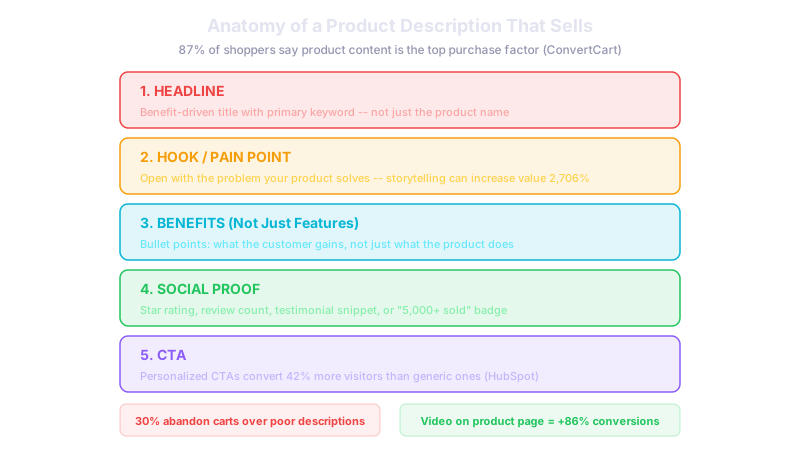
Short answer: 87% of customers say product content is the most important factor when deciding to buy online (ConvertCart research). 30% of shoppers abandon carts specifically because of poor product descriptions. Storytelling can increase perceived product value by up to 2,706%, and personalized CTAs convert 42% more visitors than generic ones.
Why Most Product Descriptions Fail
The problem with most descriptions is they list features instead of benefits. "100% cotton, machine washable, available in 5 colors" tells a customer what the product is but not why they should care. Compare that to: "The t-shirt that survives every wash cycle without shrinking, fading, or losing its shape. Five colors so you can stop thinking about what to wear."
Same product. Different conversion rate.
 87% of consumers are unlikely to make a repeat purchase if they encounter inaccurate product descriptions (industry research). And 40% of consumers have returned an online purchase due to inaccurate product content. Getting descriptions right is not just about sales. It is about avoiding returns.
The Five-Part Structure That Converts
1. Benefit-Driven Headline: Do not just use the product name. Lead with what the customer gets. "Ultra-Soft Merino Socks That End Cold Feet for Good" beats "Merino Wool Socks."
2. Hook With the Pain Point: Open with the problem your product solves. Research shows that storytelling in product descriptions can increase the perceived value of a product by up to 2,706%. You do not need a novel. One or two sentences that connect to a real frustration are enough.
3. Benefits Over Features: For each feature, translate it into a benefit. "8,000mAh battery" becomes "charges your phone twice over on a single charge, so you stop borrowing cables at coffee shops." Bullet points work well here because shoppers scan rather than read.
4. Social Proof: Include star ratings, review counts, or a short testimonial near the description. If you have sold thousands of units, say so. If a publication has featured your product, mention it. Social proof reduces the perceived risk of buying from an unfamiliar brand.
5. Personalized CTA: HubSpot shows that personalized calls to action convert 42% more visitors than generic ones. "Get yours before summer" outperforms "Add to cart" because it adds context and mild urgency.
Practical Tips That Move the Needle
Write at a sixth-grade reading level. Simple, clear language outperforms clever wordplay every time. Use short paragraphs and bullet points because most shoppers scan product pages in an F-pattern.
Add video when possible. Embedding product videos can lead to an 86% increase in conversions according to industry data. Even a simple 15-second clip showing the product in use outperforms static images alone.
For ecommerce businesses looking to scale, product descriptions are one of the highest-leverage optimizations available. Small changes across hundreds of products compound into significant revenue gains. AI-powered tools can help generate and test descriptions at scale while maintaining your brand voice.
What This Means for Your Store
Product descriptions are a conversion lever that most stores underutilize. Rewriting your top 20 products using the five-part structure above will likely produce a measurable lift in both conversion rate and average order value. Start with your best sellers, measure the results for two weeks, and then roll the approach across your catalog.
Related reads:
- How to Get Your First 100 Sales on Shopify
- Welcome Email Series: What to Send New Customers
- Freelancer vs. Agency: Website Cost Comparison
Want product descriptions that convert? We write and optimize ecommerce content that turns browsers into buyers. Talk to our team