
Your Etsy shop does $5,000 per month in revenue. Between listing fees, transaction fees, and payment processing, Etsy takes over $450 every month. That is $5,400 per year in fees that could be cut dramatically with your own Shopify store. But migration feels risky. You worry about losing search rankings, reviews, and the steady traffic Etsy provides.
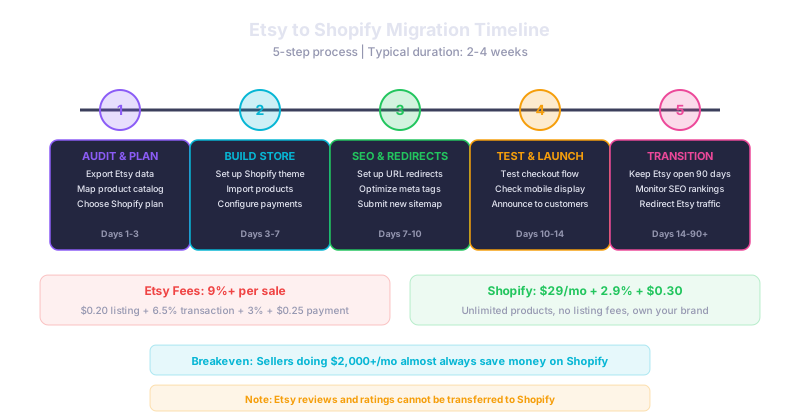
Short answer: Sellers doing over $2,000 per month almost always save money on Shopify. Etsy fees total 12 to 15 percent all-in per sale (listing fee + 6.5% transaction + 3% + $0.25 payment processing), while Shopify costs $29 per month plus 2.9% + $0.30 per transaction with unlimited product listings. The migration takes 2-4 weeks. Keep your Etsy shop open for at least 90 days during the transition.
Phase 1: Audit and Plan (Days 1-3)
Start by exporting everything from Etsy. Download your product listings as a CSV file, export your order history, and save your customer data. Document your best-selling products, top-performing keywords, and any listing variations.
Map your product catalog to Shopify's structure. Shopify organizes products differently than Etsy, so plan your collections, tags, and variant options before importing. Choose your Shopify plan. The Basic plan at $29 per month covers most migrating sellers with unlimited products, a custom domain connection, and access to the app marketplace.
Phase 2: Build Your Shopify Store (Days 3-7)
Set up your Shopify theme and import your products. Migration tools like Firebear's Import & Export Tool or LitExtension can transfer products, customer data, and order history. Manually review imported listings to fix any formatting issues.
Configure payment processing, shipping rates, and tax settings. Install essential apps for reviews (since Etsy reviews cannot be transferred to Shopify), email marketing, and analytics. Test your checkout flow end-to-end with a real transaction before launching.
The critical difference to understand: Etsy's search engine is an internal marketplace algorithm, while Shopify SEO is Google SEO. Your store competes against every other website, not just other Etsy sellers. This means your product descriptions, page titles, and site structure need to be optimized for Google, not Etsy's internal search.
Phase 3: SEO and Redirects (Days 7-10)
This is the step most sellers skip, and it costs them months of lost traffic. Set up 301 redirects from your old Etsy URLs to your new Shopify pages if you are using a custom domain. Optimize every product page's meta title and description for Google search rather than Etsy's algorithm.
Submit your new XML sitemap to Google Search Console. Create a Google Business Profile if you do not have one. Build out standalone pages for your top-performing Etsy keywords, targeting them with proper on-page SEO.
Do not assume your Etsy SEO strategy will work on Shopify. These are fundamentally different systems that require different optimization approaches.
Phase 4: Test, Launch, and Communicate (Days 10-14)
Run through the complete purchase flow on mobile and desktop. Check every product page, variant, image, and checkout step. Test your email notifications and order confirmation sequences.
Announce the new store to your existing customers. Update your Etsy shop announcement with a direct link to your Shopify store. Pin a post on social media. Send an email to your customer list explaining the move and offering an incentive for their first Shopify order.
Phase 5: Transition Period (Days 14-90+)
Keep your Etsy shop open for at least 90 days after launching Shopify. During this period, update your Etsy listings to redirect buyers to your new store. Monitor your Shopify traffic and sales daily. Track which Etsy customers make the transition and which acquisition channels replace Etsy's built-in marketplace traffic.
The biggest adjustment is marketing. On Etsy, the marketplace drives discovery. On Shopify, you drive your own traffic through SEO, social media, email marketing, and potentially paid advertising. Budget for this transition in both time and money.
What This Means for Your Business
The fee savings alone justify the move for sellers above $2,000 per month. But the real value is ownership. On Shopify, you own your customer data, your brand, your domain, and your email list. On Etsy, you rent access to their marketplace and follow their rules.
The migration is not risk-free. You will temporarily lose the organic traffic Etsy provides, and you cannot transfer your reviews. But the long-term economics and business ownership make the transition worthwhile for growing sellers.
Related reads:
Planning an Etsy to Shopify migration? We handle the complete technical migration, SEO preservation, and launch strategy for ecommerce businesses. Get started.