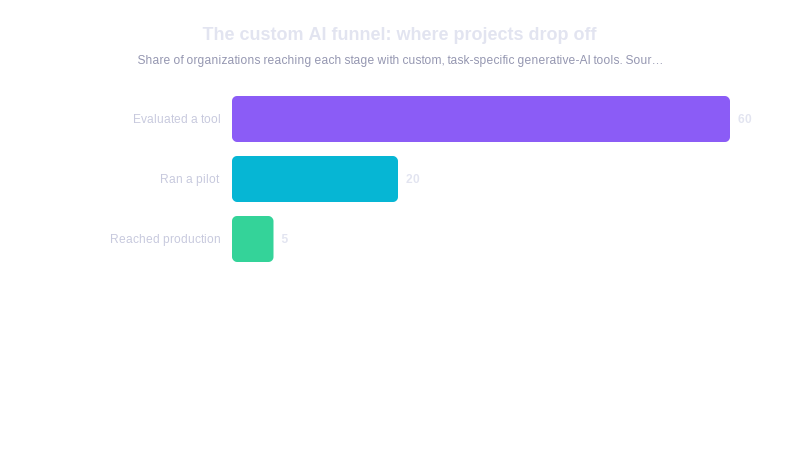
The demo was flawless. Then you tried to run it on your real customers, your real data, and your real workflow - and it fell apart. You are not doing it wrong. In a widely cited MIT study, roughly 60% of organizations evaluated a custom generative-AI tool, about 20% ran a pilot, and only about 5% reached production (MIT NANDA, "State of AI in Business 2025").
Short answer: A demo shows a general-purpose model handling a clean, hand-picked example. Production asks that same model to handle your messy edge cases, your data, and your day-to-day process - and general-purpose tools do not learn your workflow on their own. The gap between the two is normal, well-documented, and mostly closable with narrower scope and simpler customization rather than a bigger model.
The demo used a general tool; production needs one that fits you
The single most important distinction in the MIT NANDA report is general-purpose versus custom. General tools like ChatGPT and Microsoft Copilot cross from pilot into real use roughly 83% of the time, because a person is in the loop steering every prompt. Purpose-built tools that are supposed to run a specific business task on their own reach production only about 5% of the time (MIT NANDA, 2025).
That is the trap. Your demo felt like the 83% case - a human typing a clean prompt and getting a great answer. Your production plan was secretly the 5% case - software expected to handle live tickets, invoices, or calls without someone babysitting each one.
It is worth knowing the "95% of AI projects fail" headline you have probably seen comes from this same report, which is preliminary and not peer-reviewed. The honest version is narrower: most custom, autonomous tools stall before production, while human-assisted use of general tools usually sticks.
Why the demo looked better than reality: the learning gap
The report's lead author, Aditya Challapally, put the reason plainly: "Generic tools like ChatGPT excel for individuals because of their flexibility, but they stall in enterprise use since they don't learn from or adapt to workflows" (Fortune, 2025). A demo hides this because you feed it the example it handles well. Production exposes it because the tool never remembers last week's correction, never adapts to your exceptions, and hits an edge case you did not script. Nothing was faked in the demo - it just was not a fair test of the job you actually need done.
It is not just you - adoption is still early
If your rollout stalled, you are in the majority. Overall AI use among US businesses has hovered between 17% and 20%, and fewer than 20% of the smallest firms (four or fewer employees) report using AI, versus 37% of firms with 250 or more employees (US Census Bureau, 2026). Between December 2025 and May 2026, AI use rose only among firms with at least 20 employees. Adoption also varies widely by industry: about 39.7% in the information sector and 33.9% in finance and insurance, but only around 14% in retail trade (US Census Bureau, 2026). Getting AI into daily production is genuinely hard, and most operators your size have not cleared it yet.
"Working" usually means efficiency, not new revenue
Even successful deployments rarely do what the demo implied. Among enterprises using AI, 66% report efficiency gains, but only 20% say they are already growing revenue from it - while 74% are still merely hoping to (Deloitte, "State of AI in the Enterprise," 2026). So if you judged your pilot against "this will make us money," it likely disappointed. Judge it against "this saves my team hours on a specific task" and the same result may actually be a win. Set the target before you pilot, not after.
Buy narrow, and keep the customization simple
Two findings should reshape how you approach the next attempt. First, buying beats building: 76% of enterprise AI use cases are now purchased rather than built in-house, up from about half the year before (Menlo Ventures, 2025). Ready-made tools reach production faster because someone else already solved the hard parts. Second, most production customization is basic - good prompt design does the heavy lifting, with retrieval of your own documents second, while fine-tuning and fully autonomous "agents" remain niche. In fact, only about 16% of enterprise deployments are true autonomous agents (Menlo Ventures, 2025), despite the marketing. You almost certainly do not need to fine-tune a model or build an agent to get value. If a vendor's demo leans on those words, ask what actually runs in production.
What This Means for Your Business
The demo-to-production gap is not a sign you picked the wrong tool. It is a sign the demo tested a different, easier job than the one you need done. To close it:
- Pick one narrow pain point - one task, one workflow - the way the MIT report's successful adopters did, rather than "add AI to the business."
- Keep a human in the loop where the demo felt magic; that is often what made it work.
- Buy a proven tool for that task before you consider building anything custom.
- Define success as hours saved on that task, not new revenue, and measure it.
If your impressive demo has not survived contact with real customers, that is exactly the problem we help scope and fix. Talk to us about your AI project or get in touch - we will tell you honestly whether it is a buy, a build, or a "not yet."