
You have 30 hours of work that needs doing every week and a budget that can stretch to one hire or a handful of software subscriptions. The question every small business owner faces in 2026 is no longer "should I use AI?" but "which tasks get AI and which get a person?"
Short answer: If the task is repetitive, rule-based, and needs no human judgment, automate it. If it requires empathy, creativity, or complex decision-making, hire for it. Most businesses end up doing both.
The Real Cost Comparison
A full-time employee earning $55,000 per year actually costs $75,000 to $95,000 after payroll taxes, benefits, insurance, and equipment. The Society for Human Resource Management (SHRM) also reports that the average cost of the hiring process itself is $4,700 per position, before salary starts.
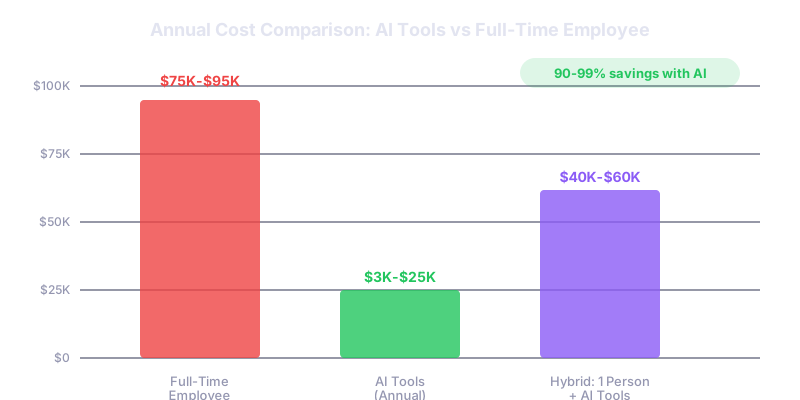
AI tools performing equivalent administrative and support tasks typically cost $3,000 to $25,000 per year. That is a fraction of the loaded employee cost. For structured, repetitive work like data entry, scheduling, email triage, and invoice processing, AI delivers results at 90 to 99 percent lower cost.
When AI Is the Clear Winner
AI handles volume without fatigue. The tasks where it consistently outperforms hiring include:
- Appointment scheduling and reminders -- tools like Calendly with AI or Zapier automations handle this for under $30 per month
- First-line customer inquiries -- chatbots handle 80 percent of routine questions at $0.50 to $0.70 per interaction versus $6 to $15 for a human agent
- Email sorting and auto-responses -- AI filters, categorizes, and drafts responses to repetitive inquiries
- Invoice processing and expense categorization -- extract data, match to categories, flag anomalies
- Review request follow-ups -- triggered automatically after every completed job or appointment
When You Need a Human
MIT Sloan published research in 2025 identifying five capability areas where AI falls short, which they call the EPOCH framework: Empathy, Presence, Opinion and Judgment, Creativity, and Hope. These map directly to the work that still needs a person.
Hire when the role involves:
- Complex client relationships -- selling high-value services, managing unhappy customers, building trust
- Creative strategy -- developing a marketing voice, writing original thought leadership, designing brand identity
- Judgment calls under ambiguity -- deciding which leads to prioritize, how to handle a PR issue, when to make exceptions to policy
- Physical presence -- jobs that require being somewhere in person
The Hybrid Approach Most Businesses Miss
The strongest move for most small businesses is not "AI or human" but "one person plus AI tools." For the same budget as two full-time employees, you can hire one capable person and equip them with AI tools that multiply their output.
As of 2026, 68 percent of U.S. small businesses use AI regularly, up from 48 percent in mid-2024 (a QuickBooks survey). And 91 percent of small businesses using AI report revenue increases. The businesses pulling ahead are not replacing people wholesale. They are giving their existing team leverage.
What This Means for Your Business
Map out every recurring task in your business this week. For each one, ask: "Does this need human judgment?" If yes, that is a hiring need. If no, that is an automation candidate. Start with the cheapest, highest-volume automations first, prove the ROI, then decide whether your next dollar goes to another tool or another team member.
Related reads:
- Can AI Replace My Receptionist?
- Simple AI Automations Any Small Business Can Set Up Today
- Best AI Tools for Small Business in 2026
Trying to figure out where AI fits in your business? We help small businesses audit their operations and identify exactly which tasks to automate and which to keep human. Talk to our team →