
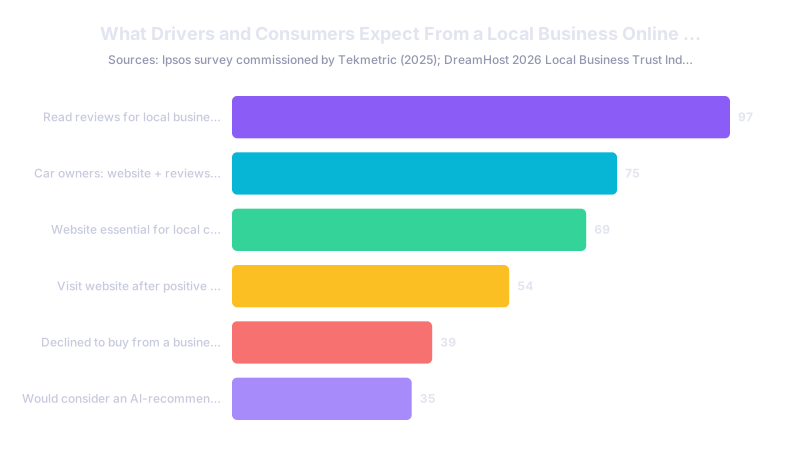
Roughly 31% of small businesses still have no website at all (LeadsByLocation, 2026, vendor data), while 75% of car owners say search-engine reviews and a professional website are critical to choosing where they get their car fixed (Ipsos survey commissioned by Tekmetric, September 2025). For an auto repair shop, that gap between what drivers expect and what many shops offer is the cheapest competitive edge in local business.
Short answer: An auto repair shop needs a fast, mobile-friendly website plus local SEO because 75% of car owners say search-engine reviews and a professional website are critical to choosing a shop (Ipsos/Tekmetric, September 2025), and consumers rate a website as roughly as important to trust as reviews themselves (DreamHost 2026 Local Business Trust Index). Yet an estimated 31% of small businesses still have no website (LeadsByLocation, 2026, vendor data), and many that do are slow or broken on mobile. A shop that simply owns a fast, review-linked, locally optimized site already beats a large share of nearby competitors. Start with the site foundation, connect it to your Google Business Profile and reviews, then build service- and city-specific pages.
The website gap: why so many shops are hard to find online
Start with the demand side. In a September 2025 Ipsos KnowledgePanel survey of 1,147 vehicle owners commissioned by Tekmetric, 75% of car owners said search-engine reviews and a professional website are critical when choosing a shop, with 18- to 34-year-olds more likely than older drivers to say so. The same survey found 73% would likely use online booking if their preferred shop offered it, rising to 82% among 18- to 34-year-olds (Ipsos/Tekmetric, 2025).
Now the supply side. About 31% of small businesses have no website at all, and among those that do, quality is uneven (LeadsByLocation, 2026, vendor data). In that same dataset, auto repair shops rank near the bottom of 34 industries for site quality: 38% of auto repair shop websites score below 80 out of 100 on mobile performance, load speed, and responsiveness. Treat these vendor figures as directional, not precise. The pattern is clear enough: a large share of shops are either invisible or slow when a driver pulls out their phone.
That is the opportunity. A basic, fast, working site already outranks the many shops that have none or run a broken one. The common excuse is that word of mouth is enough, but referrals still Google you before booking. When a neighbor recommends your shop, the next thing that driver does is search your name, and if there is nothing fast to find, the referral leaks to the shop that shows up.
A website is a trust signal, not a brochure
A website is not decoration. Businesses with websites are perceived as 41% more trustworthy than those without, and 69% of consumers say a website is essential for a local business to be credible, rising to 72% among ages 18 to 24 (DreamHost 2026 Local Business Trust Index). The cost of skipping it is concrete: 39% of consumers report they have declined to visit or buy from a business specifically because it lacked a website, a figure that rises to 45% among those aged 18 to 44 (DreamHost, 2026).
There is also a new channel opening up. As AI assistants start recommending local businesses, only 35% of consumers say they would consider working with a company an AI recommends if that company has no website (DreamHost, 2026). No site means you are simply not in the answer set. In DreamHost's index, a website ranks as roughly as important to consumer trust as positive customer feedback and well ahead of social media activity, behind only online reviews at 74%.
None of this requires a flashy build. The must-haves are practical: mobile-first design, a fast load, clearly listed services, tap-to-call phone number, hours, address, and online booking. If you are weighing what to spend, our guide on how much a small business website costs breaks down where the money actually matters.
Local SEO: getting found for "auto repair near me"
Owning a site is step one. Getting found is local SEO, and the foundation is a website plus a complete Google Business Profile plus consistent name, address, and phone (NAP) across every listing. Reviews feed directly into this: 97% of consumers read reviews for local businesses, and 54% visit a business's website after reading positive reviews (BrightLocal Local Consumer Review Survey, 2026). Reviews and your site reinforce each other, so link them.
Do not rely on one thin homepage. Build service-specific pages (brakes, transmission, oil changes, diagnostics) and city or neighborhood pages so you can rank for the specific searches drivers actually type. Internal-link those pages to your Google Business Profile and review profiles so the ranking signals compound. Our local SEO guide for service businesses walks through the full build order, and there is a companion piece on auto repair shop marketing on Google.
Reviews and content compound your ranking
Reviews are the single strongest trust and ranking lever you control, so ask every satisfied customer and respond to all of them; our playbook on getting more five-star reviews covers a repeatable ask. The striking part is how few shops pair that with a real site. Despite 89% of SMBs saying they invest in organic SEO, only 40% say they have a dedicated business website (SMB Marketing Report, 2025). The site itself is the missing link for a lot of that SEO spend.
For AI and answer-engine visibility, the emerging evidence points to concrete content tactics. In one academic benchmark, adding quotations and statistics to a page were the top-performing methods, improving AI-search visibility by up to about 40% (Quotation Addition +41%, Statistics Addition +33% on the Position-Adjusted Word Count metric; Aggarwal et al., "GEO: Generative Engine Optimization," ACM KDD 2024). The authors caution that results vary by domain and come from a synthetic benchmark, not proven local-service queries, so treat those numbers as an upper bound. The practical takeaway holds up regardless: cite sources, add real statistics, and include genuine quotes on your service pages. Keyword stuffing, by contrast, was negative in the same study. And keep NAP, hours, and your service list identical across your site, Google Business Profile, and directories.
What This Means for Your Business
If your shop has no site, or a slow one, that alone puts you behind the drivers' expectations and behind every competitor building this right. The good news is the fix is unglamorous and cheap relative to its payoff. Sequence it: a fast mobile site first, then your Google Business Profile and reviews wired in, then service and city pages, then ongoing content.
Do not over-invest in a fancy brochure with animations. A fast mobile site connected to your reviews will out-earn a $10,000 brand refresh every time. Spend on speed, service-specific local pages, review generation, and online booking. Those are the things a driver at 7pm with a check-engine light actually needs, and increasingly the things an AI assistant needs in order to recommend you at all.
Ready to stop being invisible online? Semark builds the website plus local SEO foundation that gets auto repair shops found. Book a free consult at /contact or see /industries/home-services.
