
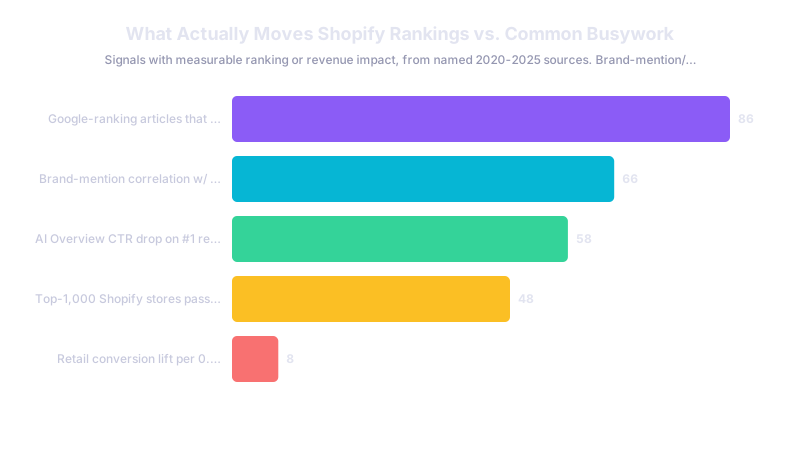
Only 48% of the top 1,000 Shopify stores pass all three Core Web Vitals thresholds on mobile (Shero Commerce, 2025) - which means most stores are losing on a fundamental, not a missing meta tag. If your rankings are stuck, the problem probably isn't the item at the bottom of some 50-point checklist. It's one of a small number of load-bearing fixes that the busywork lists bury.
Short answer: A Shopify SEO checklist that actually moves rankings has three load-bearing pillars: valid Product and Collection structured data (JSON-LD) on every template, page speed inside Google's Core Web Vitals thresholds, and genuinely unique, human-written content on your product and collection pages. Everything else - alt-text passes, meta tweaks, redundant "SEO" apps - is secondary. Fix these three first, in order, because most stores fail at least one: only 48% of the top 1,000 Shopify stores pass Core Web Vitals on mobile (Shero Commerce, 2025).
Why Most Shopify SEO Checklists Waste Your Time
The default Shopify SEO checklist reads the same everywhere: write alt text, edit your meta descriptions, install five or six apps, done. None of that is wrong, exactly. It just rarely moves rankings on its own. Rankings move when you fix the things Google actually weighs at scale - crawlability, structured data, page speed, and content depth - not when you tidy the cosmetic layer on top of them.
The Shero Commerce benchmark makes the point plainly: with only 48% of the top 1,000 Shopify stores passing Core Web Vitals on mobile, and a median mobile LCP of 2.26 seconds - right at the edge of Google's 2.5-second "good" threshold (Shero Commerce, 2025) - the median high-traffic Shopify store is one theme tweak away from failing a confirmed ranking signal. These are not stores that forgot to write alt text. They lost on a fundamental.
Shopify actually hands you a head start here. The platform ships a global CDN, automatic image optimization, and clean default URL structures. The trouble is that themes and apps routinely undo that advantage - every "SEO booster" you bolt on adds JavaScript, and every heavy theme section adds render time. The work isn't adding more. It's protecting the foundation Shopify already gave you and fixing the few things it doesn't handle for you.
Pillar 1: Get Product and Collection Schema Right
Shopify's built-in structured_data Liquid filter emits real JSON-LD, but only the basics. As Shopify's own ecommerce schema guide states, "The default output covers the basics: name, price, availability, and URL" - while fields like breadcrumbs, FAQs, GTIN/SKU, brand, reviews, and return policies "typically need to be added manually or via an app" (Shopify, 2026). If you assume the platform is handling all of it, you're shipping thin markup.
A complete Product schema block should carry name, description, image, brand, SKU or GTIN, price, currency code, and availability - plus an aggregateRating only when you have genuine reviews to back it. Collection pages benefit from breadcrumb schema so Google can render the category path. Validate every template - product, collection, article, home - with Google's Rich Results Test, because one malformed field can void the entire block, and Shopify themes vary wildly in what they output by default.
This matters more in 2026 than it did two years ago, because schema is no longer just Google rich-snippet fuel. It's the structured input that AI shopping surfaces - AI Overviews, Perplexity, Gemini - parse to decide whether to surface your product at all. Keep your on-page schema in parity with the product feed you send to Google Merchant Center; mismatched price or availability between the two is a common, quiet reason products get suppressed. As ecommerce SEO consultant Aleyda Solis puts it, "It's time to double down your PDPs optimization efforts to maximize your SERPs visibility and be ready for the next AI shopping features (without neglecting your PLPs)."
Pillar 2: Pass Core Web Vitals - Speed Is a Tiebreaker That Pays
Core Web Vitals is a confirmed Google ranking signal, and on competitive ecommerce queries it acts as a tiebreaker between similar-quality pages. When ten stores are all selling the same product with comparable content and authority, the one that loads faster wins the position. With the median top-1,000 Shopify store sitting at a 2.26-second mobile LCP - barely inside the 2.5-second threshold (Shero Commerce, 2025) - most stores are one slow hero image away from falling out of "good."
Speed is also a direct revenue lever, not just an SEO one. In Deloitte and Google's "Milliseconds Make Millions" study, a 0.1-second improvement in mobile site speed increased retail conversions by 8.4% and average order value by 9.2% (Deloitte/Google, 2020). A tenth of a second. That's the kind of return that makes speed work pay for itself before it ever affects a ranking.
The single biggest speed win for most Shopify stores is unglamorous: audit your apps and delete the ones you don't need. Every app injects JavaScript onto the main thread, and stores routinely accumulate a graveyard of trial installs, abandoned review widgets, and redundant "SEO" tools that each cost render time. After that, fix layout shift (CLS) with explicit width and height on images, lazy-load below-the-fold media, and trim unused theme sections and third-party fonts. Measure the result in PageSpeed Insights and Search Console's Core Web Vitals report - not in an app's own dashboard, which grades its own homework.
Pillar 3: Write Content Humans (and Google) Actually Value
Manufacturer descriptions are duplicate content by definition - the same paragraph sits on every retailer that carries the product. If you paste it in and move on, you've given Google no reason to prefer your page. Rewrite product descriptions from scratch, and let genuine reviews and a short FAQ do the rest of the work of making the page unique and useful.
This still pays, despite the flood of AI content online. In Graphite's 2025 analysis, 86% of articles ranking on Google and 82% of articles cited by ChatGPT and Perplexity were human-written (Graphite, 2025). Machine-spun product copy at scale is not the shortcut it looks like; the pages that win are still the ones with real human judgment behind them.
Beyond the product page, build topical authority with collection-level buying guides and blog content instead of ceding your commercial queries to publishers and affiliates. Solis frames the opportunity directly: "If you have already the expertise, why leaving publications to profit from an increasing number of relevant product commercial queries?" Give every template a unique title, H1, and meta description - not the same boilerplate stamped across 400 products - and structure internal links so collection pages pass authority down to your deep product pages. (For the wider technical groundwork, see our technical SEO audit checklist for 2026.)
The AI Search Layer: Get Cited, Not Just Ranked
Ranking #1 is no longer the whole game. Ahrefs found that the presence of an AI Overview correlates with a 58% lower average click-through rate on the top-ranking organic result (Ahrefs, December 2025). Even when you win the position, the AI answer above it can absorb the click - so the new goal is to be the source the AI cites, not just the blue link beneath it.
What earns that citation looks different from classic link building. In Ahrefs' study of 75,000 brands, brand web mentions correlated with AI Overview visibility at 0.664, versus just 0.218 for backlinks (Ahrefs, May 2025) - roughly three times stronger. The effect is winner-takes-all: brands in the most-mentioned quartile averaged 169 AI Overview mentions, against just 14 for the next quartile down.
On-page tactics matter too, though with an honest caveat. In the academic "GEO: Generative Engine Optimization" benchmark, adding quotations lifted generative-engine visibility by about 41% and adding statistics by about 33% on the paper's Position-Adjusted Word Count metric, for an overall "up to 40%" improvement (Aggarwal et al., KDD 2024). Notably, keyword stuffing hurt - it cut visibility for the highest-ranked pages. Two cautions before you treat this as gospel: these figures come from a synthetic academic benchmark, not proven Shopify or local-business queries, and efficacy varied by domain. For Shopify specifically, the practical version is simpler: structured product data, real reviews, and clear, specific specs are what AI shopping assistants extract to recommend you. (More on this in optimizing for Google AI Overviews.)
The Priority Order: What to Fix First
Order matters more than length. Do these in sequence, because content work poured onto a broken technical base is wasted effort:
- Crawl and index hygiene. Canonical tags, a clean sitemap, correct robots.txt, and no duplicate variant or filtered-collection URLs competing with each other.
- Product and collection schema, validated across every template with the Rich Results Test.
- Core Web Vitals. Cut unused apps first, then fix LCP and CLS.
- Unique content on your top revenue-driving product and collection pages - not all 400 at once, but the ones that pay the bills.
- Internal linking and topical content, then AI-search reinforcement: brand mentions, real reviews, and specific statistics on your pages.
What This Means for Your Business
Shopify hands you a fast, indexable foundation - but themes, apps, and copy-paste manufacturer descriptions routinely squander it. The winning move isn't grinding through a 50-item checklist of low-impact tasks. It's fixing the three pillars, in priority order: schema that's valid on every template, speed inside Core Web Vitals, and genuinely unique content on the pages that drive revenue.
Measure the results where the truth lives - Search Console and PageSpeed Insights - not in app dashboards that grade their own homework. And be honest about where you are: most stuck stores are blocked by just one or two of these pillars, not all of them. If you're still finding your footing, how to get your first 100 Shopify sales pairs well with this checklist. If DIY isn't moving the needle, an audit that isolates the one or two real blockers usually pays for itself.
Not sure which pillar is holding your store back? Our team runs a focused Shopify SEO audit that isolates the one or two real blockers - schema, speed, or content - instead of handing you a 50-item to-do list. See our ecommerce marketing services or get in touch at /contact.