
The average health club keeps just 66.4% of its members from one year to the next (Health & Fitness Association, 2025) - which means roughly one in three members walks out the door every year. Most gyms respond by buying more ads. That is usually the wrong move.
Short answer: For gyms and fitness studios, retention is the higher-ROI marketing lever. The industry keeps only 66.4% of members year to year (HFA, 2025), and decades of loyalty research show that a 5% lift in retention can raise profits by 25% to 95% (Reichheld & Sasser, Bain/HBR). Win locally first by dominating your Google Business Profile and reviews to lower acquisition cost, then protect that spend with a structured first-90-day onboarding system and regular staff interaction - which independent research links to members being 20% to 80% more likely to return the following month (Dr. Paul Bedford, IHRSA).
The Math on Churn Is Brutal
Fitness is a genuinely good business - it just leaks. The HFA's 2025 Fitness Industry Benchmarking Report (175 companies, 17,000+ facilities across 27 countries, surveyed April-June 2025) found operators posting median revenue growth of 9.9% versus 2023, a median EBITDA margin of 23.6%, and average net membership growth of 5.5% (HFA, 2025). Healthy numbers. But sitting underneath them is that 66.4% annual retention rate - a third of your members gone every year.
"The 2025 Fitness Industry Benchmarking Report confirms what we've long known: fitness is good business." - Liz Clark, President & CEO, Health & Fitness Association
The problem is not that fitness is unprofitable. The problem is that at 66.4% retention, you are effectively re-buying a third of your business every single year - and paying full acquisition price to do it. That is the leak most marketing budgets quietly fund instead of fixing.
Fix the Leaky Bucket First: The First Six Months
Churn is front-loaded. The pattern is consistent across the sector: the early weeks decide whether a member becomes a long-term customer or a refund.
That makes onboarding a marketing function, not just a front-desk courtesy. A structured first-90-day system - a real orientation, a follow-up in week one, a check-in in week three, a program the member actually understands - does more to protect revenue than another top-of-funnel ad campaign. You already paid to acquire these people. Onboarding is how you stop paying for them twice.
Staff Interaction Is the Cheapest Retention Tool You Have
The single most actionable retention finding in the industry comes from Dr. Paul Bedford ("The Retention Guru"), whose research on North American members - presented for IHRSA - tracked how staff contact affects whether a member comes back. Compared with members who had no staff interaction in a given month:
- 1 interaction/month: 20% more likely to visit the next month
- 2-3 interactions/month: 50% more likely to visit the next month
- 4+ interactions/month: 80% more likely to visit the next month
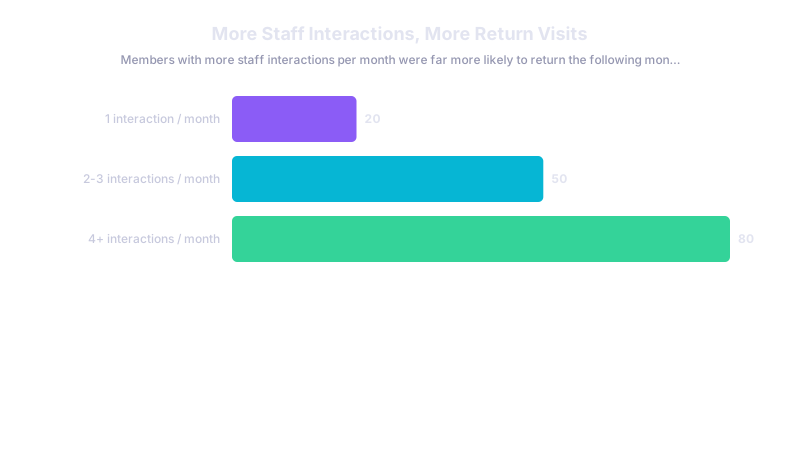
An "interaction" here is not a sales pitch. It is saying hello, learning a name, complimenting someone's form. It costs nothing, and it is almost certainly the highest-ROI "campaign" running in your building. The takeaway for a local studio: train your floor staff to have short, genuine conversations, and treat that as a marketing investment - because it is.
Retention Is Simply the More Profitable Lever
This is not unique to fitness. The foundational loyalty research by Frederick Reichheld and W. Earl Sasser found that reducing customer defections by just 5% could increase profits by roughly 25% to 95%, depending on the industry - about 85% more profit in one bank's branch system, 50% in an insurance brokerage, and 30% in an auto-service chain (Reichheld & Sasser, Harvard Business Review / Bain & Company). The exact multiplier varies by sector, but the direction never does: keeping a customer is worth far more than the acquisition math alone suggests, because a retained member keeps paying, refers others, and costs nothing more to "win."
Acquiring a new member, by contrast, means paying the full ad-and-sales cost all over again. That is why the sequence matters: lower your acquisition cost first, then stop leaking the members you just paid for.
Lower Acquisition Cost With Local Search, Reviews, and AI Visibility
Retention protects revenue; local visibility lowers the cost of the new members you do need. For a gym or studio, that means owning the local pack - an optimized Google Business Profile, a steady flow of recent five-star reviews, and consistent local listings. It is the cheapest new-member channel you have, and it compounds.
Increasingly, it also feeds AI search. An Ahrefs study of 75,000 brands found that brand web mentions correlate with AI Overview visibility far more strongly than backlinks do (0.664 versus 0.218) (Ahrefs, 2025). In plain terms: getting your studio named across the local web - directories, press, partner sites, review platforms - is now part of how you get surfaced when someone asks an AI assistant for "the best spin studio near me."
If you want the playbooks, start with our local SEO guide for service businesses, learn how to get more five-star reviews, and set up a way to measure your marketing ROI so retention and acquisition both show up as numbers you track.
What This Means for Your Business
- Fix the leaky bucket first. A structured 90-day onboarding system plus a review engine usually beats another ad campaign - you are protecting members you already paid to acquire.
- Track retention and churn monthly as a marketing KPI, not just a front-desk metric. At 66.4% industry retention, a few points either way is the difference between growth and a treadmill.
- Do both, in order. Local SEO and reviews lower acquisition cost; onboarding and community protect it. The highest-ROI move in fitness marketing isn't an ad - it's a staff member remembering a new member's name in week two.