
ChatGPT has 900 million weekly active users as of early 2026 and now handles an estimated 17 percent of all search queries (First Page Sage). When someone asks "who is the best plumber near me" or "which CRM should I use for my small business," ChatGPT gives an answer. The question is: how does it decide which businesses to name?
Short answer: ChatGPT favors businesses that are mentioned frequently across authoritative external sources, have strong review volume, and publish fresh, well-structured content on their own site. Traditional SEO signals like backlinks and domain authority have near-zero direct influence.
External Mentions Matter Most
Authoritative list mentions ('best X in [city]' roundups, industry directories, editorial recommendations) are the single strongest signal ChatGPT uses when recommending businesses. Awards, accreditations, and online reviews follow close behind. Traditional SEO factors like keyword optimization and backlink profiles have near-zero direct influence.
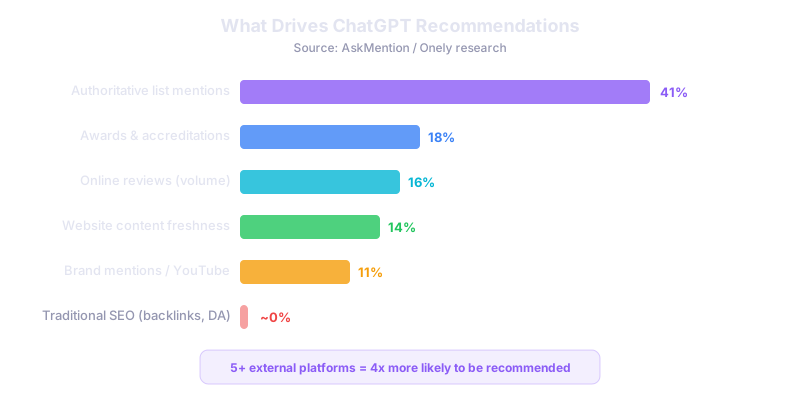
The takeaway: being listed on "best of" lists, industry directories, and review roundups matters more than on-page SEO for AI visibility. Businesses mentioned on five or more external platforms are recommended four times more often than businesses with only their own website.
Review Volume Beats Star Ratings
Onely's research, compiled by Fortis Media, found that AI-recommended businesses average 3,424 reviews compared to 955 for non-recommended businesses. Star ratings above 4.4 showed diminishing returns. In other words, ChatGPT responds more to how many people are talking about you than to whether your average is 4.7 or 4.9.
This makes sense when you consider how language models work. They synthesize patterns across their training data. A business mentioned in thousands of reviews across Google, Yelp, and industry-specific platforms creates a stronger signal than a business with a perfect score and 12 reviews.
Your Own Website Still Matters
Fortis Media's analysis found that ChatGPT cites a company's own website 3.0 points more than Google does. It treats vendor-owned content as authoritative by default. But there is a catch: 71 percent of citations come from content published between 2023 and 2025. Old, stale content gets ignored.
The first 30 percent of a page accounts for 44.2 percent of all LLM citations. This means your page introductions, service descriptions, and opening paragraphs need to clearly state who you are, what you do, and for whom, because that is what AI reads most closely.
Only 3 to 4 Brands Get Named
Onely's brand recommendation study found that ChatGPT typically names only three to four brands per category. And 26 percent of brands remain completely invisible to it. If you are not in those top three to four mentions, you do not exist in the AI answer.
This is a winner-take-most dynamic. The businesses that invest in external visibility, review velocity, and content freshness now will occupy those slots. The ones that wait will find the positions locked.
What This Means for Your Business
Start with a self-audit: ask ChatGPT about your industry and see if your business appears. If it does not, focus on three things. First, get listed on industry-specific "best of" lists and directories. Second, increase your review volume on Google and industry-specific platforms. Third, update your website content to clearly describe your services in the first few paragraphs of each key page.
Related reads:
Want to get your business recommended by AI search? We help businesses build the external visibility, review velocity, and content structure that AI models use to decide who to recommend. Talk to our team →