
As of December 2025, 89% of healthcare keywords trigger a Google AI Overview - up from 59% two years earlier - but 0% of local "provider near me" queries do (BrightEdge, December 2025). For medical and dental practices, that single gap is the whole strategy.
Short answer: Medical and dental practices win AI search by treating every page as YMYL ("Your Money or Your Life") content that Google and AI engines hold to the highest quality bar: named, credentialed clinician authors, citations to primary medical sources, and original, human-written expertise. As of December 2025, 89% of healthcare keywords trigger a Google AI Overview while 0% of local "provider near me" queries do (BrightEdge) - so informational health questions are an AI-citation game won with E-E-A-T and cited sources, while patient-acquisition queries are still won with local SEO and a strong Google Business Profile. The two need different playbooks.
Healthcare is now two different search battles
The December 2025 BrightEdge data draws a hard line down the middle of healthcare search. Informational queries are almost fully saturated with AI Overviews: treatment and procedure queries hit 100%, pain-related queries 98%, symptoms and conditions 93%, and medical coding 90% (BrightEdge, December 2025). Local, provider-intent queries like "dermatologist near me" sit at 0% - and notably, that's down from 100% in December 2023. Google deliberately reversed course and pulled AI Overviews out of local healthcare results.
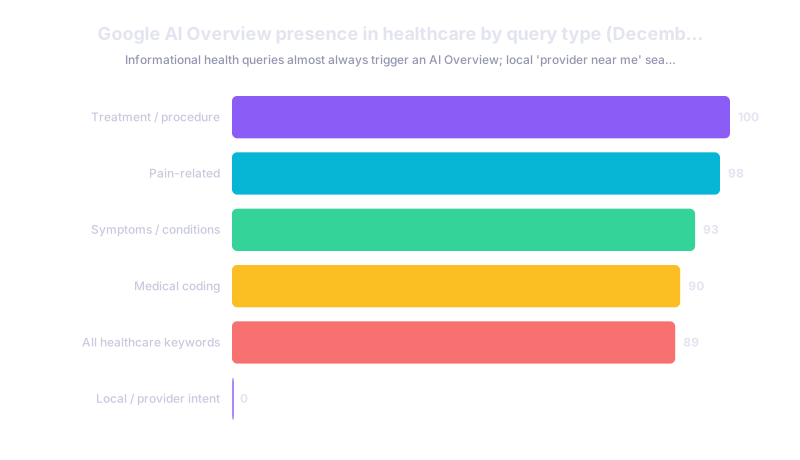
The takeaway is not "AI is eating your patient pipeline." It's the opposite. Google still wants a human to choose a doctor, so your "near me" acquisition funnel is safer than the headlines suggest. What's being commoditized is your informational content - the condition explainers, procedure FAQs, and symptom pages that AI engines now answer directly. Those two realities call for two separate strategies, not one blog trying to do both jobs.
Patients are already asking AI - so your practice has to be the source it quotes
The demand side is moving fast. In 2025, 32% of U.S. adults reported using AI chatbots for health information - double the 16% share a year earlier - with 23% using ChatGPT specifically and 64% of AI users engaging weekly or more, per Rock Health's survey of 8,000 Census-matched adults fielded December 1-23, 2025 (Rock Health, 2025 Consumer Adoption of Digital Health Survey).
That shift comes with real risk, which is exactly why credentialed, accountable content matters. As Andrea Downing, co-founder of The Light Collective, put it in the Rock Health report: "These tools can create magical experiences-they're very easy to access. But the second we leave the walls of the healthcare system, we're trading off for a lot of other risks and lack of rights. There's no duty of care, no duty of confidentiality, and often no clear path to accountability if something goes wrong."
Practices won't win by opting out. As Kristen Valdes, founder and CEO of b.well Connected Health, noted in the same report: "Patients are not going to stop using these tools because they're filling a real gap." The practical move is to become the trustworthy, cited source these engines pull from - so when a patient asks AI about a procedure you perform, your expertise is in the answer.
Why YMYL raises the bar - and why AI ghostwriting fails it
Health content is the definition of YMYL. Google's Search Quality Rater Guidelines, updated September 11, 2025, apply the highest Page Quality standards to YMYL topics precisely because low-quality pages could negatively affect people's health or safety. The same guidelines are explicit that mass-produced or purely AI-generated content published without human review or added value should be rated "Lowest" quality (Google, Search Quality Rater Guidelines, 2025).
The market data backs the human-authored approach. In an analysis of Google results and AI citations, 82% of articles cited by ChatGPT and Perplexity - and 86% of articles ranking on Google - were human-written, with data collected in June 2025 (Graphite, "AI Content in Search & LLMs"). For a medical practice, this is the one score you cannot afford to gamble on: an unreviewed AI-drafted YMYL page risks the "Lowest" rating outright.
What actually moves the needle for AI citations
For the informational half of the split, the research points to concrete on-page tactics. In the academic "GEO: Generative Engine Optimization" study (Aggarwal et al., ACM KDD 2024), the top method - Quotation Addition - lifted the Position-Adjusted Word Count visibility metric to 27.8 from a 19.5 baseline (about +41%), with Statistics Addition next at 25.9 (about +33%) and Cite Sources at 24.9 (about +28%). Adding citations was especially powerful for a lower-ranked page, producing a 115.1% visibility jump for a 5th-ranked site. Keyword stuffing, by contrast, reduced visibility. The authors stress efficacy "varies across domains, underscoring the need for domain-specific optimization methods," so treat these as an upper bound from a synthetic academic benchmark - "up to 40%" - not a guarantee on local-service queries.
Off-page signals matter too. Across a 75,000-brand study, web mentions of a brand correlated with AI Overview visibility at 0.664 versus just 0.218 for backlinks, and the most-mentioned quartile of brands averaged about 169 AI Overview mentions against roughly 14 for the next quartile - about 10x (Ahrefs, "AI Overview Brand Visibility Factors," May 2025). For practices, that means press mentions, directory listings, and citations across the web feed AI visibility more than link-building alone.
Don't neglect the click AI isn't touching
Because informational AI Overviews suppress clicks - when one appears, users click a traditional result just 8% of the time versus 15% when no summary shows (Pew Research Center, July 2025) - it's tempting to pour everything into AI visibility. Resist that. The "near me" queries that actually book appointments are still a 0%-AI-Overview zone, which means classic local SEO, an optimized Google Business Profile, and a steady flow of patient reviews remain your primary patient-acquisition engine. That's the click AI isn't competing for.
What This Means for Your Business
- Audit before you optimize. Check every health page for named clinician authorship, primary-source citations, and a recent review date before chasing anything fancier.
- Split the budget. Fund E-E-A-T content plus citations for AI-answer visibility, and separately fund local SEO, Google Business Profile, and reviews for "near me" patient acquisition. They are different battles.
- Treat GEO figures as upper bounds. The "up to 40%" gains come from a synthetic benchmark - validate on your own queries rather than assuming a fixed lift.
- Never ship unreviewed AI on YMYL pages. Consistency and clinical accuracy compound; one credentialed, well-cited page beats ten thin AI-drafted ones - and dodges the "Lowest" rating no practice can absorb.
Not sure whether your practice should be chasing AI citations or local "near me" rankings first? Semark builds split GEO + local SEO strategies for medical and dental practices through our healthcare marketing services and generative engine optimization service. Get a healthcare marketing plan at /contact.