
Google states plainly that there's "no special schema.org structured data that you need to add" to appear in AI Overviews or AI Mode (Google Search Central, 2025), and when Ahrefs tracked 1,885 pages that added JSON-LD schema, AI citations barely moved (Ahrefs, 2026). So before you build a schema project to "win" AI search, it's worth knowing what structured data actually does for large language models, and what doesn't.
Short answer: Schema markup, structured data written in JSON-LD, helps search engines and some AI systems parse, disambiguate, and reliably extract facts about your business, but it is not a lever for AI visibility. Google explicitly says no special schema is required for its AI features, and Ahrefs' 1,885-page test found adding schema produced no meaningful lift in AI citations on any platform. What actually helps LLMs understand you is a clear, consistent entity (who you are, what you do, where), being mentioned and cited across the web, and genuinely useful content, with schema as cheap foundational hygiene underneath.
What schema markup is, and what LLMs do with it
Schema markup is structured data, usually a small block of JSON-LD, that labels your content so machines don't have to guess. It tells a parser that a string is a business name, a number is a price, a block is an FAQ, and a byline is the author. Search engines have used it for years to power rich results.
The key thing to understand for AI search: LLMs and AI features draw on the same web index as classic Search. Schema helps with entity recognition and clean fact extraction; it is not a separate "AI ranking" path you can unlock. The reader's real question is whether adding FAQ or Article schema gets you cited in ChatGPT and AI Overviews, or whether it's just SEO hygiene. The evidence points firmly to the second.
What Google and Bing actually say
There are only two first-party confirmations worth citing. Google's own documentation on AI features states: "You don't need to create new machine readable files, AI text files, or markup to appear in these features. There's also no special schema.org structured data that you need to add" (Google Search Central, 2025). That is as direct as a platform gets.
On the other side, Microsoft's Fabrice Canel, a Principal Product Manager on Bing, confirmed at SMX Munich in March 2025 that schema markup helps Microsoft's LLMs understand content, as reported by Barry Schwartz at Search Engine Land (2025). It's the only on-record confirmation from a major AI platform that structured data aids LLM comprehension. OpenAI, Anthropic, and Perplexity have said nothing on the record, so any "schema equals citations" promise beyond basic eligibility is inference, not confirmation.
The hard data: adding schema barely moved AI citations
Ahrefs ran a difference-in-differences study on 1,885 pages that added JSON-LD schema between August 2025 and March 2026, compared against 4,000 matched control pages. The citation change was −4.6% on Google AI Overviews, +2.4% on Google AI Mode, and +2.2% on ChatGPT (Ahrefs, 2026). Only the −4.6% AI Overviews figure was statistically significant; the two positive numbers were indistinguishable from zero.
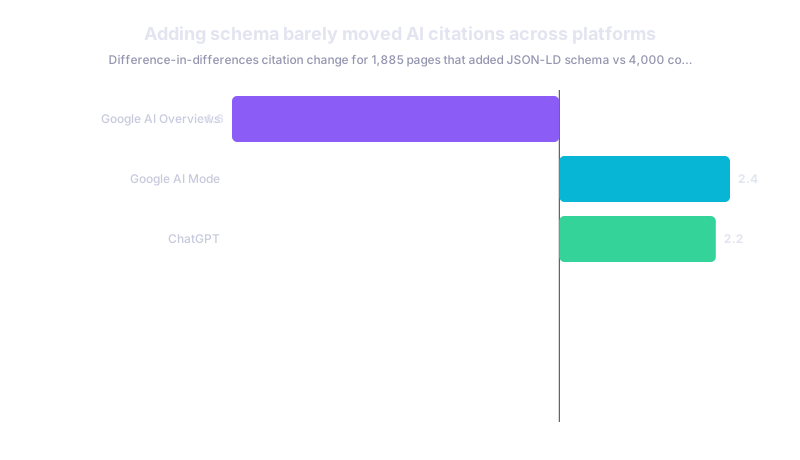
As the Ahrefs authors put it, "Adding schema produced no major uplift in citations on any platform" (Louise Linehan and Xibeijia Guan, Ahrefs, 2026). One honest caveat: this study tested pages that were already visible, each with 100-plus AI Overview citations before adding schema. Schema still gates rich results and supports entity recognition, which feed eligibility further upstream. The takeaway is that schema is a floor, not an accelerator: do it, but don't expect it to be your growth lever.
What actually helps LLMs understand and cite you
If markup isn't the lever, what is? The data points to three durable things.
Entity clarity and consistency. Use the same business name, address, and description everywhere, and connect your profiles with Organization and sameAs schema so machines resolve you to one entity.
Being mentioned across the web. In Ahrefs' study of 75,000 brands, brand web mentions correlated with AI Overview visibility far more strongly (0.664) than backlinks did (0.218) (Ahrefs, 2025). Presence and mentions, not markup, are the stronger signal.
Content built to be extracted. A peer-reviewed study found that on-page tactics, "Cite Sources, Quotation Addition, and Statistics Addition, achieved a relative improvement of 30-40% on the Position-Adjusted Word Count metric," with visibility gains of up to 40% (Aggarwal et al., GEO: Generative Engine Optimization, ACM KDD 2024). Keep the "up to" hedge in mind: these are upper bounds from a synthetic academic benchmark, the authors note efficacy "varies across domains," and keyword stuffing actually reduced visibility. Still, the direction is clear, cite real sources, add statistics, and answer questions directly.
For more on this, see Generative Engine Optimization: how small businesses get found by AI search and how to optimize for Google AI Overviews.
The schema worth implementing anyway
None of this means skip schema. Implement the core types because they're cheap and they gate rich results:
- Organization or LocalBusiness with
sameAsto anchor your entity and keep name, address, and phone consistent for the Knowledge Graph. - Article or BlogPosting, FAQPage, Product, Review, and Breadcrumb to enable rich results and hand AI clean facts to extract.
What This Means for Your Business
Implement core schema, Organization or LocalBusiness, Article, and FAQ, because it's inexpensive, gates rich results, and clarifies your entity. Just set expectations: it won't manufacture AI citations on its own. This matters more than ever now that an AI Overview is associated with a 58% lower click-through rate on the #1 organic result (Ahrefs, 2025), so being the source AI cites is worth real effort.
Put the bulk of that effort where the data points: a consistent, unambiguous entity, earning mentions across the web, and genuinely helpful content with cited stats and direct answers. Audit that your markup matches your visible content to avoid penalties, then move on, don't chase the schema hacks marketers oversell.
Want AI search to actually understand and recommend your business? Semark sets the entity, schema, and content foundation that gets you cited. Get a GEO and technical SEO assessment through Semark's Generative Engine Optimization services or reach us at /contact.