A single SEO specialist averages $86,308 in base salary alone (Glassdoor, 2026) - and base salary is the smallest part of the real bill. Once you add benefits, payroll tax, tools, and the risk that the hire doesn't work out, an in-house SEO function is one of the most expensive line items a small business can sign up for.
Short answer: A full in-house SEO team costs roughly $250,000-$500,000+ per year (a Semark estimate built from published salary data, not a single sourced figure) once you stack salaries, benefits, and software - and that's before a single ranking moves. Just one SEO specialist averages $86,308 in base pay (Glassdoor, 2026), and employer benefits add about 42% on top of wages (BLS, March 2025), pushing one fully-loaded hire past $120,000/year. By contrast, 48% of SEO agencies charge a monthly retainer of $1,500-$5,000 (~$18k-$60k/yr) (GoodFirms, 2026) - and that retainer buys a whole team, not one generalist. For most small and mid-sized businesses, the agency is the cheaper, lower-risk path to the same capability.
The In-House Price Tag Nobody Quotes Upfront
The number owners anchor on is a specialist's salary, and it's already bigger than most expect. Glassdoor puts the average SEO Specialist base at $86,308/year, with entry-level around $58,912 and senior specialists near $105,636 (Glassdoor, 2026). Move up to leadership and it climbs fast: a Head of SEO averages $150,578, with most falling between $113,500 and $174,500 and top earners at $242,500 (ZipRecruiter, 2026).
Real SEO isn't one person's job, though - it's strategy, technical fixes, content, and link building. Staff those functions internally and you're looking at a payroll of roughly $250,000-$500,000+ per year before overhead. That figure is our own estimate, derived from the confirmed salary data above rather than a single published statistic, but the direction is unambiguous: it's a large, fixed cost you pay whether or not your rankings improve.
The Hidden 42%: Salary Is Not the Real Cost
Here's the line item that wrecks in-house budgets. According to the U.S. Bureau of Labor Statistics, benefits accounted for 29.7% of total employer compensation for private industry workers in March 2025 - $13.49/hour in benefits on top of $31.89/hour in wages (BLS ECEC, March 2025). That's roughly 42% added to every base salary before you count anything else.
Run that on one specialist: an $86,308 base becomes about $122,600 fully loaded with benefits and payroll tax - and that still excludes equipment, onboarding, and software. A professional tool stack alone is a recurring cost: Ahrefs' Standard plan lists at $249/month and Semrush's Guru plan at roughly $208/month (published vendor pricing, 2026), and a working team typically layers on rank tracking, a crawler, and a content tool. Budget several hundred to a few thousand dollars a month for tools depending on how many seats and tiers you need. Recruiting time, ramp-up before the hire is productive, and turnover risk are all real too - and rarely make it into the spreadsheet.
What an Agency Retainer Actually Costs
GoodFirms' 2026 pricing data is the clearest benchmark: the most common tier sits between $1,500 and $5,000 per month, where 48% of agencies operate. Another 43.3% charge under $1,500/month (typically local businesses), and only 5.5% charge more than $5,000/month (GoodFirms, 2026).
The important part isn't the price - it's what the price includes. A single retainer buys a whole team: a strategist, a technical specialist, content help, and link building, all on the same account. Tools are included. There's no 42% benefits load, no payroll tax, no equipment, and no headcount you have to keep busy. When work slows, so does the bill - something a salary will never do.
Head-to-Head: One Specialist vs One Retainer
Put the two on the same fully-loaded footing and the comparison is stark:
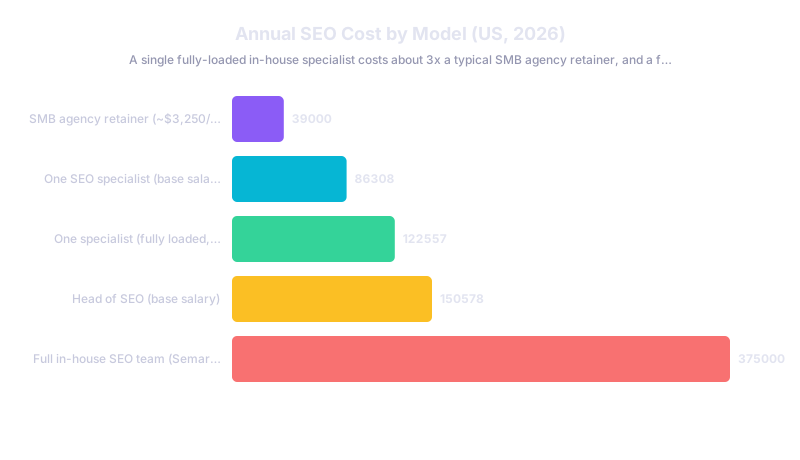
| Model | Approx. annual cost | What you get |
|---|---|---|
| SMB agency retainer (~$3,250/mo) | ~$39,000 | A multi-role team; tools included |
| One SEO specialist (base only) | $86,308 | One person, before benefits/tools |
| One specialist (fully loaded, +42%) | ~$122,600 | One person, all-in |
| Head of SEO (base only) | $150,578 | One senior leader, before benefits |
| Full in-house SEO team (Semark estimate) | ~$375,000 | Full internal function |
One fully-loaded in-house specialist costs roughly three times a typical SMB retainer - and the retainer puts four specialties on your account instead of one generalist. In-house still buys real advantages: control, deep product knowledge, and daily availability. An agency buys breadth and benchmark data across many clients with no fixed-headcount risk. But on pure economics, the break-even doesn't favor in-house until you can keep two or three SEO people busy every single week.
When In-House Actually Makes Sense
Building internally is the right call when the volume is genuinely there. That means consistent, high-volume SEO work that fills a full role week after week - usually because SEO is the business model: large e-commerce catalogs, publishers, and marketplaces where organic search drives the revenue. In those companies, an in-house team pays for itself.
A hybrid often beats both extremes: one internal owner who sets strategy and directs an agency's execution. You get accountability and product knowledge in-house, plus specialized breadth on demand, without carrying four salaries. For the typical local or SMB service business, though, the honest answer is that the weekly volume never justifies a full-time salary - let alone a team.
What This Means for Your Business
For most small and mid-sized businesses, an agency is the cheaper and lower-risk path to the same capability. Three rules to keep the decision clean:
- Compare fully-loaded cost, not base salary. Salary plus ~42% for benefits and payroll tax (BLS, 2025) plus tools is the real number to weigh against a retainer.
- Judge either option on ROIand reporting, not headcount. Done well, SEO pays back: First Page Sage reports an average 748% ROI and a ~9-month break-even for its thought-leadership SEO campaigns (self-reported vendor data, Q1 2021-Q3 2025) - a useful directional benchmark, not a guarantee.
- Only build in-house when the work is steady enough to keep 2-3 people busy. Below that, you're paying full-time rates for part-time work.
Related reading:
- In-house marketing vs agency: the cost comparison
- How much should a small business spend on digital marketing in 2026
- SEO in 2026: what actually moves the needle
Related reads: