SEO Has Changed. Your Strategy Should Too.
If your SEO strategy still revolves around stuffing keywords into meta tags and building backlinks from directory sites, you are working with a 2018 playbook in a 2026 world.
Google processes over 8.5 billion searches per day. The competition for organic visibility has never been higher, and the search engine itself has fundamentally changed - AI overviews, zero-click results, E-E-A-T signals, and Core Web Vitals have rewritten the rules. But organic search still delivers the highest-quality, lowest-cost traffic for most businesses.
Here is what actually moves the needle in 2026.
1. Technical SEO Is the Foundation (Not an Afterthought)
No amount of great content will rank if your site has technical issues that prevent Google from efficiently crawling, indexing, and rendering your pages.
The technical checklist that matters
Core Web Vitals - Google uses these as ranking signals:
- Largest Contentful Paint (LCP): Under 2.5 seconds. The main content of your page must load fast.
- Interaction to Next Paint (INP): Under 200ms. Your page must respond to user interactions quickly.
- Cumulative Layout Shift (CLS): Under 0.1. Elements should not jump around as the page loads.
- Clean sitemap.xml submitted to Google Search Console
- Logical internal linking structure (no orphan pages)
- Proper canonical tags to prevent duplicate content issues
- Structured data (Schema.org) for rich snippets
- Mobile-first responsive design (Google indexes mobile version first)
- Flat URL structure (important pages within 3 clicks of homepage)
- Descriptive, keyword-informed URLs (
/services/ai-machine-learningnot/page?id=47) - Breadcrumb navigation for both users and search engines
- HTTPS everywhere (non-negotiable since 2020)
Common technical mistakes we see
- JavaScript-rendered content that Google cannot index. If your site is a single-page app (SPA) without server-side rendering, Google may see a blank page. Use Next.js, Nuxt, or similar SSR frameworks.
- Redirect chains. Page A redirects to Page B which redirects to Page C. Each hop loses link equity. Fix chains to point directly to the final destination.
- Bloated page weight. Sites loading 5MB+ of JavaScript, unoptimized images, and unused CSS rank poorly because they load slowly.
- Missing or duplicate meta tags. Every page needs a unique title tag and meta description that accurately describes the content.
Quick win: Run your site through Google PageSpeed Insights and fix every "red" issue. Then submit your sitemap in Google Search Console and check the Coverage report for indexing errors.
2. Content Quality Beats Content Quantity
Google's helpful content system rewards pages that demonstrate genuine expertise and provide real value. Thin, AI-generated content farms are being systematically demoted. Fewer, better pages outperform hundreds of mediocre ones.
What "quality content" means in 2026
- First-hand experience and expertise. Google's E-E-A-T framework (Experience, Expertise, Authoritativeness, Trustworthiness) favors content written by people who actually know the subject. A blog post about "how to reduce support costs with AI" written by someone who has actually built and deployed AI chatbots will outrank a generic overview.
- Depth over breadth. A 2,500-word guide that thoroughly answers a question ranks better than a 500-word post that skims the surface. But length alone is not the goal - value density is. Every paragraph should teach something.
- Original data, insights, or frameworks. Content that includes original research, proprietary data, unique case studies, or novel frameworks earns links and citations naturally. This is the hardest content to create but the most valuable for SEO.
- Updated regularly. Search engines favor fresh content. Review and update your top-performing pages every 6-12 months with current data and insights.
Content strategy for business websites
Most business websites need three types of content:
| Content type | Purpose | Example |
|---|---|---|
| Service pages | Rank for commercial intent keywords | "AI automation services for e-commerce" |
| Blog posts | Rank for informational keywords and build topical authority | "How to reduce customer support costs" |
| Case studies / resources | Build E-E-A-T and earn backlinks | "How [Client] Saved $200K with AI Automation" |
3. Search Intent Is Everything
Ranking for keywords is pointless if those keywords do not match what your potential customers are actually searching for - and what they expect to find.
The four types of search intent
- Informational: "What is AI automation?" - The searcher wants to learn. Serve educational content.
- Navigational: "Semark LLC AI services" - The searcher wants a specific page. Make sure it is easy to find.
- Commercial investigation: "Best AI automation companies 2026" - The searcher is comparing options. Serve comparison content or strong service pages.
- Transactional: "AI chatbot development quote" - The searcher wants to buy. Serve landing pages with clear CTAs.
How to match intent
Before writing any page, search your target keyword in Google. Look at what currently ranks on page one:
- Are the top results blog posts or service pages?
- Are they long-form guides or short answers?
- Do they include videos, images, or tools?
- What questions do the "People Also Ask" boxes address?
4. Local SEO for Service Businesses
If you serve clients in specific geographic areas, local SEO is one of the highest-ROI channels available.
Local SEO essentials
- Google Business Profile: Claim it, complete every field, add photos monthly, and respond to every review. This is the single most important local ranking factor.
- NAP consistency: Your business Name, Address, and Phone number must be identical across your website, Google Business Profile, and every directory listing.
- Local landing pages: If you serve multiple cities, create a dedicated page for each with locally relevant content (not just the city name swapped in a template).
- Reviews: Businesses with more high-quality Google reviews rank higher in local pack results. Implement a systematic post-service review request process.
- Local backlinks: Sponsorships, local business associations, chamber of commerce memberships, and local press mentions build locally relevant link equity.
Want us to run a SEO audit on your site? Get your SEO audit - we will analyze your technical foundation, content gaps, and competitive positioning to build a prioritized action plan.
5. Backlinks Still Matter (But Quality Over Quantity)
Links from other websites remain one of Google's strongest ranking signals. But the game has shifted entirely from volume to quality and relevance.
Links that move rankings
- Editorial links from industry publications - A mention in a relevant trade publication or news site
- Resource page links - Getting listed as a recommended tool or resource
- Guest contributions - Writing genuinely valuable content for relevant blogs (not paid link-building schemes)
- Links earned from original research - Publish data, surveys, or benchmarks that others cite
Links that can hurt you
- Paid links from link farms or PBNs (private blog networks)
- Mass directory submissions
- Comment spam
- Links from irrelevant, low-quality sites
A sustainable link-building approach
- Create link-worthy content. Original research, comprehensive guides, free tools, and unique data naturally attract links.
- Build relationships, not links. Engage with industry peers, contribute to discussions, and share others' work. Relationships lead to natural editorial links over time.
- Monitor your backlink profile. Use Google Search Console or Ahrefs to identify and disavow toxic links.
6. Optimize for AI-Driven Search
Google's AI Overviews (formerly SGE) now appear for a significant percentage of searches, pulling information from multiple sources into a synthesized answer at the top of results. This changes SEO strategy in important ways.
How to get cited in AI Overviews
- Structure content clearly. Use descriptive headings, bullet points, and tables. AI systems parse well-structured content more effectively.
- Answer questions directly. Start sections with a clear, concise answer before elaborating. The direct answer is more likely to be pulled into an AI overview.
- Include data and specifics. AI overviews favor content with concrete numbers, statistics, and specific recommendations over vague generalizations.
- Maintain E-E-A-T signals. Author bios, credentials, citations, and publication dates help AI systems assess content trustworthiness.
Adapting to zero-click search
More searches than ever are answered directly in search results without a click-through to any website. To adapt:
- Target long-tail, complex queries that cannot be answered in a snippet
- Build brand awareness so people search for you directly
- Capture leads from the content itself - embed CTAs and conversion paths within your highest-ranking pages
- Diversify traffic sources - do not rely solely on organic search
7. Measure What Matters
Stop obsessing over vanity metrics. These are the SEO metrics that actually correlate with business growth:
Leading indicators (track weekly)
- Impressions and clicks by page (Google Search Console) - Is your visibility growing?
- Average position for target keywords - Are you trending up?
- Indexed pages - Is Google finding and indexing your new content?
- Core Web Vitals scores - Are technical fundamentals solid?
Business metrics (track monthly)
- Organic traffic to commercial pages (service pages, landing pages) - not just total organic traffic
- Organic-sourced leads and conversions - How many leads come from organic search?
- Organic revenue or pipeline value - What is organic search actually worth in dollars?
- Keyword portfolio growth - How many keywords drive traffic, and is that number growing?
What not to track
- Domain Authority / Domain Rating - These are third-party estimates, not Google metrics. Useful for competitive benchmarking but not a ranking factor.
- Total backlink count - Quality matters infinitely more than quantity.
- Rankings for a single keyword - Think in terms of keyword clusters and topical visibility, not individual positions.
A Realistic SEO Timeline
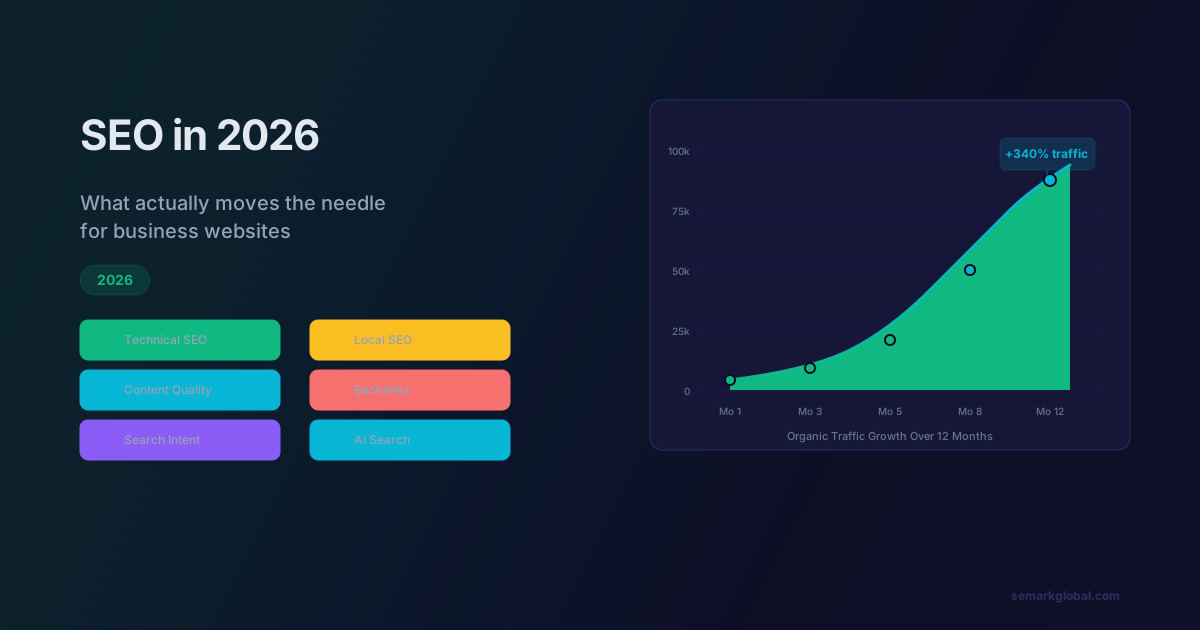
SEO is not instant. Here is what a realistic timeline looks like for a business website starting from a modest organic presence:
| Timeline | Phase | Key Activities |
|---|---|---|
| Month 1-2 | Foundation | Technical audit and fixes, keyword research, on-page optimization of existing pages |
| Month 3-4 | Content Production | Publish pillar pages, begin outreach and link building, optimize Google Business Profile |
| Month 5-6 | Traction | First ranking improvements appear, organic impressions growing, identify early winners |
| Month 7-12 | Compounding | Consistent traffic growth, conversion optimization of high-traffic pages, expand into adjacent keyword clusters |
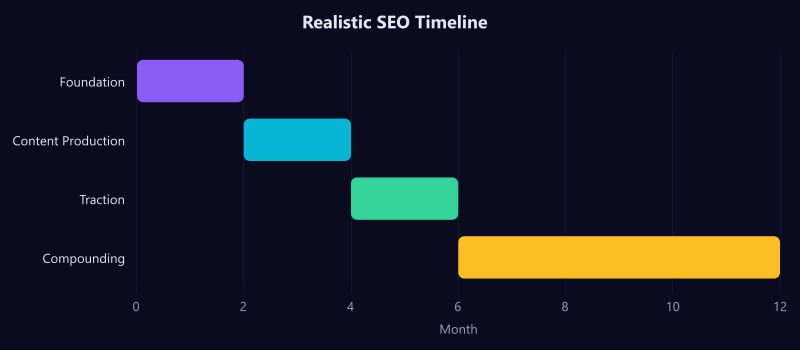
Do not expect significant results before month 4-5. Any agency promising page-one rankings in 30 days is either targeting keywords nobody searches for or using tactics that will eventually get your site penalized.
The Bottom Line
SEO in 2026 is not about tricks or shortcuts. It is about building a technically sound website, creating genuinely valuable content that demonstrates expertise, and earning trust from both search engines and users.
The businesses winning at organic search are the ones that treat SEO as a long-term investment in their digital presence - not a one-time project. The compounding nature of SEO means the gap between businesses that invest consistently and those that do not grows wider every month.
Get a SEO audit of your website - we will identify your biggest ranking opportunities and provide a prioritized action plan to start driving organic growth.
Frequently Asked Questions
How long does SEO take to show results? Most businesses see meaningful organic traffic improvements within 3-6 months of consistent effort.
Is SEO still worth it in 2026? Yes. Organic search remains the highest-ROI digital marketing channel for most small businesses.
Do I need to hire an SEO agency? Not necessarily. Many fundamentals are DIY-friendly, but competitive markets often require professional expertise.
What is the most important SEO factor? High-quality, relevant content that genuinely answers what your target audience is searching for.
How much should I budget for SEO? Small businesses typically invest $1,000-$3,000 per month for professional SEO services.