
Your Google Business Profile category is not a minor detail. It is the single most important factor determining whether your business shows up in the Local Pack when someone searches for your services. Choose wrong, and you are fighting an uphill battle no matter how good your reviews or website are.
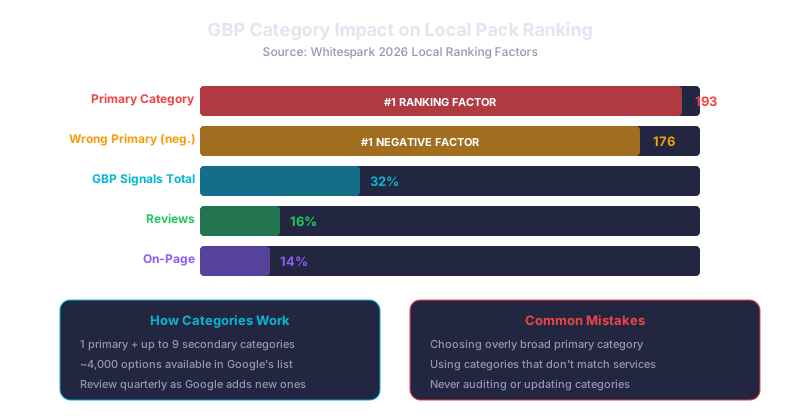
Short answer: Your primary category is the number one Local Pack ranking factor, with a weight score of 193 according to the Whitespark 2026 Local Ranking Factors study. Choosing the wrong primary category is also the number one negative factor, with a score of 176. You get one primary category and up to nine secondary categories from roughly 4,000 options. Get the primary right, and everything else works harder for you.
Why Your Primary Category Matters So MuchGBP signals account for 32 percent of all Local Pack ranking factors (Whitespark's 2026 study). Within those signals, the primary category carries the heaviest weight at a score of 193 -- more than any other single factor including reviews, on-page SEO, or backlinks.
Nova BrandWorks confirmed the flip side: choosing the wrong primary category is the number one negative ranking factor with a score of 176. This means a single bad choice in your profile settings can override months of SEO work.
How to Choose Your Primary Category
Your primary category should describe your core business function as specifically as possible. Google offers roughly 4,000 category options, and the more specific you can be, the better.
If you are a plumber, your primary category should be "Plumber," not "Home Services Company" or "Contractor." If you are a family dentist, use "Dentist" or "Family Dentist," not "Medical Office." If you run a pizza restaurant that also does delivery, "Pizza Delivery" and "Pizza Restaurant" are both options -- pick the one that matches how most customers find you.
Search for your main service on Google Maps and look at what categories your top-ranking competitors use. This tells you what Google considers most relevant for those searches. If the top three plumbers in your area all use "Plumber" as their primary, you should too.
Choosing Secondary Categories
You can add up to nine secondary categories. These should cover your other services and specialties without diluting your primary focus.
A general contractor might use "General Contractor" as the primary, then add "Kitchen Remodeler," "Bathroom Remodeler," "Home Builder," and "Roofing Contractor" as secondaries. Each secondary category opens a new set of searches where your business can appear.
Rules for secondary categories: only add categories for services you actively provide, do not add categories just because they seem popular, and never add categories for services you plan to offer someday but do not currently deliver.
Common Mistakes That Kill Rankings
Using an overly broad primary category. "Business Services" when you should use "Bookkeeping Service." Broad categories mean you compete with everyone and rank for nothing specific.
Choosing a category that does not match your actual services. Some businesses pick aspirational categories or ones they think sound better. Google can and does verify, and mismatches hurt your ranking.
Never reviewing or updating categories. Google regularly adds new categories. A category that did not exist when you set up your profile two years ago might be a perfect fit now. Review your categories quarterly and check for new, more specific options.
Adding too many unrelated secondary categories. If your secondaries are all over the map, Google may struggle to understand what your business actually does. Keep them focused and relevant.
How to Audit Your Current Categories
Log into your Google Business Profile, go to "Edit profile," and check your current primary and secondary categories. Then search Google Maps for each of your main services plus your city. Note whether your business appears. If it does not, your category selection may be the reason.
Compare your categories to the top three competitors who do appear. Adjust your primary to match the most specific relevant option and refine your secondaries to cover your actual service offerings.
For a complete GBP audit and optimization strategy, local SEO services can identify every factor affecting your Local Pack visibility, starting with categories.
What This Means for Your Business
Spend 15 minutes this week reviewing your GBP categories. Check that your primary category is as specific as possible, your secondaries cover your real services, and nothing has become outdated. This single change -- picking the right primary category -- can have more impact on your local visibility than any other optimization you make this quarter.
Related reads:
- Google Business Profile Not Showing Up? Here Is What to Do
- Get More Calls from Google Business Profile
- Voice Search Optimization for Local Businesses
Not sure which categories are right for your business? We audit GBP profiles and optimize every factor that affects your Local Pack ranking. Get a free audit