A customer calls your business. Instead of hold music or voicemail, a natural-sounding voice picks up instantly. It answers their question, books an appointment, or takes a detailed message. That is voice AI in 2026, and it has moved well past the clunky phone trees that frustrated everyone for decades.
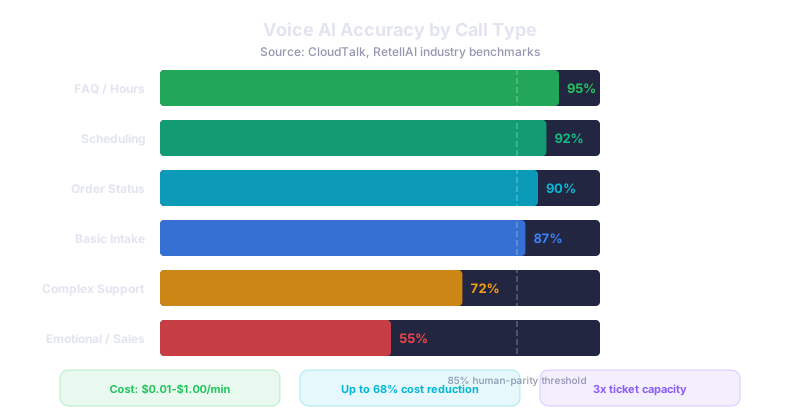
Short answer: Modern voice AI achieves 85 to 95 percent accuracy for routine phone inquiries like scheduling, FAQs, and order status. It costs $0.01 to $1.00 per minute depending on the provider, and businesses report up to 68 percent cost reduction compared to staffed phone lines.
How Voice AI Actually Works Today
Voice AI uses speech recognition to transcribe what callers say, natural language understanding to figure out what they mean, and text-to-speech to respond in a natural-sounding voice. The entire exchange happens in real time with minimal delay.
The technology has improved dramatically. Modern systems handle routine inquiries at 85 to 95 percent accuracy (CloudTalk and RetellAI industry benchmarks). That means for straightforward calls about business hours, appointment booking, pricing questions, and order status, voice AI performs at or near human level.
What It Costs in Practice
Voice AI pricing falls into two models. Per-minute pricing from providers like CloudTalk ranges from $0.01 to $1.00 per minute depending on features and volume. Flat-rate plans from providers like Synthflow start at roughly $199 per month for unlimited minutes.
For context, Aloware reports that businesses using voice AI see up to 68 percent cost reduction and handle three times the ticket capacity compared to fully staffed phone operations. The math is straightforward: if you are paying a receptionist $3,000 per month and voice AI handles 80 percent of those calls for $200, you save $2,200 monthly.
Where Voice AI Excels
Voice AI works best for high-volume, predictable call types:
- Appointment scheduling and confirmation -- the system checks your calendar, finds open slots, and books the appointment while the caller is on the line
- FAQ responses -- hours, location, pricing, service descriptions, and common policy questions
- After-hours coverage -- every call gets answered, even at midnight, with full lead capture
- Call qualification -- the system asks the right intake questions and routes qualified leads to your team with context already captured
- Appointment reminders and follow-ups -- outbound calls for confirmations and review requests
Where It Falls Short
Voice AI struggles with emotionally charged conversations, complex multi-step problem solving, heavy accents or background noise, and situations that require genuine empathy. A caller who is upset about a botched repair needs a human. A caller who needs to schedule that repair does not.
The practical approach is to let AI handle the 80 percent of calls that are routine and route the remaining 20 percent to your team. This gives your staff more time for the conversations that actually need a person.
Setting Up Voice AI the Right Way
Start by mapping your call volume. Track incoming calls for two weeks and categorize them: how many are scheduling, how many are basic questions, and how many require human judgment.
Next, choose a solution that matches your volume and complexity. If you handle fewer than 100 calls per month, a flat-rate plan around $199 keeps costs predictable. For higher volume, per-minute pricing often makes more sense.
Build your call flows around your actual top ten call reasons. Every voice AI system is only as good as its configuration. A generic setup will frustrate callers. A system trained on your specific services, pricing, and scheduling rules will feel like talking to someone who knows your business.
For businesses that need a custom-built voice AI solution with deep integrations into scheduling, CRM, and dispatch systems, a tailored build delivers the best caller experience and highest capture rates.
What This Means for Your Business
Voice AI in 2026 is reliable enough for routine calls and affordable enough for small businesses. The question is not whether the technology works but whether your call volume and call mix justify the investment. If you miss calls, lose leads to voicemail, or have staff spending hours on repetitive phone work, voice AI is worth testing today.
Related reads:
- AI Answering Service for Small Business: What to Know Before You Buy
- Can AI Replace My Receptionist?
- How to Use AI to Answer Missed Calls for Your Service Business
Ready to stop losing calls? We design and deploy voice AI systems built for your specific business and call flow. Get started