
Your phone rings. Nobody picks up. The caller hangs up and dials your competitor. If this sounds familiar, you are not alone. Missed calls cost small businesses an estimated $1,200 per lost opportunity, and most small businesses miss more calls than they realize.
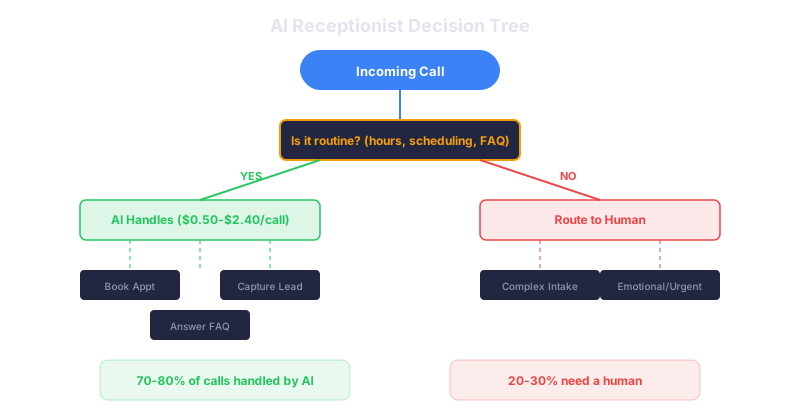
Short answer: AI can handle 70 to 80 percent of your inbound calls -- the routine ones about hours, scheduling, pricing, and basic FAQs. It cannot handle emotionally complex calls, nuanced legal or medical intake, or high-stakes sales conversations. Most businesses do best with a hybrid: AI for routine and after-hours calls, a human for everything else.
What AI Receptionists Actually Cost
The price gap is significant. A full-time in-house receptionist costs $36,000 to $41,000 per year in salary, or $2,900 to $4,100 per month when you factor in taxes, benefits, and overhead.
AI receptionist services cost a fraction of that:
- UpFirst starts at $24.95 per month for basic call coverage
- Smith.ai charges $2.40 per call for AI-only handling, or $292.50 per month for 30 calls with a human backup
- Dialzara and similar tools run about $29 to $67 per month for average call volumes
What AI Handles Well
AI receptionists excel at high-volume, predictable interactions:
- Answering business hours, location, and service questions -- the calls that eat up your front desk time
- Scheduling and rescheduling appointments -- integrates with Calendly, Google Calendar, or your booking system
- Capturing lead information -- name, phone, email, what they need, sent straight to your CRM or inbox
- After-hours coverage -- this is where the biggest money is saved, since most small businesses have zero coverage after 5 PM
Where AI Falls Short
Smith.ai, one of the largest virtual receptionist providers, explicitly states that an AI receptionist is not the same as a virtual receptionist. The distinction matters.
AI struggles with:
- Emotionally charged callers -- someone calling a law firm about a custody dispute or a medical office about test results needs empathy that AI cannot deliver
- Complex intake conversations -- multi-step qualification where the caller's answers change the next question
- De-escalation -- an angry customer needs a person who can listen, adapt, and make real-time judgment calls
- Accent and dialect variability -- AI speech recognition still has higher error rates with non-standard accents
The Hybrid Setup That Works
The most practical approach for most small businesses: deploy AI as your first line and after-hours coverage, with a clear escalation path to a human when the AI detects complexity. Services like Smith.ai offer exactly this model. The blended cost is still a fraction of a full-time hire.
What This Means for Your Business
If you are missing calls after hours or during busy periods, an AI receptionist at $25 to $300 per month is one of the highest-ROI investments you can make. Start with after-hours coverage only. Track how many calls it handles and how many it escalates. That data tells you whether to expand coverage or add a human.
Related reads:
- AI vs Hiring an Employee: When to Automate
- Simple AI Automations Any Small Business Can Set Up Today
- Our Voice AI Services
Want to set up AI call handling for your business? We build and configure voice AI systems that answer calls, book appointments, and route complex inquiries to your team. Talk to our team →