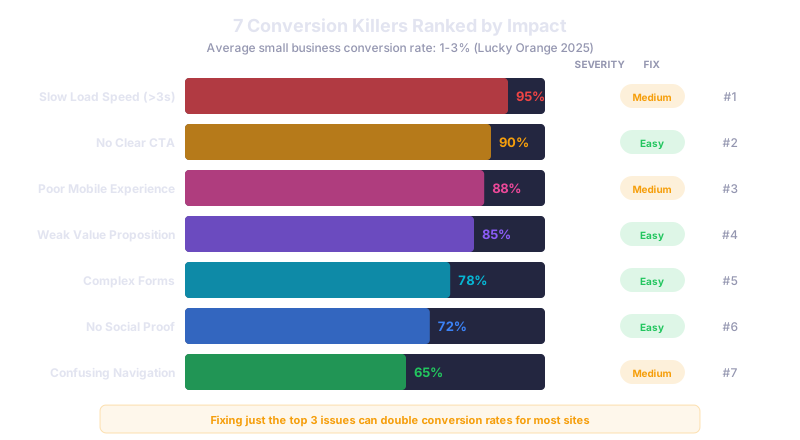
Your website gets traffic. People show up, look around, and leave. No calls, no form submissions, no sales. You are not alone: the average small business website converts between 1% and 3% of visitors into customers. That means 97 out of every 100 visitors do nothing.
Short answer: Most websites fail to convert because of slow load times, missing or weak calls to action, poor mobile experience, unclear value propositions, complex forms, no social proof, or confusing navigation. The good news: most of these are fixable in a week or less.
1. Slow Load Speed
The ideal website load time is under three seconds. Every additional second increases bounce rates dramatically. Faster sites rank better in search, perform better in ads, and keep visitors engaged long enough to take action.
Test your speed at Google PageSpeed Insights. Common fixes include compressing images, enabling browser caching, using a CDN, and removing unused plugins or scripts.
2. No Clear Call to Action
If your visitors do not know what to do next, they will do nothing. Every page needs a clear, visible call to action that tells visitors exactly what step to take. "Contact Us" buried in the footer is not enough.
Place your primary CTA above the fold on every key page. Use action-oriented language: "Get Your Free Quote" converts better than "Submit." Make the button visually distinct with contrasting color.
3. Poor Mobile Experience
More than half of web traffic comes from mobile devices. If your site is hard to navigate on a phone, with tiny text, buttons too close together, or horizontal scrolling, you are losing the majority of your potential customers.
Test your site on an actual phone, not just the browser's responsive mode. Pay attention to tap targets, form usability, and page load speed on mobile connections.
4. Weak Value Proposition
Your homepage has about five seconds to answer: "Why should I choose you?" If visitors cannot immediately understand what you offer, who it is for, and why you are different, they will bounce.
Lead with benefits, not features. "We help restaurants save $50,000/year on delivery commissions" is stronger than "We offer online ordering solutions."
5. Complex Forms
Reducing form fields from four to one can increase sign-ups by 50%. Research shows 17% of shopping cart abandonments happen because of a long and complicated checkout process.
Only ask for information you absolutely need at the first point of contact. Name, email, and a brief message is enough for most service businesses. You can collect more details later.
6. No Social Proof
People trust other people more than they trust your marketing copy. If your website has no reviews, testimonials, case studies, or client logos, visitors have no reason to believe your claims.
Add testimonials to your homepage and service pages. Include specific results when possible: "Increased our online orders by 40% in three months" is more convincing than "Great service."
7. Confusing Navigation
If visitors cannot find what they are looking for within two clicks, they leave. Complex mega-menus, inconsistent naming, and buried contact information all kill conversions.
Keep your main navigation to five or six items. Include your phone number and a CTA button in the header of every page. Use clear, descriptive labels instead of clever ones.
What This Means for Your Business
You do not need a complete redesign. Start with the highest-impact, easiest fixes: add clear CTAs, speed up your site, and add social proof. These three changes alone can double conversion rates for most small business websites.
The average Google Ads conversion rate across all industries is 7.52%, significantly higher than organic because those visitors have high intent. If your paid traffic is not converting either, the problem is definitely your website, not your marketing.
Related reads:
Tired of paying for traffic that does not convert? We audit websites, identify conversion blockers, and fix them. Get a free conversion audit.