About 70.22% of online shopping carts are abandoned (Baymard Institute, 2025), and Baymard estimates roughly $260 billion in lost-but-recoverable orders across the US and EU. The good news: recovering some of that revenue is one of the most mechanical wins in ecommerce, because a triggered abandoned-cart email flow earns more per recipient than any other email a store sends.
Short answer: About 70% of ecommerce carts are abandoned (Baymard Institute, 2025), so a triggered abandoned-cart email flow is one of the highest-ROI automations a store can run - Klaviyo benchmarks put abandoned-cart flows at the highest revenue per recipient of any email type ($3.65 average, $28.89 for top-10% brands). Build a 3-email cart sequence (a reminder at about 1 hour, an objection-handler at about 24 hours, a final nudge at about 48 hours), then chain it to a post-purchase flow that thanks the buyer, sets shipping expectations, and drives the second order - email overall returns about $36 per $1 spent (Litmus). Do not lead with a discount; solve the real reason people leave, which is unexpected extra costs at checkout (the #1 cited reason at 39% - Baymard).
Why abandoned-cart flows are the highest-ROI email you can send
Email is already the highest-return channel most stores have - Litmus puts its ROI at about $36 for every $1 spent (Litmus, 2025), higher than any other channel. Abandoned-cart flows sit at the very top of that range. In Klaviyo's benchmark of more than 143,000 abandoned-cart flows, they drove the highest average revenue per recipient of any flow type: $3.65, with a 3.33% average placed-order (conversion) rate and a 50.5% average open rate (Klaviyo, 2024). Top-10% brands pushed that to $28.89 per recipient and a 7.69% conversion rate.
The reason the math is so good is that a cart-abandoner is not cold outreach. They found your store, chose a product, and started checkout - you have already earned the attention that campaigns spend money to buy. A cart flow simply recovers a sale that was one small friction point away from closing.
The 3-email abandoned-cart sequence that recovers the sale
You do not need a complicated flow. A three-email sequence covers almost all of the recoverable revenue:
- Email 1 (~1 hour): the simple reminder. Show the cart contents with product images and a one-click button back to checkout. No discount. Many carts are abandoned to a distraction, not a decision - a timely nudge is often all it takes.
- Email 2 (~24 hours): handle the real objection. This is where you address shipping cost and speed, sizing, returns, and trust (reviews, guarantees, secure-checkout badges). Answer the question that actually stopped them.
- Email 3 (~48 hours): the last nudge. Only here do you consider urgency ("your cart is about to expire") or a modest incentive - as a last resort, not a reflex.
Don't lead with a discount - fix the reason people actually leave
Here is the mistake almost every store makes: attaching a coupon to the first abandoned-cart email. Baymard's data shows why that is backwards. The #1 reason shoppers abandon at checkout is unexpected extra costs - shipping, tax, and fees - cited by 39% of abandoners (Baymard Institute), far ahead of any other cause.
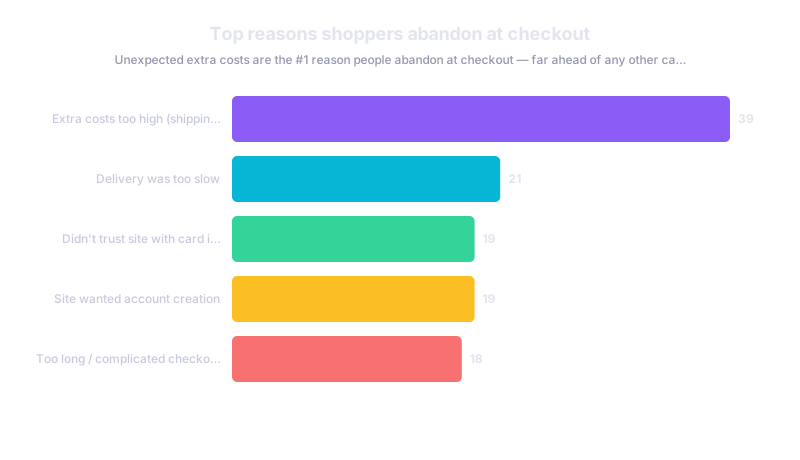
A discount does not fix a transparency problem - it just trains your best customers to abandon on purpose because they have learned the coupon is coming, and it quietly taxes your margin on every recovered order. The higher-leverage move is to make total cost, shipping, and any free-shipping threshold visible before checkout begins, so the surprise never happens. Then your cart flow reinforces a store people already trust instead of papering over a leak. Many of the same issues show up in our breakdown of why your website isn't converting.
When you do test incentives, test them deliberately. As Tim Akers, founder of Akers Digital, puts it in Klaviyo's benchmark report: "The ability to A/B test flows is critical. Test out different offers and the timing of the sequence to see what version works best for your brand."
Post-purchase flows: where repeat revenue is won or lost
Most stores obsess over the abandoned-cart flow and ignore the one that follows the sale - which is exactly backwards, because the post-purchase flow is where lifetime value is built. Post-purchase emails see open rates almost 17% higher than the average email automation (Klaviyo, 2025), giving you a rare window of genuine attention right after someone has spent money.
A strong post-purchase sequence runs roughly: order confirmation, shipping and expectation-setting, product onboarding or how-to, a review request, and finally replenishment or a relevant cross-sell. The goal of the early emails is not to sell again immediately - it is to make the first purchase feel great so the second one happens at all.
The biggest leak is the jump from first to second order, and the usual culprit is over-emailing. As Adam Kitchen, CEO of Magnet Monster, explains: "Most brands see the biggest drop-off from first to second purchase, normally because they bombard the user with such a high frequency of emails that they churn before you're able to convey value to them on the channel." The fix is counterintuitive - you win repeat revenue by emailing less, and better. Zac Fromson, co-founder of Lilo Social, frames the stakes: "The post-purchase journey is one of the most powerful marketing touch points because it's the crossroads where brands either fall flat or earn long-term loyalty."
How to measure whether your flows are working
Track three things per email and per flow: revenue per recipient (RPR), placed-order (conversion) rate, and open/click rates. RPR is the number that matters most, because it captures both how many people convert and how much they spend. Benchmark it against Klaviyo's figures - a 3.33% average abandoned-cart conversion rate versus 7.69% for top-10% brands - so you know whether you are average or leaving money on the table.
Watch your unsubscribe rate and total email frequency alongside revenue; a flow that recovers a sale today but churns the subscriber is a bad trade. And attribute recovered revenue to the flow, not the store overall, so you can prove the automation is doing work a batch campaign wouldn't. For the full picture, see our guide on how to measure digital marketing ROI in 2026.
What This Means for Your Business
If you run a store with no abandoned-cart flow, this is the single fastest email-revenue win available - start there. Build the three-email cart sequence, then add a post-purchase flow before you layer on any more broadcast campaigns. Fix checkout cost transparency first, so the flow reinforces a store people already trust rather than bribing them past a leak you never closed.
Semark builds and wires up the abandoned-cart and post-purchase email flows that recover this revenue for you. See our ecommerce marketing services, or get a flow audit.
