
57% of businesses found their current accountant through a peer referral, while just 3% chose one through advertising (TaxDome 2025 Niche Business Accounting Report, via CPA Practice Advisor). If most of your growth walks in through trust, then marketing that only switches on for four months a year is leaving the other eight months of relationship-building on the table.
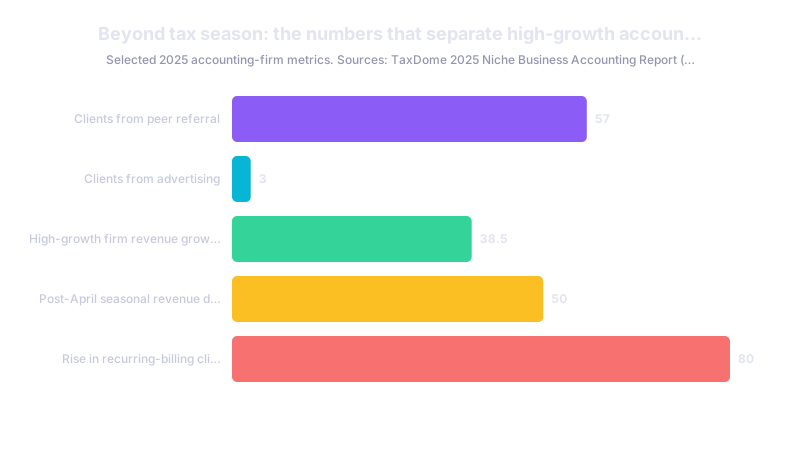
Short answer: Accounting and bookkeeping firms grow beyond tax season by turning referrals into a repeatable system, building visible authority (reviews, a niche, and thought-leadership content), and getting found in local and AI search year-round. Referrals still dominate discovery - 57% of businesses find their accountant through a peer referral and only 3% through advertising (TaxDome 2025 report) - but the fastest-growing firms also spend twice as much on marketing (2.1% of revenue vs. 1%) and grow revenue 38.5% a year (AAM 2025-26 Marketing Budget Benchmark Study). The firms that escape seasonality package monthly bookkeeping and advisory into recurring engagements, which firms report drives an estimated 80% increase in clients on recurring billings (Thomson Reuters, 2025).
Why accounting firm marketing breaks after April 15
The core problem is seasonality. Firms report post-April revenue drops of up to 50% once tax filings clear, which drives real financial strain and operational uncertainty (Paul Peterson, Managing Partner and CEO at Wiss, writing in Accounting Today, 2025). When your revenue is built on one-off, compliance-only engagements, you rebuild demand from zero every winter.
Peterson names the structural cause directly: "Hourly billing and one-off engagements limit growth and deepen seasonality" (Accounting Today, 2025). Marketing that only turns on in January makes it worse - you are cold-starting your pipeline at the exact moment every competitor is shouting the loudest. The fix is a mindset shift from seasonal transactions to year-round relationships, and it starts with where clients actually come from.
Referrals still win - so make them a system, not luck
Referrals are not a nice-to-have; they are the channel. 57% of businesses found their accountant through a peer referral versus 3% through advertising (TaxDome 2025 report, via CPA Practice Advisor). That gap tells you where to spend your energy: not on ads, but on becoming referable and making the ask deliberate.
Trust is the currency, and it compounds slowly. A documented referral process - who you ask, when you ask (right after a win, not at year-end), and how you make it easy - beats hoping satisfied clients happen to mention you. Pair that with a review engine, because public proof does the same work at scale: consistent Google reviews turn a private recommendation into a signal every prospect and every search engine can see. If you want a repeatable playbook, start with our guide to getting more five-star reviews.
Get found the way buyers actually search: local + AI
When a referral isn't in the room, prospects search - and search now has two front doors. The first is local: "accountant near me" and "bookkeeper for [industry]" queries are won with strong local SEO and a complete, active Google Business Profile. This is the highest-intent traffic you can capture, and most firms under-invest in it. Our local SEO guide for service businesses walks through the setup.
The second door is AI search, and the ranking logic is different. In a study of 75,000 brands, brand web mentions correlated with AI Overview visibility at 0.664, versus just 0.218 for backlinks - and the most-mentioned brands averaged about 169 AI Overview mentions, roughly 10x the ~14 of the next quartile down (Ahrefs, May 2025). The lesson: to get cited by ChatGPT, Perplexity, and Google's AI Overviews, you need to be talked about, not just linked to. That matters because AI Overviews now cut the click-through rate on the #1 organic result by about 58% (Ahrefs, December 2025) - if the AI answer doesn't mention you, the click may never happen. For a deeper look, see how ChatGPT chooses businesses to recommend.
Pick a niche and prove authority with content
Specialization is defensible in a way general practice never is. Businesses will pay up to 25% more for industry-specific offerings, and 98% of businesses that leave a specialist move to another specialist rather than back to a generalist (TaxDome 2025 report, via CPA Practice Advisor). A niche makes you the obvious answer, and it makes your content sharper.
It also happens to be exactly what AI search rewards. In the "GEO: Generative Engine Optimization" study, structuring content for extraction lifted generative-search visibility by up to 40%, with adding direct quotations the single most effective tactic (+41%) and adding statistics close behind (+33%); citing authoritative sources produced an outsized gain for lower-ranked pages (Aggarwal et al., Princeton/Georgia Tech, KDD 2024). Those figures come from an academic benchmark rather than live local-business queries, so treat them as directional - but the direction is clear: write authority content that answers real client questions (entity structure, R&D credits, cash-flow planning, industry-specific bookkeeping) and back every claim with a source and a stat.
Turn tax clients into year-round revenue
The deepest fix for seasonality is not a marketing tactic at all - it's your engagement model. Package monthly bookkeeping, quarterly planning, and advisory into recurring engagements, and the post-April cliff flattens. Accounting firms that made this shift to value-based, recurring pricing estimate an 80% increase in the number of clients on recurring billings and about a 25% increase in annual revenue within the first 12 months (Thomson Reuters, 2025 - firms' own estimates, not a measured outcome).
Recurring revenue does double duty: it smooths the cash-flow cycle and it funds the consistent, off-season marketing that referrals and AI both reward. It also gives you something worth marketing all year instead of a once-a-year transaction. And the payoff for spending consistently is real - the fastest-growing firms grew revenue 38.5% while investing 2.1% of revenue in marketing, twice the rate of everyone else (AAM 2025-26 Marketing Budget Benchmark Study, 87 firms). As Hinge Managing Partner Liz Harr put it: "the accounting industry tends to be risk averse and invests less than most other professional services industries. But the data shows that those that spend more on marketing are getting superior results." For help sizing your own number, see how much to spend on digital marketing.
What This Means for Your Business
The firms that beat seasonality do the same four things, in order:
- Build a referral system and review engine first. That's where 57% of clients come from (TaxDome 2025) - document the ask and collect reviews all year, not just in April.
- Invest in local and AI visibility year-round. A complete Google Business Profile plus being mentioned across the web is what gets you found and cited now that AI Overviews cut top-result clicks by ~58% (Ahrefs, 2025).
- Choose a niche and publish authority content structured for extraction. Specialists command up to 25% higher fees and keep clients (TaxDome 2025), and quote- and stat-rich content earns AI citations (GEO study, KDD 2024).
- Package advisory and bookkeeping into recurring revenue. It kills the post-April cliff and funds the consistent marketing everything else depends on.