
Businesses that add photos to their Google Business Profile receive 42% more requests for directions on Google Maps and 35% more clicks through to their websites than those that don't (Google, via RioSEO). For a restaurant, that profile is where the "where should we eat?" decision actually gets made.
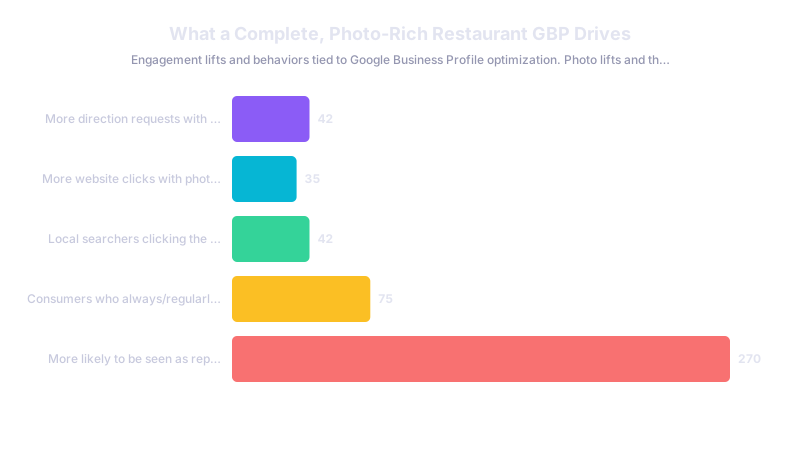
Short answer: To optimize a restaurant's Google Business Profile, set the most specific primary category (e.g., "Italian restaurant," not "restaurant") - it's the #1 overall local ranking factor in Whitespark's 2026 survey - then keep it stocked with fresh photos, a current menu, accurate hours, and a steady flow of new reviews you reply to. Google reports that adding photos drives 42% more direction requests and 35% more website clicks, and that a complete profile makes customers 2.7x more likely to view you as reputable. Treat the profile as a living channel: post regularly, add a couple of photos a month, and ask for reviews after every good visit.
Why Your GBP Is Your Most Valuable Restaurant Listing
Your Google Business Profile is the card diners see before they ever reach your website - hours, photos, menu, and reviews all in one place. Google reports that a complete profile makes customers 2.7x more likely to view a business as reputable, and businesses with a complete profile are 50% more likely to be considered for a purchase (Google, via Backlinko). Meanwhile, 42% of people who conduct a local search click on a result inside the Google Maps Pack (Backlinko) - so a strong profile isn't a nice-to-have, it's the storefront.
The mindset shift matters more than any single tactic. Treat the GBP as owned real estate you maintain every week, not a phone-book entry you fill out once and forget. That's exactly why it's the cheapest place to out-market a better-funded competitor: the winners aren't spending more, they're just showing up.
Nail Your Category, Name, and Attributes First
Get the foundation right before you chase anything else. The primary Google Business Profile category is the number-one overall local ranking factor in Whitespark's 2026 Local Search Ranking Factors report, and 8 of the top 10 Local Pack ranking factors come directly from the GBP (Whitespark, 2026). Completeness, in other words, is leverage.
Whitespark founder Darren Shaw puts the category point plainly: "This is one of the most important things you can optimize, so you must choose the category that most closely reflects the term that you want to rank for" (Whitespark). Pick the most specific primary category that fits - "Sushi restaurant," "Mexican restaurant," "Pizza restaurant" - rather than the generic "Restaurant," then add relevant secondary categories.
From there, fill in the attributes diners actually filter by:
- Outdoor seating, takeout, delivery, and dine-in
- Reservations and accepts walk-ins
- Dietary options (vegan, vegetarian, gluten-free)
- Wheelchair accessible entrance and restroom
Photos and Menu: The Conversion Engine
Photos do double duty - they rank and they convert. Google's own data shows profiles with photos get 42% more direction requests and 35% more website clicks than profiles without them (Google, via RioSEO). Add roughly two fresh photos a month and cover the full range: food, interior, exterior, and team. Stale galleries quietly lose impressions.
For the menu, use the native GBP menu editor and "Popular dishes" rather than only linking a PDF. Native menus are searchable and match a diner's query to a specific dish; a PDF is a dead end. Keep pricing and items current so what search shows matches what the kitchen serves.
Reviews: Volume, Recency, and Replies
Reviews are both proof and a ranking signal. Some 75% of consumers say they "always" or "regularly" read online reviews when researching local businesses (BrightLocal, via Backlinko), and native review quantity and rating are among the heaviest Local Pack signals in Whitespark's 2026 report.
The trap is treating reviews as a one-time push. Shaw's advice: "I did a whole video recently on how important it is to get reviews coming in on a consistent basis. It's an underrated ranking factor" (Whitespark). Build a steady cadence - ask after every good visit - rather than a single burst. And reply to every review, good and bad; replies signal an active, managed profile to both diners and Google. If you want a repeatable system, see our guide on how to get more five-star reviews.
Keep It Live: Posts, Hours, and Q&A
A profile that looks alive gets recommended. Publish Google Posts for specials, events, and seasonal menus - it's free visibility right on your card. Keep hours accurate for holidays and one-off events so you show as "open" exactly when a hungry searcher is looking; hours are one of the surest ways to lose a walk-in when they're wrong.
Seed and answer the Q&A section yourself with the questions you hear most - parking, reservations, dietary options - so the answers come from you, not a guessing stranger. Where available, turn on messaging and add ordering or reservation links. For the broader playbook beyond restaurants, our Google Business Profile optimization guide and local SEO guide for service businesses go deeper.
Don't Forget AI Search
AI answer engines increasingly summarize local results, and they lean on the same signals - consistent brand presence and clear, factual pages. An Ahrefs study of 75,000 brands found brand web mentions correlate with AI Overview visibility far more strongly than backlinks: 0.664 versus 0.218 (Ahrefs, May 2025). A consistent, well-maintained GBP and menu feed those answers.
The academic GEO study points the same direction: on a synthetic benchmark, adding quotations and statistics to content were the top-performing tactics, lifting AI visibility by up to roughly 40% (Aggarwal et al., KDD 2024) - figures from an academic benchmark, not proven on local-business queries, but the spirit applies to your site and menu pages. Notably, keyword stuffing hurt visibility in the same study. Practically: keep your NAP (name, address, phone) identical across your site, GBP, and every directory so the machines never see a contradiction.
What This Means for Your Business
Your Google Business Profile is the single highest-leverage free marketing asset a restaurant owns - so treat it like a weekly job, not a one-time setup. The compounding wins are boring on purpose: a specific primary category, two fresh photos a month, a current native menu, a steady stream of reviews you reply to, and regular posts. Small, consistent maintenance beats a big one-time optimization that goes stale by next quarter. Chasing the exact percentage weight of each ranking factor is a distraction; the profile that looks alive, answers questions, and matches reality is the one Google - and increasingly AI search - trusts enough to recommend.
Want your restaurant's Google Business Profile managed for you - photos, posts, reviews, and menu kept current every week? See Semark's restaurant marketing services, or get a free profile audit.