
A programmatic setup can publish thousands of URLs from a single template and a spreadsheet, but scale is not the same as demand: 86% of the articles ranking in Google Search are still written by humans, and 82% of the articles cited by ChatGPT and Perplexity are too (Graphite, 2025). Volume is the easy part. Earning the authority that makes those pages rank, convert, and get cited is the whole job.
Short answer: A programmatic content engine for SaaS works in sequence, not all at once. Build real topical authority with a cluster of genuinely useful editorial pages first, then use programmatic templates to scale that authority across the long-tail query surface, and tie every page to a real user journey so it drives signups instead of just impressions. Pages on high-authority sites reach traffic roughly 57% faster than low-authority ones (Graphite, via Growth Memo, 2025), while thousands of thin templated pages can rack up impressions and convert almost no one. In 2026, that same authority is what gets your brand cited by AI Overviews and ChatGPT, where branded web mentions out-predict backlinks by roughly 3-to-1 (Ahrefs, 2025).
What a programmatic content engine actually is
Programmatic SEO is a production method: you take one template and a structured dataset and generate many pages that target a repeatable query pattern. For SaaS, the classic patterns are
That is a tactic, not a strategy. It is worth separating from product-led SEO, the approach Eli Schwartz popularized in his book Product-Led SEO: the idea that content should map to a real buyer journey and show how your product solves the problem behind the query. Programmatic is how you scale pages. Product-led is why any of them should exist. Point a template at a spreadsheet with no journey behind it and you get lots of pages with no reason to convert.
The thesis of this guide is about order. Topical authority comes first, programmatic scale second, and each page maps to a specific search demand and a specific step in someone's decision. Get the sequence right and scale multiplies your results. Get it backwards and scale multiplies your liabilities.
Step 1: Build topical authority before you scale
Authority is a multiplier, and the data shows it compounds through speed. A Graphite study analyzed by Kevin Indig found that pages on sites with high topical authority gain traffic about 57% faster than pages on low-authority sites (Graphite, via Growth Memo, 2025). When you finally template a thousand pages, you want them landing on a domain that already has that tailwind, not one that is starting from zero on every URL.
The mechanism is the cluster model. You build a pillar page on a theme, then surround it with 10 to 15 supporting articles that genuinely cover the subtopics. New pages inherit the credibility the cluster has already earned, so they index and rank faster than isolated pages would. Indig frames the goal as owning a topic the way you would track share of voice: measure the share of a topic's traffic and coverage you actually control, and expand it deliberately.
As Indig puts it, "True topical authority isn't about checking boxes. It's about earning the perception of being an authority in a space from humans and algorithms alike" (Growth Memo, 2025).
The practical rule: pick one theme you can genuinely out-cover your competitors on, and prove you can rank for it with real editorial pages before you touch a page template. If you can't win a topic with 15 hand-built articles, a thousand templated ones won't save you.
Step 2: Design programmatic pages around real demand
The most common failure mode is building pages around the data you happen to have rather than the queries people actually search. A programmatic strategy can generate enormous traffic that converts almost no one when the pages answer questions nobody is asking with buying intent. High session counts on a programmatic project are a vanity metric when the conversion column is empty.
Two guardrails keep templates honest.
First, hold a real quality bar. Each page needs unique, differentiated content, not spun boilerplate with a variable swapped in. Google filters thin templated pages, and generative engines simply won't cite them. If the only thing that changes between two pages is a city name or a product name, you're building crawl budget waste, not an asset.
Second, map every template to a funnel stage:
| Template pattern | Funnel stage | Job |
|---|---|---|
| Bottom | Capture switching intent, convert |
| Bottom | Win the comparison, convert |
| Middle | Qualify and educate |
| Top | Brand and citation plays |
Step 3: Make product-led content the payload, not filler
Once a template is pointed at real demand, the content on the page has to do the selling. Product-led content shows the buyer exactly how your product solves the problem the query implies, so the page generates leads instead of just sessions. That is the difference between a page that ranks and a page that pays for itself.
The most defensible pages carry something only your product can credibly provide: real product screenshots, a working calculator, downloadable templates, or interactive elements pulled from your own data. Competitors can copy your prose. They can't copy a tool that runs on your product.
This is also where the human-versus-AI question gets settled by evidence. Human-written content still wins where ranking and citation happen: 86% of Google-ranking articles and 82% of the articles cited by ChatGPT and Perplexity are human-written (Graphite, 2025). The takeaway isn't "never use AI." It's to use AI to draft and scale, and use humans to add the product depth, judgment, and original detail that make a page worth ranking and citing. Purely generated filler is exactly what the filters and the models are learning to discard.
Step 4: Optimize the engine for AI search, not just Google
The search surface has split in two, and programmatic pages now have to earn visibility in both. That changes what you optimize for.
Start with brand. Across 75,000 brands, Ahrefs found that branded web mentions correlated with Google AI Overview visibility at 0.664, versus just 0.218 for backlinks, roughly three times the predictive power (Ahrefs, 2025). For an AI-search era, that means the mentions, reviews, and citations your brand accumulates across the web matter more than the raw link count, and your content engine should be built to generate reasons to be mentioned, not just links to be pointed at.
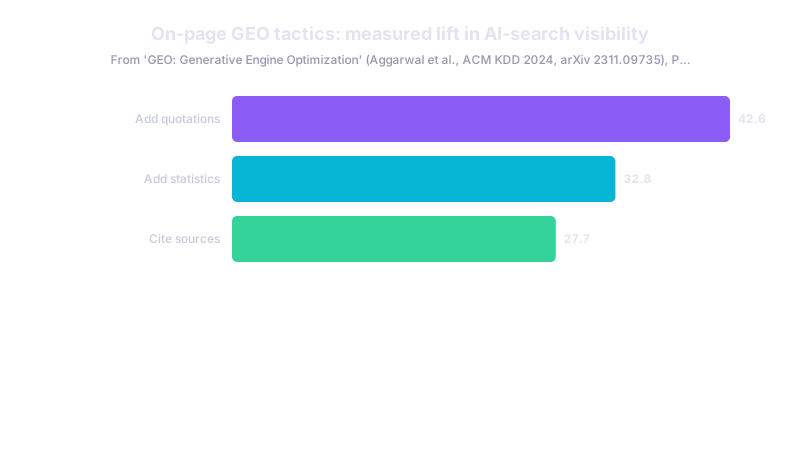
On the page itself, structure matters. A study from Princeton, Georgia Tech, IIT Delhi, and the Allen Institute for AI ("GEO: Generative Engine Optimization," ACM KDD 2024) tested which on-page tactics increase visibility inside generative answers. Adding quotations was the single most effective method, lifting the study's visibility metric by about 43%, followed by adding statistics (about 33%) and citing sources (about 28%), with the headline result that GEO methods can boost visibility by up to 40% (Aggarwal et al., 2024). Keyword stuffing, notably, went the other way and reduced visibility. These are upper-bound figures from a synthetic academic benchmark and vary by domain, so treat them as directional rather than guaranteed lift, but the direction is clear and it maps cleanly onto how you should build programmatic pages.
The zero-click reality raises the stakes. Ahrefs found that the presence of an AI Overview correlates with a 58% lower average click-through rate on the top-ranking organic result (Ahrefs, 2026), and Pew Research found that users clicked a search result just 8% of the time when an AI summary appeared, versus 15% when it didn't (Pew Research Center, 2025). Google disputes elements of the Pew methodology, but the pattern across sources is consistent: fewer people click through when a summary answers them in place. The implication for a programmatic engine is direct. Structure your pages to be quoted and cited, with clear claims, real statistics, and named sources, so that even when the click doesn't happen, your brand is the one the AI names.
Step 5: Measure the engine like a growth loop, not a blog
A programmatic engine has hundreds of moving parts, so measure it at the template level, not the aggregate. Track signups and product-qualified leads per template, not just total organic traffic. Aggregate traffic hides the exact problem you're trying to catch: a template pulling huge impressions and zero pipeline.
From there, run it like a portfolio. Kill or consolidate templates where pages get impressions but no engagement and no conversions. Watch indexation and time-to-visibility as leading indicators, since a healthy authority position shows up as pages ranking faster, the 57%-faster effect made visible on your own dashboard.
Finally, report ROI on a realistic horizon and be honest about the source of your benchmarks. Organic and thought-leadership SEO programs commonly take multiple months to break even. First Page Sage's self-reported data attributes a 748% ROI and a roughly 9-month break-even to its thought-leadership SEO tier, drawn from proprietary campaign data (First Page Sage, self-reported, 2025). That's vendor data, not an independent benchmark, so treat it as a plausible order of magnitude rather than a promise, but it's a useful reminder that these engines are built on a quarters-long timeline, not a weekly one.
What This Means for Your Business
If you're a SaaS founder or growth lead, the worst move is to lead with a 10,000-page dump. Earn topical authority on one theme first, prove you can rank with real editorial pages, and only then template it. Programmatic scale amplifies whatever you point it at: real user journeys turn into pipeline, thin pages turn into a maintenance burden and a traffic-cliff risk the next time an algorithm or a model updates.
In the AI-search era, the engine's real job is to make your brand the cited authority. That means investing in brand mentions, original data, and product-led depth, not just link count and page count, because the pages that get quoted are the ones with something only you can say. If a template can't be tied to a specific step in someone's buying journey, it isn't a growth engine. It's technical debt with a sitemap.
For the connective tissue around this engine, see our SEO strategy guide: zero to page one in 2026 and how to get your first 100 SaaS customers. If AI search is where you need to win, our Generative Engine Optimization services and SaaS industry marketing practice go deeper.
Want a programmatic content engine that earns signups, not just impressions? Semark builds topical-authority-first SaaS SEO systems tuned for both Google and AI search. Talk to us or explore our Generative Engine Optimization services.