Only 25% of residential contractors report using AI at all (ServiceTitan, 2026) - yet nearly every scheduling and dispatch vendor markets AI as if the whole industry already runs on it. So what actually works, and what is sales copy?
Short answer: AI scheduling and dispatch for home services is real and delivering measurable results - automated call-booking, route optimization, and technician assignment - but adoption across the trades is still low, and the verified wins are efficiency and time savings, not the revenue explosions ads promise. The smart move is to automate one narrow, high-frequency task first, keep a human overseeing it, and measure the result before you expand.
The reality: most home-services firms haven't adopted AI yet
The gap between the marketing and the ground truth is wide. Across the whole US economy, about 18% of firms used AI at the end of 2025 (Federal Reserve, 2026). Adoption is lowest exactly where home-services businesses live: among the smallest firms. Fewer than 20% of firms with four or fewer employees use AI, versus 37% of firms with 250 or more employees (US Census Bureau, 2026).
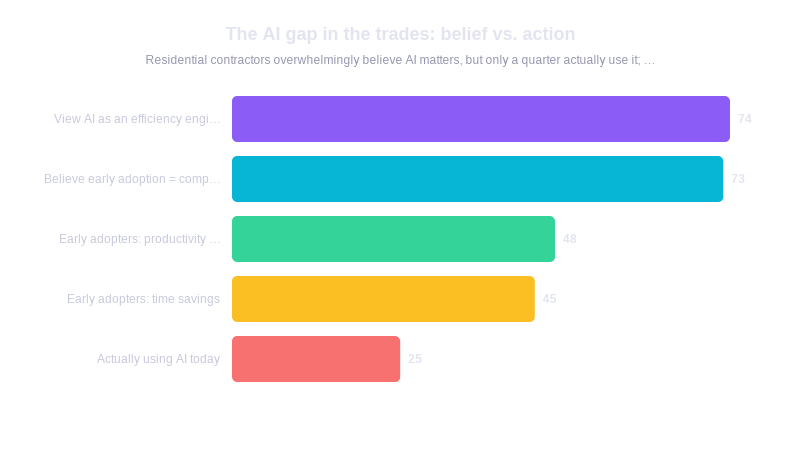
The trades-specific numbers tell the same story. In ServiceTitan's 2026 Residential State of the Trades Report - an independent survey of 1,000 residential contractors conducted by Thrive Analytics - 74% view AI as an efficiency engine and 73% believe starting early creates a competitive advantage, but only 25% are actually using it (ServiceTitan, 2026). That belief-versus-action gap is the real state of the market: most owners are convinced AI matters and haven't deployed it yet.
What AI scheduling and dispatch actually does today
Strip away the "revolutionary" language and the working use cases are concrete and narrow. Three tasks are where home-services AI earns its keep right now:
- Call and job booking. An AI voice or chat agent answers inbound calls, collects the customer's problem and address, and drops a booked job onto the schedule without a person picking up the phone. (For how this works and what it costs, see our voice AI for small business phone calls and AI answering service guides.)
- Route optimization. The system sequences the day's stops to cut drive time between jobs.
- Technician assignment. Software matches the right tech - by skill, location, and parts on the truck - to each job on the board.
Hype check: "agentic" and the efficiency-vs-revenue gap
Two pieces of marketing deserve a hard look before you sign anything.
First, the word "agentic." Vendors increasingly brand any automation as an "AI agent," but across enterprises actually deploying generative AI, only about 16% of deployments are true autonomous agents (Menlo Ventures, 2025). Most "AI dispatch" is smart automation with a human in the loop - which is fine, and often what you want, but it is not the self-driving operation the label implies. If you want the plain-English version of what an agent is and isn't, we wrote a whole explainer on AI agents for small businesses.
Second, watch what the wins actually are. In Deloitte's State of AI in the Enterprise survey, 66% of organizations report efficiency gains from AI, but only 20% are already achieving revenue growth from it - while 74% merely hope to (Deloitte, 2026). Translate that to your shop: AI scheduling will likely give your dispatcher time back and squeeze more jobs into a route. It is far less likely to, by itself, grow your top line the way a sales-focused ad implies. Efficiency is the verified benefit. Revenue is the aspiration.
Where it works - and where it still needs a human
The dividing line is repetitive volume versus judgment. High-frequency, rules-based tasks - booking a standard service call, sequencing a route, flagging which tech is closest - are where today's tools are strong. Anything requiring negotiation, an angry-customer save, a safety judgment, or a pricing exception still needs a person. Even the platforms that automate dispatch keep a dispatcher overseeing the board rather than removing them. So the honest framing is not "AI replaces your dispatcher" but "AI handles the routine so your dispatcher handles the exceptions." If you're weighing that trade-off against hiring, our piece on when to automate versus when to hire walks through the math.
What This Means for Your Business
The hype says AI will run your dispatch board. The reality, backed by the data, is more useful and less dramatic: a minority of home-services firms have adopted AI, the ones that have are saving time and lifting productivity on specific tasks, and the biggest, most reliable payoff is efficiency - not automatic revenue growth.
A practical path for an operator in the home services vertical:
- Pick one task, not a platform. After-hours call booking or route optimization are the highest-frequency, lowest-risk starting points.
- Keep a human overseeing it for at least the first few months, and measure one number - jobs per tech per day, booked calls captured, or dispatcher hours saved.
- Ignore the "agentic," "revolutionary," and revenue-multiplier claims and judge the tool on that one measured result.
- Expand only after the first task pays for itself.