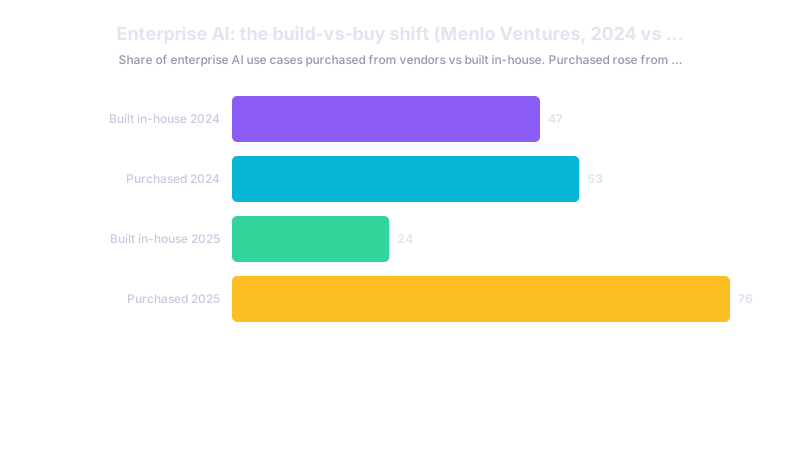
In 2025, 76% of enterprise AI use cases were purchased from a vendor rather than built in-house, up from 53% the year before (Menlo Ventures, 2025: The State of Generative AI in the Enterprise, December 2025). If large companies with dedicated AI teams are overwhelmingly choosing to buy, the build-vs-buy question for a small or mid-market business is even more lopsided than most sales pitches admit. This guide walks through an honest framework, grounded in primary-source data rather than vendor hype.
First, a reality check on who is actually using AI
Before you decide how to adopt AI, it helps to know where you really stand. Only about 17-20% of U.S. businesses report currently using AI to produce goods or services, according to the U.S. Census Bureau's Business Trends and Outlook Survey (Census Bureau, May 2026). Adoption is heavily skewed by company size: roughly 37% of firms with 250 or more employees use AI, versus under 20% of firms with four or fewer employees (Census Bureau, 2026). Between December 2025 and May 2026, AI use rose only among firms with at least 20 employees and did not change significantly among smaller firms (Census Bureau, 2026).
That matters for two reasons. First, if you are a small operator who has not deployed AI yet, you are in the majority, not behind. Second, the splashy "76% now buy" build-vs-buy statistic comes from a survey of nearly 500 enterprise decision-makers (Menlo Ventures, 2025). It is a signal worth learning from, but it is not an SMB number. Your constraints (no ML engineers, tighter budget, thinner margin for failed experiments) push you even harder toward buying than the enterprise data suggests.
What "build" and "buy" actually mean in 2026
The terms have blurred, so let us be concrete.
Buy means you use a finished product someone else maintains: a scheduling assistant, a customer-service chatbot platform, an AI note-taker, a CRM with AI features baked in. You configure it and pay a subscription. You do not touch a model or write code.
Build spans a wide range. At the light end, "building" today usually means connecting a general-purpose model (like the ones behind ChatGPT or Claude) to your own documents and writing instructions for it. At the heavy end, it means training or fine-tuning a custom model, which is rare and expensive. The Menlo Ventures report found that in production, prompt design remains the dominant customization technique, followed by retrieval-augmented generation (RAG, which is the "connect the model to your documents" approach); more advanced methods like fine-tuning and reinforcement learning are "still niche" (Menlo Ventures, 2025). In plain terms: even companies that "build" mostly write good instructions and feed the model their own data. Almost nobody trains a model from scratch.
This is the single most useful thing to internalize. When a vendor or consultant proposes a fine-tuning-first custom build, the enterprise evidence says that is the exception, not the norm. Start by assuming you will buy, or lightly assemble, before you assume you will build.
The honest track record: efficiency, not revenue
Buying is cheaper and faster, but does either path pay off? Here the honest answer is nuanced. In Deloitte's State of AI in the Enterprise survey of 3,235 leaders, 66% reported productivity and efficiency gains from AI, but only 20% said they were already achieving revenue growth from it, while 74% hoped to grow revenue in the future (Deloitte, 2026). AI today reliably saves time; it does not reliably grow the top line yet.
For a build-vs-buy decision, that reframes the math. If the realistic payoff is efficiency (hours saved on drafting, scheduling, answering repetitive questions), then a large custom build rarely justifies its cost, because a bought tool captures most of the same time savings at a fraction of the investment and risk. You should build only when the efficiency gain is both large and unavailable off the shelf.
You have probably also heard that "95% of AI projects fail." Treat that number with suspicion; it has drifted far from its source. The often-cited MIT NANDA report State of AI in Business 2025 is a preliminary, non-peer-reviewed working paper based on a small sample (roughly 52 interviews and 153 survey responses), and it explicitly cautions that its findings are directionally accurate rather than official reporting. Its actual finding is narrower: for custom, task-specific generative-AI tools, about 60% of organizations evaluated them, 20% piloted, and only 5% reached production, whereas general-purpose LLM tools like ChatGPT and Copilot moved from pilot to implementation far more often (roughly 83%). Read correctly, that report is not evidence that AI fails. It is evidence that custom builds stall while bought, general-purpose tools succeed, which is exactly the case for buying.
A five-question decision framework
Here is the framework we use with clients. Walk down it in order and stop at the first honest "build" answer.
- Does a mature product already do this? For common jobs (front-desk phone answering, appointment booking, review responses, email drafting, first-line support), a bought tool almost always exists and will be cheaper and more reliable than anything you assemble. Buy it.
- Is the job your actual competitive edge, or just overhead? Buy for overhead. Only consider building when the capability is the thing customers pay you specifically for, and no vendor serves your niche.
- Do you have proprietary data or workflow that a generic tool cannot use? If a generic tool would give generic answers because it cannot see your pricing, inventory, or case history, a light "build" (connecting a model to your own data via RAG) may be worth it. This is assembly, not a from-scratch build.
- Can you tolerate the maintenance? A bought tool is patched, secured, and improved by the vendor. Anything you build, you own forever: model updates, breakage, security, and the person who understands it. Be honest about whether you have that person.
- Is the volume high enough that per-use vendor pricing hurts? At very high volume, building on a raw model API can be cheaper than a per-seat or per-message product. If you get there, note that engineering techniques like prompt caching materially cut costs. For example, on Anthropic's API, reading from a cache costs 0.1x the standard input-token price while a five-minute cache write costs 1.25x, so a cached prompt pays for itself after the first reuse (Anthropic pricing documentation, verified July 2026; confirm current rates before you model this).
Watch the "AI agent" label
One more honesty note, because it changes what you are buying. Vendors increasingly market "AI agents," but the term is mostly aspirational today. In the Menlo Ventures data, only 16% of enterprise deployments (and 27% at startups) were genuine agents that plan, act, observe, and adapt; most were fixed-sequence or routing workflows wrapped around a single model call (Menlo Ventures, 2025). That is not a knock on those tools, many are useful, but it means "agentic" on a pricing page often describes a scripted automation. Buy the outcome the tool actually delivers, not the label. Our guide on what AI agents really are for small businesses unpacks the distinction.
What the buy path looks like in practice
For most operators, a healthy 2026 AI stack is almost entirely bought: a customer-service or receptionist tool, an AI feature inside software you already pay for, and a general-purpose assistant for drafting. Our roundups of the best AI tools for small business and what an AI chatbot actually costs are good starting points. The build (really, assemble) path enters only when you have proprietary data or a workflow no vendor serves, and even then it usually means connecting an existing model to your own information, not training your own.
If your real question is whether to automate a role at all versus hiring a person, that is a separate but related decision; we cover it in AI vs. hiring an employee.
What This Means for Your Business
The enterprise verdict is clear and the small-business verdict is even clearer: default to buying. Roughly three-quarters of enterprise AI use cases are now purchased (Menlo Ventures, 2025), the reliable payoff is efficiency rather than revenue (Deloitte, 2026), and custom builds are exactly where projects tend to stall. Reserve building for the rare case where the capability is your competitive edge, you hold data no vendor can use, and you can maintain what you own. For everything else, buy a proven tool, capture the time savings, and put your scarce attention into your actual business.
Not sure which side of the line your use case falls on? We help small and mid-market operators make this call without the hype. Talk to us about your AI decision or learn more about our AI and machine learning services.