
If you have spent any time on LinkedIn in the past year, you have seen the number: "95% of AI projects fail." It is usually delivered as a warning, sometimes as a reason to give up before you start. The stat traces back to one document - MIT NANDA's The GenAI Divide: State of AI in Business 2025 - a preliminary, non-peer-reviewed report built on structured interviews with just 52 organizations and survey responses from 153 senior leaders (MIT NANDA, July 2025). Almost nobody who repeats the number has read the report, and the report does not say what the headline claims.
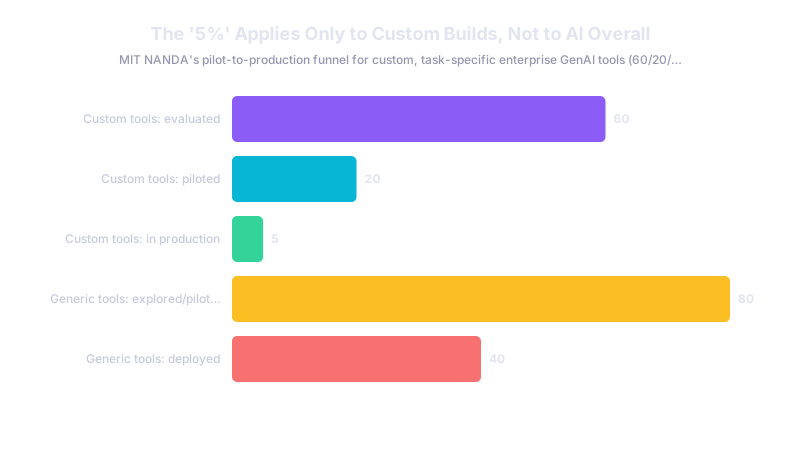
Short answer: The MIT NANDA report never says "95% of AI projects fail." It says 95% of organizations were getting zero measurable return on GenAI, and that only 5% of custom, task-specific enterprise AI tools reached production. Generic tools like ChatGPT and Copilot told the opposite story in the same report: over 80% of organizations had explored or piloted them and nearly 40% reported deployment (MIT NANDA, 2025). "AI fails" and "custom enterprise builds stall while off-the-shelf tools spread fast" are very different conclusions - and only one of them is true.
Where the 95% Number Actually Comes From
Here is the exact sentence from the report's executive summary: "Despite $30-40 billion in enterprise investment into GenAI, this report uncovers a surprising result in that 95% of organizations are getting zero return" (MIT NANDA, 2025). Note the wording. It is not "95% of projects fail." It is "95% of organizations are getting zero return" - measured as P&L impact, meaning a direct hit to profit and loss statements.
That is a much higher bar than "the project worked." A customer-service assistant that cuts your response time in half but does not show up as a line item on your income statement counts as "zero return" under this definition, even if your team loves it and your customers are happier. The report itself acknowledges this, noting that widely adopted tools "primarily enhance individual productivity, not P&L performance" (MIT NANDA, 2025).
The other half of the myth - the "5%" - is even more specific. It refers only to custom, task-specific enterprise systems. In the report's words: "Sixty percent of organizations evaluated such tools, but only 20 percent reached pilot stage and just 5 percent reached production" (MIT NANDA, 2025). That is a funnel for bespoke, integrated software builds. It is not a statement about whether AI works for your business.
The Report Contradicts the Headline in Its Own Words
The most important line in the entire report is one that never makes it into the LinkedIn posts. Right below the pilot-to-production numbers, the authors add a section titled "Research Limitations": "These figures are directionally accurate based on individual interviews rather than official company reporting. Sample sizes vary by category, and success definitions may differ across organizations" (MIT NANDA, 2025).
Read that again. The authors themselves - Aditya Challapally, Chris Pease, Ramesh Raskar, and Pradyumna Chari - describe their own numbers as "directionally accurate," drawn from interviews rather than audited company data, with sample sizes that vary and success definitions that differ between organizations. This is a preliminary research deck, not a peer-reviewed study. Treating "5%" as a hard, universal failure rate misrepresents what its own authors said it was.
And within the same report, generic tools look nothing like a 95% failure story. The authors write that tools like ChatGPT and Copilot are "widely adopted. Over 80 percent of organizations have explored or piloted them, and nearly 40 percent report deployment" (MIT NANDA, 2025). The report's real thesis is not that AI fails. It is that off-the-shelf tools spread easily while heavy, custom enterprise builds stall on "brittle workflows, lack of contextual learning, and misalignment with day-to-day operations." That is a design lesson, not a death sentence.
What the Real Adoption Data Shows
If AI were genuinely failing 95% of the time, you would expect adoption to be collapsing. It is not. According to the US Census Bureau's Business Trends and Outlook Survey, about 19.8% of US firms reported using AI as of May 2026, and use has been climbing - rising among firms with 20 or more employees between December 2025 and May 2026 (US Census Bureau, 2026). Adoption scales sharply with company size: under 20% for firms with four or fewer employees, versus 37% for firms with 250 or more (US Census Bureau, 2026).
The measurement gets even more interesting when you change the lens. The Federal Reserve notes that while roughly 18% of firms had adopted AI by late 2025 (firm-weighted), about 78% of the labor force works at a company that has adopted AI (employment-weighted), and roughly 41% of workers report personally using generative AI at work (Federal Reserve, 2026). Same economy, three very different numbers - depending on whether you count companies, employees, or actual users. None of them look like failure.
By sector, the Fed's data shows professional services around 33% adoption and financial services around 30%, while accommodation and food services sits near 8% (Federal Reserve, 2026). The pattern is not "AI doesn't work." It is "AI has landed hard in cognitive, document-heavy work and lightly in hands-on service industries." If you run a professional-services or finance-adjacent business, your competitors are already using these tools. If you run a restaurant or a trades company, you are early - which is an opportunity, not a warning.
"Zero Revenue" Is Not the Same as "Failed"
The strongest evidence that the failure narrative is a definition problem comes from Deloitte. In its State of AI in the Enterprise report, based on a survey of 3,235 leaders, 66% of organizations said they were already seeing productivity and efficiency gains from AI. But only 20% said AI was already growing their revenue, versus 74% who hoped it would in the future (Deloitte, 2026).
That gap explains the whole "95% zero return" story. Most AI today pays off as efficiency - fewer hours on repetitive tasks, faster drafts, quicker answers - not as new top-line revenue. If you define success narrowly as "measurable revenue growth this quarter," most deployments look like failures. If you define it the way a small-business owner actually experiences it - "my team spends less time on grunt work" - most deployments are quietly succeeding. For a practical look at where those hours go, see our guide on simple AI automations for small business.
The Build-vs-Buy Trap Behind the Stalls
The MIT NANDA report reserves its harshest numbers for custom builds, and that is the actionable insight for a small business. The 5% production rate applies to bespoke, integrated systems - the kind that require months of engineering and rarely survive contact with messy real-world workflows. Generic, purchased tools fared far better in the same report.
The broader market has already voted with its wallet. Menlo Ventures' 2025 enterprise report found that 76% of AI solutions are now purchased rather than built in-house, up from 53% the prior year (Menlo Ventures, 2025). That is enterprise data, not a small-business statistic - but the direction of travel is the lesson. Even large companies with real engineering budgets are concluding that buying and configuring a proven tool beats building a custom system from scratch. For a business owner with no ML team, that lesson is even more important: start with tools that already exist. Our roundup of the best AI tools for small business in 2026 is a reasonable place to begin, and if you are weighing automation against headcount, when to automate versus when to hire walks through the tradeoff.
A related caution: much of what is marketed as autonomous "AI agents" is still closer to scripted automation than the fully independent worker the term implies. Be skeptical of pitches that promise a system that runs your operations unsupervised. If you want the honest version of what agents can and cannot do today, we cover it in what AI agents are and how small businesses can use them.
What This Means for Your Business
The "95% of AI projects fail" statistic is folklore built on a real report that says something narrower and more useful. Three takeaways should shape how you act:
First, ignore the scary headline but read the actual lesson. The stalls in the MIT NANDA report were concentrated in expensive, custom-built systems - 5% production for bespoke tools - while off-the-shelf tools like ChatGPT saw over 80% pilot rates in the same study (MIT NANDA, 2025). Buy before you build.
Second, define success honestly before you start. Deloitte found 66% of organizations getting efficiency gains and only 20% getting revenue growth (Deloitte, 2026). If you expect a chatbot to grow revenue next quarter, you will be disappointed. If you expect it to save your team hours, you will likely succeed. Pick metrics you can actually see.
Third, remember the odds are with early, sensible adopters. Adoption is still under 20% for the smallest firms (US Census Bureau, 2026), which means a well-chosen, well-scoped tool is a genuine edge in most local markets - not a coin flip you are likely to lose.
The failure rate you should worry about is not 95%. It is the failure rate of jumping to a complicated custom build when a configured, purchased tool would have done the job. If you want a straight answer about what AI can realistically do for your specific operation - and what it cannot - talk to us about AI and machine learning or get in touch through our contact page. We will tell you honestly whether a project is worth doing before you spend a dollar on it.