
A cache hit costs one-tenth the price of the tokens it replaces (Anthropic, 2026). If your business runs an AI chatbot, a document summarizer, or any tool that calls a large language model many times a day, that single fact is worth real money - because most of what you pay for is the same text sent to the model over and over.
Short answer: You can lower an AI inference bill without changing what the tool does, using three levers. Prompt caching charges you roughly 10% of the normal input price for repeated context. Routing sends easy requests to a smaller, cheaper model instead of paying top-tier prices for every call. Batching gives you a 50% discount on work that doesn't need an instant answer. Applied to the right workload, these can meaningfully cut cost with no visible change in quality.
Only 17-20% of US businesses reported using AI in operations between December 2025 and May 2026, and adoption rose with company size - reaching 37% among firms with 250 or more employees (US Census Bureau, Business Trends and Outlook Survey, 2026). The small operators who do adopt tend to be the most price-sensitive, so knowing exactly where the bill comes from - and which levers actually move it - is the difference between "AI is too expensive" and "AI pays for itself."
Where your AI bill actually comes from
You are billed for two things on almost every AI API: input tokens (the text you send - your instructions, the customer's question, any documents or history) and output tokens (the text the model writes back). A token is roughly three-quarters of a word. Output is priced higher than input across the board.
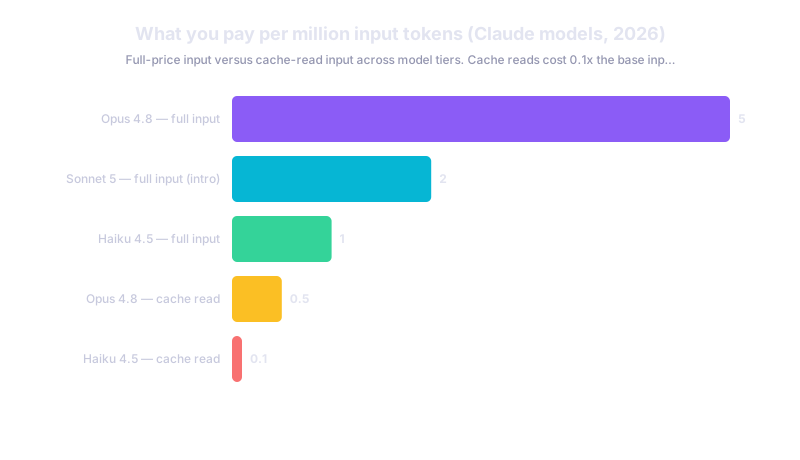
The prices vary a lot by model. On Anthropic's Claude line, for example, the current published rates are $5 per million input tokens and $25 per million output tokens for its top Opus model, versus $1 per million input and $5 per million output for its fast Haiku model (Anthropic pricing, 2026). That is a 5x difference for the same unit of work - verify current prices before you build a budget, because vendor pricing changes often.
Two patterns drive most waste. First, you resend the same instructions and reference material on every single request - a 6,000-token system prompt and knowledge base sent 10,000 times a day is 60 million tokens of repeated input. Second, you use one expensive model for everything, including questions a much cheaper model would answer just as well. The three levers below attack exactly these two patterns.
Lever 1: Prompt caching - pay 10% for the parts you repeat
Prompt caching lets the provider store the unchanging front portion of your prompt - your system instructions, a product catalog, a policy document - so it doesn't have to reprocess it on every call. The economics are published and specific: a cache read costs 0.1x the standard input price (a 90% discount), while writing to the cache costs 1.25x the standard price for a 5-minute cache or 2x for a 1-hour cache (Anthropic pricing, 2026).
Because the write premium is small and the read discount is large, caching pays for itself fast. Anthropic's own documentation states that caching pays off after just one cache read for the 5-minute duration, or after two reads for the 1-hour duration (Anthropic, 2026). In plain terms: as long as your repeated block gets reused at least once or twice before it expires, you come out ahead.
Here is a concrete, illustrative example. Say your support chatbot sends a 6,000-token block - system prompt plus a knowledge-base excerpt - on every customer message, and it handles thousands of messages an hour on the top-tier model at $5 per million input tokens.
- Without caching: that 6,000-token block costs 6,000 × $5 ÷ 1,000,000 = $0.03 per message, every message.
- With caching: the first request writes the cache at the 1.25x rate (about $0.0375, paid once). Every subsequent request within the window reads it at 0.1x - 6,000 × $0.50 ÷ 1,000,000 = $0.003 per message, ten times cheaper on that block.
Lever 2: Routing - send easy work to a cheaper model
Most businesses pick one capable model and run every request through it. But a large share of real traffic is easy: "What are your hours?", "Reset my password," "Is this item in stock?" Those don't need a frontier reasoning model. Routing means classifying each request by difficulty and sending the simple ones to a smaller, cheaper model while reserving the expensive model for genuinely hard tasks.
The savings come straight from the price gap between tiers, which you can verify on any vendor's pricing page. Sticking with the Claude example: routing a simple query to the Haiku model ($1 input / $5 output per million tokens) instead of the Opus model ($5 input / $25 output) is exactly 5x cheaper per token on both input and output (Anthropic pricing, 2026). A mid-tier model sits in between - Anthropic's Sonnet model is currently priced at $2 per million input and $10 per million output under introductory pricing that runs through August 31, 2026 (Anthropic, 2026). If half your traffic is routine and you move it from the top tier to the cheapest tier, you cut the cost of that half by roughly 80%.
You don't need a fancy machine-learning router to start. A simple rule set gets you most of the way: keyword or intent matching for the obvious FAQ questions, a length or complexity threshold, or a "customer tier" rule. Only escalate to the expensive model when a cheap-model answer is low-confidence or the task clearly requires deeper reasoning. The important discipline is to stop treating every request as if it needs your best model - because you're paying for that assumption on every call. Deciding when to reach for a bigger model at all is the same judgment we walk through in when to automate versus when to hire.
Lever 3: Batching - 50% off for work that can wait
Not everything an AI does has to happen in real time. Summarizing yesterday's reviews, tagging a backlog of support tickets, generating product descriptions for a catalog, cleaning up a spreadsheet of leads - none of that needs a two-second response. For work like this, most major providers offer a batch mode that trades speed for a steep discount.
Anthropic's Batch API applies a 50% discount on both input and output tokens for asynchronous processing, with most batches completing within an hour (Anthropic, 2026). That is a flat half-off on jobs you were going to run anyway - you just submit them as a batch and collect the results when they're done instead of demanding each answer instantly.
The best part is that these levers stack. Anthropic's documentation confirms the Batch API discount and prompt caching can be combined (Anthropic, 2026). So an overnight job that reuses a large instruction block can get both the 50% batch discount and the cache-read discount on the repeated portion. If you have recurring back-office AI tasks, sort them into "must be instant" and "can wait an hour" - and move everything in the second bucket to batch. Our roundup of simple AI automations for small business is a good place to spot which of your workflows are batch-friendly.
Putting the three levers together
Imagine an e-commerce shop running a customer-service assistant plus nightly review analysis:
- Caching on the assistant's fixed system prompt and return-policy document - the repeated context now costs about a tenth as much per message.
- Routing the flood of "where's my order" and store-hours questions to the cheap model, reserving the expensive model for complex complaints - up to 5x cheaper on the routed share.
- Batching the nightly job that reads and tags the day's reviews - a flat 50% off, stacked with caching on the shared instructions.
What This Means for Your Business
If you're already paying for AI and the bill makes you nervous, you probably don't need to switch vendors or rebuild anything. You need to (1) find the large, repeated chunk of text in your prompts and cache it, (2) stop sending easy questions to your most expensive model, and (3) move anything that can wait into a batch. These are configuration and architecture changes, not product changes - the customer experience stays the same while the invoice drops.
Two honest caveats. First, model prices and discount terms change frequently - every number in this article was verified against the vendor's live pricing on July 17, 2026, but you must re-check current rates before you commit to a budget or design. Second, the biggest savings show up when a workload genuinely has repeated context, a mix of easy and hard requests, and some work that can run asynchronously; if your usage is small and every request is unique, caching and batching won't help much, and the honest answer is that your bill is already close to the floor.
If you'd like help figuring out where your AI spend is actually going and which of these levers fits your workload, that's exactly the kind of work our team does. Explore our AI and machine learning services or get in touch for a straight assessment - no hype, just the math.


