
Nine in ten renovating U.S. homeowners hired a professional in 2024, and the median renovation ran $20,000 - with the top 10% of projects topping $150,000 (Houzz, 2025). Yet construction and contractor paid-search leads cost an average of $165.67 each (LocaliQ, 2025). That gap between high-value work and expensive clicks is exactly where most remodelers lose money on marketing.
Short answer: General contractors and remodelers sell high-ticket, high-trust work - the median 2024 renovation was $20,000 and 90% of renovating homeowners hired a professional (Houzz, 2025) - so marketing should lead with visual proof of completed projects, not price. The most cost-effective growth stack is a portfolio-driven website, strong local SEO and a complete Google Business Profile, a steady flow of reviews, and AI-search visibility - because paid search alone runs $165.67 per lead at a 2.61% conversion rate for construction and contractors (LocaliQ, 2025), the lowest conversion rate of any home-services category tracked.
Why remodelers are an underserved, high-ticket market
Renovation demand has softened from its pandemic peak but stayed durable. The 2025 Houzz & Home study - which surveyed nearly 22,000 U.S. homeowners - found the median renovation spend was $20,000 in 2024, with the top 10% of projects reaching $150,000 or more (Houzz, 2025). Critically for anyone selling these services, 90% of renovating homeowners hired a professional and 49% hired a specialty service provider (Houzz, 2025). This is not a DIY market at the high end; homeowners spending five and six figures want a pro.
That demand is holding up in 2026. The NAHB/Westlake Royal Remodeling Market Index posted a reading of 64 in Q4 2025 - up four points from the prior quarter, and comfortably above the 50 line that separates "more remodelers see conditions as good than poor" from the reverse. The current backlog-of-jobs component came in at 58 (NAHB, 2026). Looking ahead, Houzz reports that more than half of homeowners renovated in 2025 and plan to continue into 2026, with kitchens carrying the highest median spend at $24,000, up from $22,000 in 2024 (Houzz, 2026).
Put together, the picture is a market with resilient demand, large ticket sizes, and buyers who default to hiring out. As Houzz staff economist Marine Sargsyan framed the recent cooldown:
The softening in renovation spend reflects the impact of elevated borrowing costs and the rising prices for everyday goods and services, which limit how much homeowners can allocate toward home improvements.
The takeaway is not that demand is gone - it's that budgets are scrutinized. When a homeowner is choosing carefully who gets a $20,000-plus job, the contractor who has proven the work wins. That is a marketing problem, not a lead-volume problem.
Visual proof is your single most persuasive asset
High-ticket, disruptive work is bought on trust. Before a homeowner requests a quote for a kitchen gut or a full addition, they want evidence you've done the same job well - not a slogan and not a discount. Your portfolio is your best salesperson.
Build it deliberately:
- Document every finished job. Professional before/after photos, the project scope, the materials used, the timeline, and the specific problem you solved. A caption that reads "Replaced a 1980s galley kitchen in Maple Grove with a quartz-and-white-oak layout in six weeks" does more than a gallery of pretty pictures.
- Match pages to the work you want. Build service-area and project-type pages for the jobs you actually want more of - kitchens, baths, additions - rather than one generic "our work" page. This is also how you win local SEO for service businesses.
- Load your Google Business Profile with recent project photos and complete every section. It's the first proof most local searchers see.
- Treat photos as trust and as GEO fuel. Captioned, described project pages are the raw material AI engines can quote when a homeowner asks an assistant to recommend a remodeler. A photo with no words around it is invisible to those engines.
The paid-search math most contractors get wrong
Most "contractor lead gen" advice pushes remodelers straight into Google Ads. For a high-ticket, low-frequency purchase, that's the worst place to start - and the 2025 numbers show why.
In LocaliQ's 2025 Home Services Search Advertising Benchmarks - based on 3,211 U.S. campaigns running April 2024 through March 2025 - Construction & Contractors averaged $165.67 per lead at a 2.61% conversion rate, the lowest conversion rate of all 16 home-services subcategories tracked, with a $5.31 average cost per click. For context, the average cost per lead across all home services was $90.92 (LocaliQ, 2025). So contractor leads cost roughly 82% more than the home-services average, and convert worse.
| Metric (2025) | Construction & Contractors | All home services |
|---|---|---|
| Avg. cost per lead | $165.67 | $90.92 |
| Conversion rate | 2.61% (lowest tracked) | - |
| Avg. cost per click | $5.31 | - |
The point isn't "never run ads." It's sequencing. Paid search is a supplement, not a foundation, for high-ticket remodelers. Owned assets - a portfolio site, local SEO, and reviews - compound over time; ad spend resets to zero every month. A realistic local paid budget starts around $1,500-$3,000/month (our illustrative range, not a benchmark figure), but only after your website actually converts the traffic you already have. Pouring $166-per-lead ad spend onto a site with no proof is how contractors conclude "marketing doesn't work."
Win local search and AI answers before the first call
By 2026, the search results page is not the finish line - the AI answer above it often is. Two data points from Ahrefs reframe the whole game.
First, visibility inside AI Overviews tracks brand mentions far more than links. In Ahrefs' study of AI Overview visibility factors, brand web mentions correlated with AI Overview visibility at 0.664 versus just 0.218 for backlinks, and brands in the top quartile for web mentions averaged about 169 AI Overview mentions versus roughly 14 for the next quartile down - a nearly 10x gap (Ahrefs, 2025). Second, those AI answers are eating clicks: as of Ahrefs' December 2025 update, the presence of an AI Overview correlates with a 58% lower click-through rate on the #1 organic result - up from 34.5% eight months earlier (Ahrefs, 2025). Being the cited source now matters more than merely ranking.
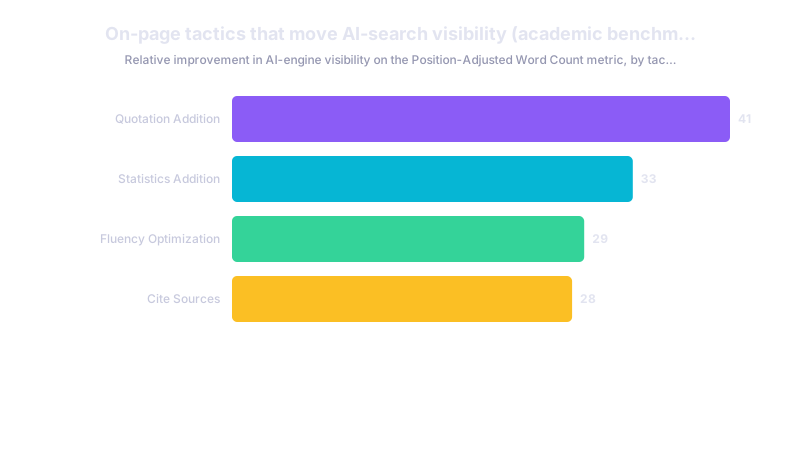
What actually earns that citation? The clearest evidence comes from the academic paper that named the field. In "GEO: Generative Engine Optimization" (Aggarwal et al., ACM KDD 2024), on-page tactics like citing sources, adding statistics, and adding direct quotations were the top performers, lifting visibility by up to ~40% on the Position-Adjusted Word Count metric - while keyword stuffing was counterproductive and actually reduced visibility. As the authors put it:
Our top-performing methods - Cite Sources, Quotation Addition, and Statistics Addition - achieved a relative improvement of 30-40% on the Position-Adjusted Word Count metric... the efficacy of these strategies varies across domains, underscoring the need for domain-specific optimization methods.
Those figures are upper bounds from a synthetic academic benchmark and vary by domain - treat them as directional guidance for your project pages, not guarantees, and note they haven't been proven on local-service queries. But the direction is exactly what a remodeler should want to hear: the things that make a project page trustworthy to a human (named neighborhoods, real materials, timelines, outcomes, cited numbers) are the same things that make it quotable to an AI engine. That's what generative engine optimization is for.
The practical checklist for local plus AI visibility:
- Optimize your Google Business Profile and your location/service-area pages for "near me" and city-plus-trade queries ("kitchen remodeler in [city]").
- Make every project page quotable: name the neighborhood, the materials, the timeline, and the measurable outcome.
- Add real numbers and cite them, the way this page does.
Reviews and reputation close the deal on expensive jobs
The bigger and more disruptive the project, the harder a homeowner scrutinizes your reviews - how many, how recent, and how you respond to criticism. On a $20,000-plus job that will tear up someone's home for weeks, reputation is the final gate.
Two habits move the needle. First, ask every satisfied customer for a review - the mechanics of a repeatable ask are in our guide to getting more five-star reviews. Second, reply to all of them, including the critical ones; a calm, specific response to a complaint reassures the next reader more than a wall of five-star ratings does.
Reviews do double duty. They feed local rankings, and they add to the brand mentions that AI engines weigh when deciding whom to recommend (Ahrefs, 2025). And the single strongest trust combination for a remodeler is a written testimonial paired with the before/after photos of that exact job - proof and voice, together.
What This Means for Your Business
For a general contractor or remodeler, the 2026 strategy is not complicated, but it is a specific order of operations:
- Lead with proof of work, not price. Your documented portfolio is your best salesperson for a high-trust purchase.
- Build owned assets before scaling ads. A portfolio-first website, local SEO, a complete Google Business Profile, and a review engine compound month over month - get them working before you pay $165+ per lead in paid search.
- Treat AI search as a new front door. Brand mentions and citable, richly described project pages are what get you recommended when a homeowner asks an assistant who to hire.
- Turn every finished job into a marketing asset - photographed, described, and cited - so it keeps selling long after the crew packs up.