
Landscaping is a $184.1 billion U.S. industry served by 726,565 businesses (IBISWorld, 2025), and demand for it arrives in a wave every spring. The companies that win aren't the ones who scramble for leads in April when everyone is bidding up the same clicks. They're the ones who built their marketing in the off-season and turned one-time jobs into recurring contracts.
Short answer: Winning landscaping and lawn care marketing means front-loading demand capture before each season and converting one-time jobs into recurring contracts. Because 59% of contractors already earn most of their revenue from recurring maintenance (Aspire, 2025) and Google has said roughly 46% of searches carry local intent, the highest-ROI moves are ranking in Google's local 3-pack, keeping a complete Google Business Profile, and stacking recent reviews before spring search interest peaks in April. Paid search is seasonal too: landscaping Google Ads average a $3.65 cost-per-click and an $87.80 cost-per-lead (Evergrow Marketing, 2024), so budgets should climb in March through May and pull back in winter.
Why landscaping marketing lives and dies by the season
Search demand for outdoor services is sharply seasonal. Evergrow Marketing's analysis of landscaping and lawn care ad accounts found that demand "peaks in April (NOT March) and valleys in December" - steep enough that they recommend roughly $314.79 of monthly ad spend in January versus $1,070.25 in April (Evergrow Marketing, 2024). That is more than a 3x swing driven entirely by the calendar.
The strategic implication is the part most contractors miss: SEO and content have to be built and indexed before the season, because ranking gains lag weeks to months behind the work. If you start optimizing your site in April, you are competing for spring rankings you won't earn until summer. The off-season - winter for northern markets - is when the marketing groundwork actually gets done. Sunbelt calendars run longer, and northern companies can bridge the winter with snow removal or holiday lighting to keep cash flow and marketing continuity alive, but the underlying rule holds everywhere: rank early or pay a premium to compete late.
Recurring contracts are the real prize, not one-off jobs
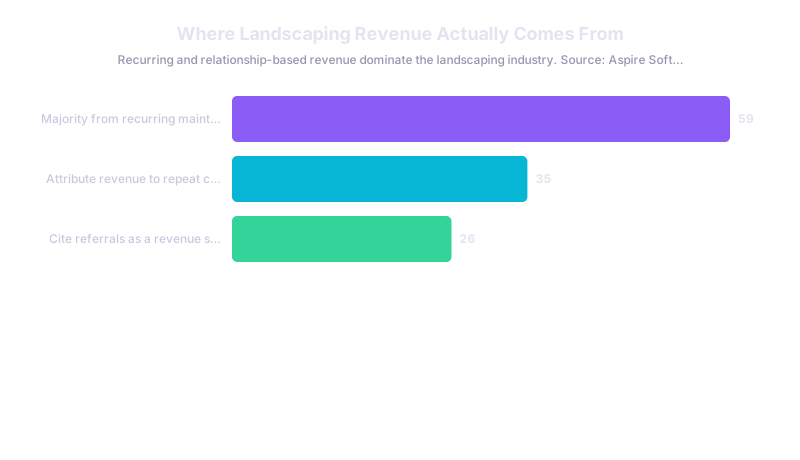
Here is the number that should reshape your whole marketing plan: 59% of landscaping contractors earn the majority of their revenue from recurring maintenance services (Aspire, 2025). In the same industry data, 35% of contractors attribute revenue to repeat clients and 26% cite referrals as a revenue source. Existing relationships, not fresh leads, carry the business.
That reframes the entire goal of acquisition marketing. You aren't buying a one-time cleanup; you're buying the first transaction in a multi-season relationship. As Jon Gohl, Director of Customer Experience at Aspire, put it, contractors are "demonstrating resilience by focusing on what they can control, retaining clients, streamlining processes, and investing in scalable tech." The tactics that follow from this are unglamorous and highly profitable: seasonal service agreements, autopay so renewals don't require a decision, and proactive outreach before the growing season starts so you lock the contract before a competitor's flyer lands. Retention compounds lifetime value and smooths the exact cash-flow valleys the season creates.
Local SEO and the Google 3-pack decide who gets the call
Homeowners find landscapers the same way they find everything local - they search, and they click fast. Google has stated that roughly 46% of searches have local intent (a figure Google first shared in 2018, still widely cited via BrightLocal). Yet just 35% of SMBs have a Google Business Profile (BrightLocal SMB Marketing Report, 2025), which means a complete, active profile is still a real competitive edge rather than table stakes.
It matters because the profile is the storefront. Google reports that customers are 70% more likely to visit and 2.7 times more likely to consider a business reputable when they find a complete Business Profile on Search and Maps. To rank in the map pack, get the fundamentals right: consistent name, address, and phone number (NAP) everywhere, accurate categories, real photos, and full service descriptions. Then build service-area pages for local ranking that target specific cities and suburbs so "lawn care [city]" queries land on a page written for that place. For the full playbook, see our local SEO guide for service businesses and how to optimize your Google Business Profile.
Reviews and reputation win the click
Ranking in the 3-pack gets you seen; reviews get you chosen. 97% of consumers read reviews for local businesses (BrightLocal Local Consumer Review Survey, 2026). Inside a 3-pack, a homeowner compares three options on photos, star rating, review count, and how recent those reviews are - often in seconds, before they've read a single service description.
The move is to run a review-generation routine year-round and time an extra push so fresh reviews land right before spring search peaks. Ask every satisfied customer, make it a one-tap link, and respond publicly to reviews - responses signal an active, attentive business to both prospects and Google. A steady drip of recent, answered reviews beats a stale pile of five-year-old five stars. If you need a system, here's how to get more five-star reviews.
Paid search and AI search: where to spend the marginal dollar
When you do run paid search, spend against the demand curve. Landscaping and lawn care Google Ads benchmarks - drawn from Evergrow Marketing's analysis of 61 accounts spending a combined $225,000-plus in 2024 - came in at a $3.65 average cost-per-click, an $87.80 cost-per-lead, a 5.05% click-through rate, and a 4.16% conversion rate (Evergrow Marketing, 2024). Ramp budgets in March through May and throttle them December through February; a flat annual budget overpays in winter and underspends at the peak.
AI search is the emerging front. Ahrefs' study of 75,000 brands found that branded web mentions correlate with AI Overview visibility far more strongly than backlinks - 0.664 versus 0.218 (Ahrefs, May 2025). In plain terms, being talked about across the local web increasingly beats classic link-building for showing up in AI answers. On the content side, a Princeton-led academic study ("GEO: Generative Engine Optimization," Aggarwal et al., 2024) found that enriching pages with quotations and statistics were the most effective tactics for generative-engine visibility, lifting it by up to roughly 40% on their benchmark, while keyword stuffing showed little to no benefit. Treat that number as an upper bound from a synthetic academic test, not a guarantee on local-business queries - but the direction is clear: cite sources, add real numbers, and write like an authority.
What This Means for Your Business
The edge in landscaping marketing is quieter and slower than most contractors expect. Build and index your local SEO and service-area pages before the season, not during it, so you already rank when homeowners start searching in April. Treat every one-time job as a recurring-contract lead, because with 59% of contractor revenue coming from recurring maintenance, acquisition marketing exists to feed a retention machine - not to win a single cleanup. Own your Google Business Profile and run a year-round review engine, since a third of your competitors still haven't claimed the basics. And match ad spend to the demand curve instead of burning flat budgets all year. Whoever owns the Google 3-pack and the recurring contract owns the neighborhood.
Ready to own the local 3-pack before spring hits? Semark builds seasonal, retention-focused marketing for home-services companies. Get a landscaping marketing plan at /contact or explore digital marketing and ads.
