
As of July 2025, patients in all 50 states, the District of Columbia, and the U.S. Virgin Islands have some form of direct access to a physical therapist without a physician's referral (APTA, 2025). That single fact rewires how a PT clinic gets patients: most now start the way they'd find a plumber - with a search.
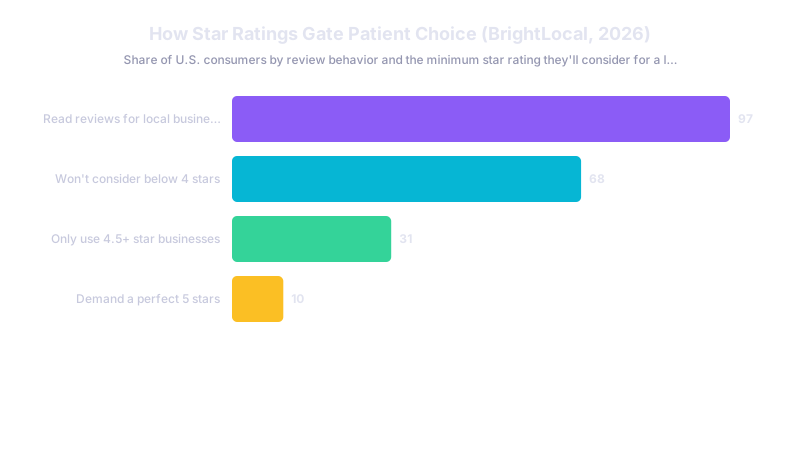
Short answer: Physical therapy clinic marketing in 2026 is won on local search. Because patients in every state now have direct or provisional access to a PT without a referral (APTA, 2025), most begin with a "physical therapy near me" Google search - so the highest-ROI moves are a fully optimized Google Business Profile, a steady flow of 4-plus-star reviews (68% of consumers won't consider a business rated under 4 stars, per BrightLocal, 2026), and location- and condition-specific service pages. Physician referrals still matter, but a clinic that owns its map pack and review presence controls its own patient pipeline instead of renting it from the doctor down the street.
Why Local Search Now Decides Which PT Clinics Grow
Direct access is universal. As of 2025, 21 states allow unrestricted direct access to a PT, and 29 states plus DC and the U.S. Virgin Islands allow provisional access - meaning time or visit limits, or a referral requirement for specific procedures like needle EMG (APTA, 2025). Know which rules govern your market, but the strategic takeaway is the same everywhere: patients can self-refer, so many of them do - and self-referral almost always begins with a search.
The market they're searching in is large and fragmented. The U.S. physical and occupational therapy industry was worth about $53 billion in 2024, up 6.4% year over year, spread across 50,883 clinics providing physical therapy, occupational therapy, speech therapy, and audiology (Marketdata, 2025). Demand is climbing, too: the Bureau of Labor Statistics projects physical therapist employment to grow 11% from 2024 to 2034 - much faster than average - with about 267,200 jobs in 2024 and roughly 13,200 openings projected each year (BLS, 2025). Rising demand is good news, but a fragmented, growing market also means more clinics competing for the same "near me" searches in your ZIP code.
Your Google Business Profile Is the Front Door
"Physical therapy near me" and condition-plus-city queries surface the map pack before anything else. Your Google Business Profile (GBP) completeness, categories, and reviews largely decide who appears there - which makes it the single most controllable ranking asset a clinic owns.
Jordan Clevenger, PT, DPT, who writes on practice growth for the Behind the Practice publication, puts it plainly: "Most PT clinics have incomplete, outdated profiles that quietly sabotage their visibility. The good news? This is the most controllable ranking factor you have."
So fill every field. Set an accurate primary category and relevant secondary categories, list your services, keep hours current, add real photos, and use the Q&A section. Insurance- and condition-specific searches - "PT that takes Blue Cross near me," "vestibular therapy [city]" - are among the highest-intent queries a clinic can capture, so reflect the insurance you accept and the conditions you treat both in your profile and on your pages. For the underlying mechanics, work from our Google Business Profile optimization guide rather than chasing "hacks" that don't move rankings.
Reviews Are the Currency of Patient Trust
Reviews are where trust is won or lost before a patient ever calls. In BrightLocal's 2026 survey (n=1,002), 97% of consumers read reviews for local businesses, and 68% said they won't consider a business rated below 4 stars - up sharply from 55% a year earlier. Expectations are only rising: 31% now use only businesses rated 4.5 stars or higher (BrightLocal, 2026).
The practical move is a simple ask-at-discharge routine: when a patient finishes a successful plan of care, that's the natural moment to request a review. Both recency and volume signal an active, trusted practice, so make the ask a standard step, not an afterthought. Respond to every review, positive or critical - a thoughtful public reply is a live demonstration of how you treat people. For a repeatable system, see our guide on how to get more five-star reviews.
Build Pages That Rank for How Patients Actually Search
Your website should mirror the way patients actually type. Create location and service-area pages ("Physical Therapy in [City]") and condition pages (low back pain, ACL rehab, vestibular therapy) - each one targets a real query and gives Google an unambiguous page to rank.
How you write those pages increasingly determines whether AI search engines cite you, too. In the "GEO: Generative Engine Optimization" study (Aggarwal et al., ACM KDD 2024), adding quotations was the single best on-page tactic for generative-engine visibility, improving the paper's Position-Adjusted Word Count metric about 42% over baseline, with adding statistics (about +33%) and citing sources close behind - up to roughly 40% more visibility overall. Those figures come from a synthetic academic benchmark, not from local-business queries, so treat them as directional; but the direction is clear: cite named sources, quote credible voices, and back claims with data on your pages.
Off-page, being talked about matters more than being linked to. Ahrefs' study of 75,000 brands found that brand web mentions correlate with AI Overview visibility far more strongly than backlinks (0.664 vs. 0.218) (Ahrefs, 2025). And with AI Overviews now correlating with a 58% lower click-through rate on the #1 organic result (Ahrefs, December 2025), being the clinic that gets cited and recommended matters more than a raw ranking. Get mentioned by local press, community health sites, and reputable directories.
What This Means for Your Business
Physical therapy is a high-value, locally competitive vertical, and the clinics that treat local SEO as core operations - not a once-a-year afterthought - take share. Prioritize in order: a complete Google Business Profile, a review engine, location and condition pages, then brand mentions and generative-engine visibility. Most owners do the opposite, over-investing in ads while under-investing in the assets that compound.
You don't need a bigger ad budget to beat a corporate chain in your own ZIP code. A solo clinic with a fully optimized profile and 120 recent 4.8-star reviews will out-book a chain that's ignoring the fundamentals, because local and AI search reward consistency on the signals they actually measure - not spend. In 2026, the clinic that shows up in the map pack and gets recommended by AI assistants owns its growth. Everyone else rents it.
Want a local-search plan built for your clinic - GBP, reviews, and pages that actually book patients? See Semark's healthcare marketing services or get a plan at /contact.
CONTENT