
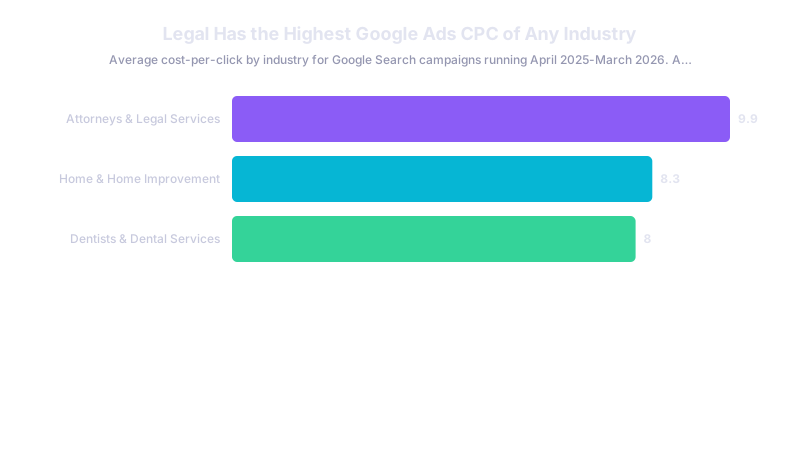
Legal is the most expensive vertical on Google Ads - an average $9.87 per click and $131.63 per lead across campaigns running April 2025 to March 2026 (WordStream/LocalIQ, 2026). For a family law firm, that means outbidding competitors on "divorce lawyer" is one of the least durable advantages you can buy.
Short answer: Family law prospects search Google in a moment of crisis and decide fast, so the highest-ROI marketing for divorce and custody clients is local visibility plus trust signals - Google Local Services Ads (pay-per-lead, with the Google Screened badge), a fully optimized Google Business Profile, and a steady stream of recent 4-plus-star reviews. Because legal carries the highest cost per click and cost per lead of any industry ($9.87 CPC, $131.63 CPL; WordStream/LocalIQ, 2026), broad "divorce lawyer" pay-per-click should be a supplement, not your foundation. Win on reputation and local intent first: 97% of consumers read reviews before choosing a local business and 68% will only use one rated 4 stars or higher (BrightLocal, 2026).
Why Family Law Is a Brutal (and Winnable) Marketing Vertical
Attorneys and legal services top all 23 industries WordStream tracks for both cost per click ($9.87) and cost per lead ($131.63), running well ahead of the next-priciest verticals, home improvement ($8.33 CPC) and dentistry ($8.00 CPC) (WordStream/LocalIQ, 2026). Broad divorce and custody keywords in major metros routinely run far above that industry average, so a bidding war is a losing arms race for most local firms.
The flip side is what makes the vertical winnable. Family law clients search in a crisis and decide fast - they want immediate, trusted, local help. That intent is unusually high and the purchase is emotional, so trust signals convert better here than in most verticals. Legal also posts a healthy 5.55% average conversion rate on search (WordStream/LocalIQ, 2026), which rewards firms that show up credibly over firms that simply spend more.
Lead With Local Services Ads and Google Business Profile
Google Local Services Ads (LSAs) charge per lead instead of per click and attach the Google Screened badge - a strong fit for divorce and custody prospects who need reassurance before they pick up the phone. LSAs and the local Map Pack also appear above traditional PPC and organic results, capturing "divorce lawyer near me" intent at the top of the page.
Under the ads, your Google Business Profile is the listing that wins or loses the Map Pack. Fully optimize it: correct family-law practice-area categories, accurate service areas and hours, real photos of your office and team, and answered questions in the Q&A. For the mechanics, see our local SEO guide for service businesses.
Reviews Are Your Conversion Engine
Reviews are the single biggest lever on whether a scared prospect calls you. In BrightLocal's 2026 survey, 97% of consumers said they read reviews for local businesses, 68% said they will only use a business rated 4 stars or higher - up sharply from 55% a year earlier - and consumers check an average of six review sites before deciding (BrightLocal, 2026).
Family law prospects scan those reviews for specific words - "compassionate," "responsive," "respectful" - because they are hiring for the experience as much as the outcome. Coach satisfied clients to describe how you made them feel and how you handled the process, not just the result. Then build review velocity and recency into your intake and case-closing workflows so a steady flow of recent reviews keeps arriving; our guide on how to get more five-star reviews walks through the ask.
One caution worth internalizing, from legal-marketing expert Gyi Tsakalakis, co-founder of AttorneySync: "I encourage people not to trade trust for visibility." Manufactured or incentivized reviews put the one asset you cannot rebuild at risk.
Content and GEO: Get Recommended by AI and Google
AI is now part of the family law buying journey. Clio's 2025 Legal Trends Report found that more than half of consumers have used or would consider using AI to answer a legal question - and of those who used AI, 28% were directed to contact a lawyer (Clio, 2025). That is a direct bridge from a consumer's AI query to a signed client.
At the same time, AI answers are eating search clicks. Ahrefs found that the presence of an AI Overview correlates with a 58% lower average click-through rate for the top-ranking page (Ahrefs, December 2025). Being cited inside the AI answer now matters as much as ranking beneath it. What earns those citations is brand presence: across a 75,000-brand study, web mentions correlated with AI Overview visibility far more strongly than backlinks (0.664 vs 0.218; Ahrefs, May 2025).
The practical move is to answer the real questions clients ask - how custody works in your state, what a divorce typically costs and how long it takes - and back your answers with cited sources, statistics, and direct quotations. Those are the exact on-page tactics an academic study of generative engines found most effective: adding quotations, statistics, and cited sources ranked among the highest-performing methods, for gains of up to 40% overall (Aggarwal et al., "GEO: Generative Engine Optimization," arXiv 2311.09735, 2024). Two caveats keep this honest: those results come from an academic benchmark rather than live local-service queries, and the paper found effectiveness varies by domain, so treat them as direction rather than a guarantee. For the deeper playbook, see how lawyers get found in AI search (GEO).
Budget Smart: Don't Bet Everything on Google
Use LSAs and the Map Pack for high-intent capture, and reserve PPC for specific, lower-cost long-tail terms rather than broad "divorce lawyer." Then diversify so a single algorithm change can't sink your caseload. As Tsakalakis puts it: "diversify as fast as you can. And if you're over reliant on Google, if you're over reliant on ads, if you're over reliant on any single channel, now is the time."
Pricing is part of marketing, too. Clio reports that 71% of clients would prefer to pay a flat fee for their entire case (Clio Legal Trends Report), so publishing transparent pricing - or at least a clear explanation of how you bill - is itself a conversion lever for prospects comparing firms.
What This Means for Your Business
For family law, reputation and local intent beat ad budget. Win the Map Pack, the reviews, and the AI answer before you scale broad PPC. Treat pay-per-lead LSAs as your foundation and broad keyword PPC as a controlled supplement you can turn down when cost per lead climbs. And publish genuinely helpful, sourced content so both Google and AI assistants recommend your firm by name - because when clicks are shrinking, being the firm the AI names is worth more than ranking one spot higher.
See how Semark helps family law and legal practices get found by clients and AI - visit our legal marketing services or book a strategy call at /contact.
