
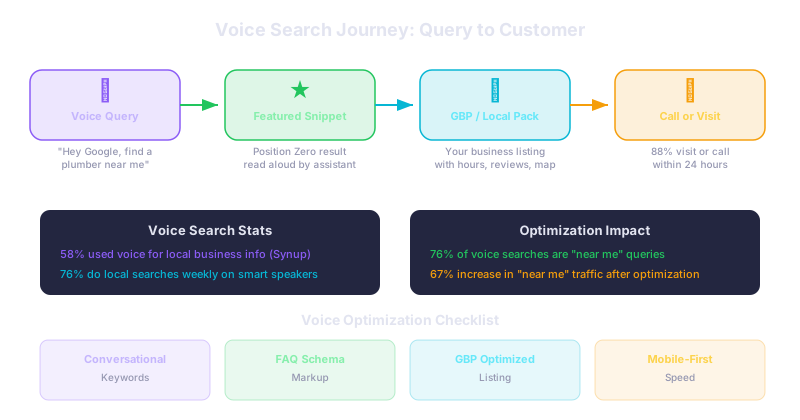
"Hey Google, find a plumber near me." That five-second voice command triggers a search, pulls up three local results, and often leads to a phone call within minutes. If your business is not showing up in those results, you are invisible to a growing segment of customers who never touch a keyboard.
Short answer: 58 percent of consumers have used voice search to find local business information (Synup). Optimizing for voice search means structuring your content around conversational questions, keeping your Google Business Profile complete, and earning featured snippets. The payoff is significant -- 88 percent of people who do a local search on their phone visit or call a business within 24 hours.
How Voice Search Works Differently
Voice queries are fundamentally different from typed searches. When someone types, they use shorthand: "plumber Phoenix AZ." When they speak, they use full sentences: "Who is the best plumber near me that is open right now?"
This means voice search optimization requires a different content approach. 76 percent of voice searches use "near me" language (MonsterInsights). Invoca reports that 76 percent of smart speaker users perform local searches at least weekly. Your content needs to answer the exact conversational questions people ask out loud.
Optimize Your Google Business Profile First
Your Google Business Profile is the foundation of voice search visibility. When someone asks a voice assistant for a local recommendation, the assistant typically pulls from Google's Local Pack, which is driven primarily by GBP data.
Make sure every field is complete and accurate: business name, address, phone number, hours (including holiday hours), service categories, service area, and business description. Add photos regularly. Respond to reviews. Post weekly updates. The more complete and active your profile, the more likely Google is to surface your business for voice queries.
If your GBP is not performing well, start there before investing in any other voice search tactic. See our guide on local SEO services for a deeper dive.
Structure Content Around Questions
Voice searches are almost always questions. Structure your website content to answer them directly.
Create an FAQ page that answers the 10 to 20 most common questions about your business and industry. Format each question as an H2 heading and provide a concise, direct answer in the first sentence followed by supporting detail. This format is exactly what Google uses to generate featured snippets, and featured snippets are what voice assistants read aloud.
For each service you offer, build content around "how," "what," "where," "when," and "how much" questions. For example: "How much does AC repair cost in Phoenix?" with a clear, specific answer in the opening paragraph.
Target Featured Snippets
Voice assistants read from Position Zero, the featured snippet that appears above regular search results. Businesses that systematically optimized for voice search saw a 67 percent increase in "near me" traffic (SEO Solution Local).
To earn featured snippets, provide direct answers in 40 to 50 words at the top of your page, use structured lists and tables where appropriate, and mark up your content with FAQ and LocalBusiness schema. GreenBananaSEO found that 88 percent of people who do a local search on their smartphone visit or call a business within 24 hours, so earning that snippet position translates directly to leads.
Technical Foundations
Voice search optimization requires a fast, mobile-first website. Voice searches happen almost entirely on mobile devices and smart speakers, and Google prioritizes fast-loading, mobile-friendly pages.
Ensure your site loads in under three seconds. Use SSL. Implement structured data markup for your business information, services, FAQs, and reviews. Claim and verify your listings on Apple Maps, Bing Places, and Yelp in addition to Google, since Siri, Cortana, and Alexa pull from different data sources.
What This Means for Your Business
Voice search is not a future trend. It is current behavior. More than half your potential customers are already using it. The good news is that most local businesses have not optimized for it, so the opportunity to stand out is still wide open.
Start with your Google Business Profile. Then add structured FAQ content to your website. Implement schema markup. These three steps will cover the majority of voice search optimization and position your business for both traditional and AI-powered search engines.
Related reads:
- How to Get Your Business Recommended by ChatGPT
- Google Business Profile Not Showing Up? Here Is What to Do
- Get More Calls from Google Business Profile
Want to show up in voice search results? We help local businesses optimize for voice, AI search, and the Local Pack. Talk to our team