
In residential real estate, 43% of buyers found their agent through a referral from a friend, neighbor, or relative, and 66% of sellers hired an agent who was referred to them or whom they had worked with before (National Association of Realtors, 2025 Profile of Home Buyers and Sellers). Read that again: the brokerage logo is not the product. You are. The highest-ROI marketing you can do is being the person people already trust enough to recommend.
Short answer: In real estate, you are the brand. Because 43% of buyers hire an agent from a personal referral and 66% of sellers pick someone they already know or were referred to (NAR, 2025), the highest-ROI marketing is staying top-of-mind, not buying cold leads. The winning 2026 playbook pairs a focused personal brand - one niche, one geography - with local SEO (a fully optimized Google Business Profile plus hyperlocal content) and generative-engine optimization, so you surface when buyers ask Google's AI Overviews or ChatGPT to recommend an agent.
Why Your Personal Brand Is the Product (Not the Brokerage)
The referral numbers are not a soft signal - they are the whole game. In NAR's 2025 Profile of Home Buyers and Sellers, 43% of buyers found their agent through a referral from a friend, neighbor, or relative, and a full 66% of sellers either used an agent they'd worked with before or one who was referred to them. Portal leads, direct mail, and open houses trail far behind for both groups.
That pattern holds inside an agent's own book, too. According to the NAR 2025 Member Profile, the typical REALTOR earned 21% of their business from referrals from past clients and another 20% from repeat clients - roughly 41% of a working agent's volume coming from people who already know them. Among members with 16 or more years of experience, 40% said repeat clients make up more than half their business. The longer you do this well, the more your reputation does the selling.
Here's why that matters for where you spend money. The typical REALTOR's median gross income was $58,100 in 2024, up from $55,800 in 2023, and the median member has 12 years of experience (NAR 2025 Member Profile). At that income level, you cannot out-spend big teams on paid portal leads and win on volume. What you can do is be unforgettable to a specific set of people - which means marketing dollars are better spent keeping you memorable than promoting a brokerage brand a client will forget the day after closing.
Pick a Profitable Niche Before You Build the Brand
A brand needs a target. "Local agent who does everything for everyone" is not a brand - it's a business card. The agents who compound are the ones who dominate a defined slice: a location (one set of neighborhoods), a demographic (first-time buyers, downsizing retirees, military relocations), a property type (mid-century homes, luxury condos, small multifamily), or a situation (divorce, probate, corporate relocation).
The practical rule is simple: pick one client type plus one geography you can genuinely own, rather than being a generalist across a whole metro. This is not just positioning advice - it's a search and AI advantage. Specificity is exactly what Google's local algorithm and AI assistants reward. A page that credibly answers "best agent for first-time buyers in [specific neighborhood]" will outrank and out-cite a generic "top realtor in [big city]" page every time, because it matches how real people actually ask.
Niching down feels risky because it seems to shrink your market. In practice it does the opposite: it makes you the obvious, nameable choice inside a market small enough to actually cover - which is precisely the choice a referrer, a review, or an AI answer can make on your behalf.
Hyperlocal Content: Own One Map, Not the Whole Metro
Once you've picked your slice, your content should prove you own it. Think in content pillars: educational (how the process works), authority and point of view (your read on the market), personal and lifestyle (who you are), client wins, and - the one most agents skip - hyperlocal. Hyperlocal content names things: specific streets, subdivisions, school attendance zones, HOA quirks, price trends, and the coffee shop everyone actually meets at.
That specificity is what earns "near me" and neighborhood-name rankings, because it uses the exact language buyers type and speak. A monthly market update for one neighborhood - real median prices, days-on-market, what's moving and what's sitting - is worth more than a dozen generic "5 tips for buyers" posts. And it's efficient: turn one neighborhood update into a blog post, a short video, a Google Business Profile post, and an email to past clients. One piece of real reporting, four touchpoints.
This also happens to be the strongest on-page tactic for AI-search visibility. In the peer-reviewed "GEO: Generative Engine Optimization" study (Aggarwal et al., ACM KDD 2024), adding cited sources, quotations, and statistics to a page produced the largest gains in whether generative engines surfaced the content - more on that below. Stat-rich, source-cited hyperlocal content isn't just good for readers; it's what AI answers pull from.
Local SEO Fundamentals Every Agent Skips
Content gets you found in AI and organic search. Your Google Business Profile gets you found in the Map Pack - the local results with the map and the pins - which is where a huge share of "agent near me" intent lands. Claim it, verify it, and fill in everything: categories, service areas, hours, photos, and regular posts. It is the front door for local discovery, and most agents treat it like an afterthought.
Three fundamentals do most of the work:
- Service-area and neighborhood landing pages that match how buyers actually search. Build pages for the specific communities you serve, not one generic city page. See our guides on service-area pages that rank locally and the broader local SEO guide for service businesses.
- Reviews, systematically. Volume and recency both signal trust to Google and to the human reading your profile. Build a review ask into every single closing - a short, specific request the day after keys change hands converts far better than a vague "leave a review sometime."
- Consistent NAP. Your name, address, and phone number should be identical everywhere they appear online, with links tying your profile back to your niche and hyperlocal content.
Where Buyers Actually Find You: Follow the Lead Data
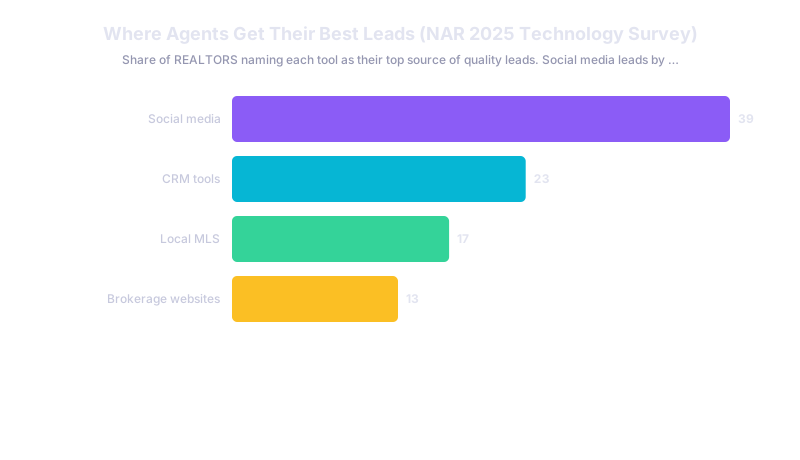
Ask agents where their best leads come from and the answer has shifted. In NAR's 2025 Technology Survey, 39% of REALTORS said social media provides their highest number of quality leads - ahead of CRM tools (23%), the local MLS (17%), and brokerage websites (13%).
Adoption backs that up: 75% of REALTORS now use social media as a work tool, and 46% use AI-generated content, such as for listing descriptions (NAR 2025 Technology Survey). As NAR Deputy Chief Economist Jessica Lautz put it, "These results show a profession that is adapting quickly to technological change while prioritizing client satisfaction."
The lesson isn't "go all-in on social and skip everything else." Social media builds and broadcasts the personal brand; search, reviews, and referrals convert the intent that brand creates. A viral neighborhood reel means little if the person it impresses Googles your name and finds a half-empty Google Business Profile with two three-year-old reviews. You need the top of the funnel (social, brand) and the bottom (search, reviews, GBP) working together - not one at the expense of the other.
Get Recommended by AI Search, Not Just Google
Buyers increasingly ask ChatGPT, Perplexity, and Google's AI Overviews to recommend an agent or explain a neighborhood. Getting surfaced there is a different game than classic SEO. Ahrefs' study of 75,000 brands (Louise Linehan, May 2025) found that a brand's web mentions correlate with AI Overview visibility at 0.664 - far more strongly than backlinks at 0.218. In that study, brands in the top quartile for web mentions averaged roughly 169 AI Overview mentions, versus about 14 for the next quartile down - close to a tenfold gap.
Translation for agents: being talked about across the web matters more than accumulating links. Earn named mentions - local press, community and neighborhood sites, podcasts, guest posts, chamber and school-district features - so your name appears in the same context as your market.
On the page itself, the GEO study points the same direction. Its top-performing tactics were adding quotations, statistics, and cited sources, which delivered relative improvements in the 30-40% range (up to about 40%) on the study's visibility metric - with quotation and statistic additions leading. Notably, keyword stuffing did the opposite of help: it fell below the baseline, offering no improvement in generative responses. The takeaway is to write like a credible local expert - real numbers, real sources, real quotes - not like someone gaming a keyword.
One honest caveat: these GEO figures come from a synthetic academic benchmark and vary by domain. They haven't been proven specifically on local real-estate queries, so treat them as direction, not a guarantee. The direction - be mentioned, be specific, be source-rich - is consistent with everything else here. For the full playbook, see how small businesses get found by AI search.
What This Means for Your Business
Real estate is the purest "you are the brand" business there is. With roughly 41% of a typical agent's book coming from referrals plus repeat clients (NAR 2025), the highest-ROI move is being unforgettable to people who already know you - before you buy another batch of cold portal leads.
Here's the sequence we'd run:
- Niche down. Pick one client type and one geography you can genuinely dominate. Specificity is what both referrers and AI answers reward.
- Claim and optimize your Google Business Profile, then build a systematic review engine into every closing.
- Publish hyperlocal, stat-rich content - named streets, schools, and real price trends - and repurpose each piece into video, a GBP post, and a past-client email.
- Earn named mentions across local press and community sites so you surface in AI answers, not just Google.
- Amplify on social to keep the brand top-of-mind, knowing search and reviews are what convert the interest it creates.
Want a personal brand and local-SEO system built for your market instead of another lead subscription? See Semark's local SEO and GEO services, or book a strategy call.