
In 2024, US healthcare data breaches reported to federal regulators exposed the protected health information of more than 289 million people (HHS OCR breach portal, via HIPAA Journal, 2026). AI did not cause most of those breaches, but AI is now the fastest way for a well-meaning practice to leak patient data by accident: a receptionist pastes a patient message into a free chatbot, and protected health information (PHI) leaves your control forever.
Short answer: HIPAA does not ban AI. It does require that any AI tool touching PHI be covered by a signed Business Associate Agreement (BAA) with the vendor, that patient data is not used to train the vendor's models, and that you keep the same access controls, risk analysis, and human oversight you already owe. Consumer and free AI plans are almost never eligible for a BAA, so they are off-limits for anything with real patient data.
First, the rule that never changes: HIPAA follows the data
HIPAA does not regulate "AI." It regulates protected health information, wherever it goes. If your practice is a covered entity and a piece of software creates, receives, stores, or transmits PHI on your behalf, the company behind that software is a business associate, and you need a Business Associate Agreement before that data changes hands. An AI vendor is not a special category. It is a business associate like your billing service or your cloud host.
That means the compliance question is never "Is this AI HIPAA compliant?" It is "Does this specific product, on this specific plan, come with a BAA, and are we using it the way the BAA allows?" A large-language-model chatbot that only ever sees de-identified or non-patient text (drafting a blog post, summarizing a public article) is not a HIPAA problem at all. The same chatbot, fed a patient's name and diagnosis, is.
"HIPAA compliant" is a marketing claim, not a certificate
Here is the single most important thing to understand before you buy anything. There is no government seal that makes a product HIPAA compliant. As attorneys Daniel Pepper and Hannah Sweiss of the law firm Fisher Phillips put it: "There is no federal HIPAA certification, seal, or registry. The Department of Health and Human Services (HHS) Office for Civil Rights (OCR) is the federal agency that enforces HIPAA, and it does not pre-clear, certify, or endorse any product as compliant" (Fisher Phillips, 2025). They note the Federal Trade Commission has warned that "HIPAA compliant" badges can be deceptive under Section 5 of the FTC Act precisely because they imply a government blessing that does not exist.
So when a vendor's homepage says "HIPAA compliant," that is a self-assessment. Compliance is a property of how your organization deploys and governs the tool, not a feature the vendor ships. The only document that legally matters is the signed BAA and the plan it applies to.
What you CAN do with AI (the green light)
Plenty. HIPAA is an operational framework, not a ban on new technology. With the right setup, a practice can use AI for intake triage, note summarization, prior-authorization drafting, appointment scheduling, and phone answering. What makes it lawful is the plumbing underneath.
Use a plan that comes with a BAA. The major AI vendors do sign BAAs, but only on specific tiers. Anthropic, for example, offers a BAA covering its first-party Claude API (the Messages API) and its Enterprise plan with HIPAA mode explicitly enabled by the organization owner; its Free, Pro, Max, and Team consumer plans, plus the Console, Workbench, and beta features, are expressly not covered (Anthropic Privacy Center, 2026). OpenAI follows the same pattern: a BAA is available for ChatGPT Enterprise, ChatGPT Edu, and the API platform (request it by emailing [email protected]), but not for ChatGPT Free, Plus, Team, or Business (OpenAI Help Center; Paubox, 2026).
| AI service tier | BAA available for PHI? |
|---|---|
| Enterprise / Edu plans (sales-managed) | Yes, when the BAA is signed and HIPAA mode is enabled |
| First-party developer API | Yes, once a BAA is in place |
| Free, Plus, Pro, Team, or "Business" plans | No - do not put PHI here |
Keep the safeguards you already owe. A BAA is the entry ticket, not the whole game. You still need role-based access controls, a current security risk analysis, audit logging, and a human reviewing anything clinical before it reaches a patient. See our companion guide on HIPAA-compliant email marketing for healthcare for how these same principles apply to patient outreach, and our healthcare industry page for where AI fits in a practice workflow.
What you CAN'T do (the red lines)
You can't paste PHI into a consumer or free AI tool. This is the most common violation, and it happens quietly. The free tier has no BAA, and many consumer products reserve the right to use your inputs to train their models. Once PHI is in someone else's training pipeline, you cannot claw it back. Train your whole team that "no patient information goes into any tool we have not approved" is a hard rule.
You can't assume the enterprise plan is automatically covered. With several vendors, buying the enterprise tier is not enough. The BAA and "HIPAA mode" must be actively accepted and switched on by an administrator, and specific features (batch processing, file uploads, web browsing, beta tools) may sit outside the agreement even on a covered plan. Read the covered-services list, not just the sales deck.
You can't let AI make discriminatory care decisions. OCR has made clear that anti-discrimination law applies to AI. Under Section 1557 of the Affordable Care Act, OCR began enforcing nondiscrimination duties for patient-care decision-support tools that use AI on July 5, 2024, and organizations were expected to identify and mitigate the risk of discrimination based on race, color, national origin, sex, age, or disability by May 1, 2025 (OCR "Dear Colleague" letter, via Reed Smith, 2025). If an AI tool influences who gets a screening, a referral, or a treatment, you are responsible for auditing it for bias and keeping a human able to override it.
You can't skip the BAA and hope. Using a business associate without a BAA is itself a HIPAA violation, separate from any breach. And you can't quietly let a vendor use your patient data to improve its product. The covered enterprise and API tiers from the major vendors do not train on your data by default, but a consumer plan gives you no such promise.
The rules are tightening, not loosening
HIPAA's Security Rule had not been substantially updated in over a decade until OCR proposed a major overhaul, published in the Federal Register on January 6, 2025, with the public comment period closing March 7, 2025 (Federal Register, 2025). The proposal would strengthen requirements around encryption, risk analysis, and maintaining a written inventory of the technology assets that handle ePHI, and it included a formal request for comment on how the Security Rule should apply to emerging technologies including artificial intelligence. As of this writing the rule is proposed, not final, so treat the direction as a strong signal rather than a settled requirement, and watch for the final version.
The takeaway: regulators are moving toward more documentation of exactly which systems (including AI) touch patient data, not less. A practice that already keeps a clean inventory and BAA file will be ahead of whatever lands.
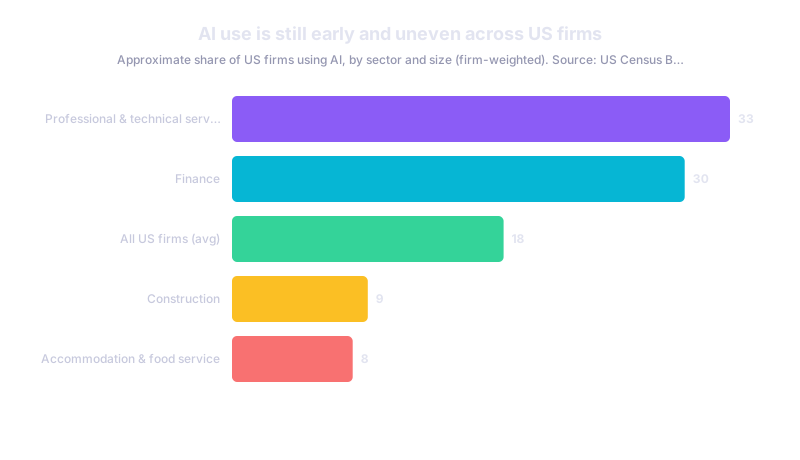
For context, AI use is still early across US businesses. Only about 37 percent of firms with 250 or more employees report using AI, and adoption across all firms is markedly lower (US Census Bureau BTOS, 2026). Small practices are not behind by moving carefully. You have time to set this up correctly rather than racing to plug PHI into whatever tool a staff member found first. If you are weighing an AI phone or intake tool, our guides on AI answering services for small business and whether AI can replace your receptionist walk through the practical tradeoffs, and what AI agents actually are separates the marketing from the reality.
What This Means for Your Business
If your practice wants to use AI without betting the clinic on a breach, the checklist is short and non-negotiable. One, decide whether the tool will ever see PHI; if the answer is no and you can keep it that way, most of HIPAA's weight lifts. Two, if it will see PHI, use only an enterprise or first-party API tier that comes with a signed BAA, and confirm in writing that your data is not used for training. Three, actually turn on the vendor's HIPAA mode and keep the BAA and covered-services list in your compliance file. Four, keep a human reviewing anything clinical, audit AI-assisted decisions for bias, and add every AI system to your technology inventory and risk analysis. Five, treat "HIPAA compliant" badges as sales copy and verify the plan yourself, because OCR does not certify anyone.
None of this requires you to be a lawyer, but the stakes (millions of exposed records, six- and seven-figure penalties, and real harm to patients) make it worth getting right the first time. If you want help evaluating vendors, drafting the internal policy, or building an intake or scheduling workflow that stays on the right side of the line, our team can help. Learn more about our AI and machine learning services or contact us for a practical, honest assessment of what your practice can safely automate.
This article is general information, not legal advice. Confirm current vendor terms and consult qualified counsel before deploying AI with protected health information.


