Only about 18% of US businesses were using AI to produce their goods or services in early 2026 - and among firms with four or fewer employees, adoption sat under 20%, versus 37% at companies with 250 or more staff (US Census Bureau Business Trends and Outlook Survey, 2026, and Federal Reserve FEDS Notes, 2026). For most small and mid-market operators, the thing standing between you and that first useful AI project is one question: who actually builds and maintains it?
Short answer: For most small and mid-sized businesses, an agency or fee-for-service partner is the smarter first move. A full-time AI engineer's average base pay runs roughly $134,000 to $185,000 before benefits (Glassdoor and Built In, 2026), and AI capabilities are now the single hardest skill set to hire for on the planet (ManpowerGroup, 2026). Hire in-house only once AI is core to your product and you have steady, ongoing work to justify a permanent salary - otherwise you're paying senior-engineer money to wait for the next task.
What a full-time AI engineer actually costs
The sticker price is high and the market is brutal. Built In pegs the 2026 US average AI-engineer base salary at $184,757, with total compensation around $211,243; Glassdoor's median base sits lower, near $134,023 (Built In and Glassdoor, 2026). That spread of roughly $50,000 tells you how loosely "AI engineer" is defined - the title covers everyone from a prompt-and-integration generalist to a research-grade model builder. On top of base pay, you carry benefits, payroll taxes, and equipment, which push the true annual cost meaningfully higher.
Then there's the hunt. ManpowerGroup's 2026 Global Talent Shortage Survey of 39,063 employers across 41 countries found that 72% report difficulty filling roles, and for the first time ever, AI skills - specifically AI model and application development (20%) - rank as the hardest capabilities to find worldwide, ahead of engineering and traditional IT (ManpowerGroup, 2026). "Companies are responding with upskilling and more flexible workforce models, recognizing they will need to hire for potential," said Jonas Prising, ManpowerGroup's Chair and CEO (ManpowerGroup, 2026). Translation for a 15-person company: you will compete for this person against firms that pay far more, and you may wait months.
This is the same math as the classic in-house marketing vs. agency cost decision, just with a scarcer, pricier hire.
The market itself is shifting from build to buy
Even large, well-funded companies have stopped building AI from scratch. In 2025, 76% of enterprise AI use cases were purchased from vendors rather than built internally - up sharply from roughly half just a year earlier (Menlo Ventures State of Generative AI in the Enterprise, December 2025). "AI is fundamentally rewiring how enterprises buy software," said Joff Redfern, a partner at Menlo Ventures (Menlo Ventures, 2025).
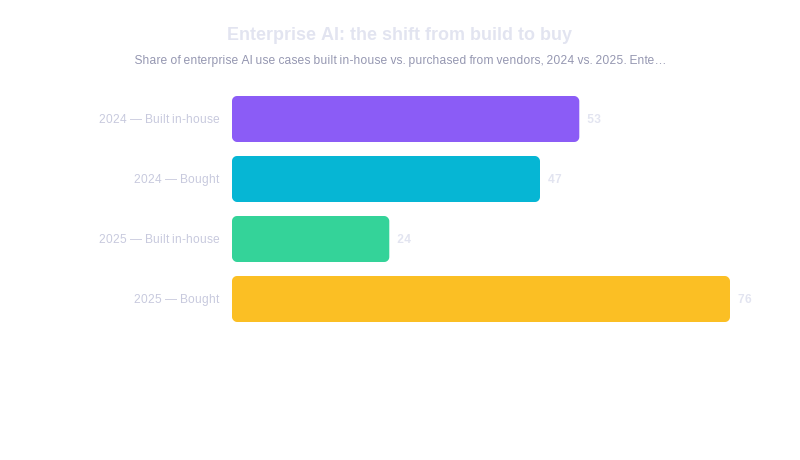
Important caveat: that 76% figure is enterprise data, not a small-business number. But the direction is instructive. If companies with deep engineering benches are increasingly choosing to buy, a business without a technical team almost certainly should - at least to start. A partner or off-the-shelf tool gets you to a working result in weeks instead of the many months an in-house build takes.
Most AI work is simpler than the job title suggests
A big reason you rarely need a research-grade hire: production AI is mostly plumbing, not invention. In enterprise deployments, prompt design is the dominant customization technique, with retrieval-augmented generation (connecting a model to your own documents) a distant second; fine-tuning and reinforcement learning remain niche (Menlo Ventures, 2025). And despite the hype, only 16% of enterprise deployments - and 27% at startups - are true "AI agents" that plan and act autonomously; most are fixed workflows with a single model call (Menlo Ventures, 2025).
In plain terms, most small-business AI wins - a support chatbot, a document summarizer, a lead-qualification workflow - are configuration-and-integration jobs, not deep ML research. That's precisely the work an agency or a good no-code setup handles well, and it's why our guides on AI chatbot cost and what AI agents really are matter more than any org chart.
Ignore the "95% of AI projects fail" scare - but respect the real risk
You've probably seen the "95% of AI projects fail" headline. It's folklore built on a misread of one preliminary, non-peer-reviewed MIT NANDA report based on a small set of interviews and surveys; the study itself is self-caveated as "directionally accurate." Its actual finding was narrower: for custom, task-specific GenAI tools, roughly 60% were evaluated, 20% piloted, and only about 5% reached production - while general-purpose tools like ChatGPT and Copilot moved from pilot to implementation about 83% of the time (MIT NANDA, State of AI in Business 2025). The lesson isn't "AI fails." It's "custom builds are where projects die, and general-purpose tools succeed far more often" - another point in favor of buying before building.
Set your expectations correctly, too. AI's payoff today is efficiency, not a revenue rocket: 66% of organizations report efficiency gains, but only 20% say they're already growing revenue from AI, versus 74% who merely hope to (Deloitte State of AI in the Enterprise, January 2026). A partner who promises a fast, cheap win on a well-scoped efficiency task is realistic; one promising transformational new revenue is selling you the hope, not the data. See our red flags when hiring an agency for how to vet the pitch.
When hiring in-house does make sense
Buy-first isn't buy-forever. Bring the work in-house when:
- AI is core to your product, not just a supporting tool behind the scenes - if your offering is the model, own it.
- You have continuous, ongoing work - a steady backlog that keeps a $150K+ salary busy every week, not a single project.
- Your data is highly sensitive or regulated and you can't hand it to an outside team.
- You've already validated version one with a partner and know exactly what you want to maintain and extend.
What This Means for Your Business
For the vast majority of small and mid-market operators, the answer is: start with an agency or fee-for-service partner, not a full-time hire. The salary is high, the talent is the scarcest on the market, most of the work is configuration rather than research, and even enterprises are overwhelmingly choosing to buy. The strongest play is usually hybrid - have a partner ship and validate your first one or two AI use cases, then decide what, if anything, is worth internalizing once you know the work is steady and core.
If you want a straight, no-hype assessment of whether your next AI project should be bought, built, or skipped entirely, talk to Semark or explore our AI and machine learning services. We'll tell you when an agency is the right call - and when it isn't.
Related reads: