
Only 1.74% of newly published pages crack Google's top 10 within a year, down from 5.7% in 2017 (Ahrefs, May 2025). So if you're wondering how long SEO takes to work, the honest answer is longer than most agencies admit, and it depends heavily on your industry.
Short answer: Most businesses see meaningful SEO results in 4 to 12 months, and Google's own guidance says to expect "four months to a year" before improvements show real benefit (Maile Ohye, Google). Break-even on the investment varies sharply by vertical: SEO agency First Page Sage reports roughly 5 months for construction and 6 for HVAC, and up to 14 months for legal services, based on its own client data (Q1 2021 to Q3 2025). Timelines run longer in competitive fields and for brand-new websites.
The Honest Answer: 4 to 12 Months, and Why
Google has been clear about this for years. In its official "How to Hire an SEO" guidance, Google's Maile Ohye put it plainly:
In most cases, the SEO will need four months to a year to help your business first implement improvements and then see the potential benefit.
That range is wide for a reason. SEO is cumulative, not a switch that flips. There's a difference between first traction, which is early movement in impressions and rankings you might see in 3 to 6 months, and break-even, the point where the revenue SEO generates covers what you spent to get there.
The data backs up the patience. Semrush analyzed 28,000 new domains over 13 months and found about 41% reached the top 10 within 6 months (Semrush). Progress is real, but it stacks up over quarters, not weeks.
Break-Even by Industry (First Page Sage Data)
This is where the "how long does SEO take" question gets specific. First Page Sage, an SEO agency, published break-even timelines from its own client campaigns run between Q1 2021 and Q3 2025. Treat this as directional vendor data, self-reported and not an independent benchmark, but it's one of the few sources that breaks results out by vertical.
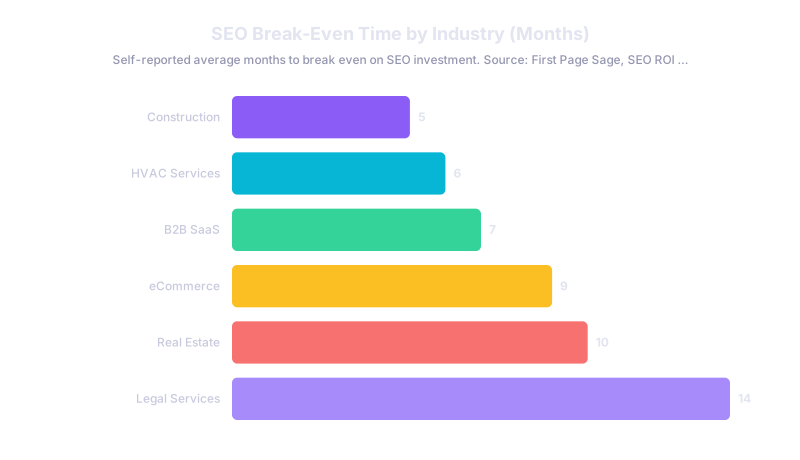
Here's how the industries in that report stack up (First Page Sage, Q1 2021 to Q3 2025):
| Industry | Break-Even | Reported ROI |
|---|---|---|
| Construction | ~5 months | 681% |
| HVAC Services | ~6 months | 678% |
| B2B SaaS | ~7 months | 702% |
| eCommerce | ~9 months | 317% |
| Real Estate | ~10 months | 1,389% |
| Legal Services | ~14 months | 526% |
Why Your Timeline May Be Longer (or Shorter)
Two factors move your clock more than almost anything else: your site's age and your competition.
New websites start slow. That 1.74% of new pages reaching the top 10 within a year (Ahrefs, May 2025) is a sobering number, and it gets worse when you learn that the average #1-ranking page is now 5 years old, up from 2 years in 2017 (Ahrefs, May 2025). Incumbents have a head start you have to earn your way past.
There's a flip side. Of the pages that do eventually reach the top 10, 40.82% got there within a month (Ahrefs, May 2025). Translation: the right page on a trusted site can move fast, but building that trust is the part that takes time. Content velocity and technical health accelerate results; thin content and broken foundations stall them.
Rankings Aren't Permanent, So Plan for Maintenance
Reaching the top 10 is not the finish line. In Semrush's 13-month study, only 27% of the pages that made the top 10 stayed there for the full period (Semrush). Rankings fluctuate, pages drop out and reappear, and competitors keep publishing.
This is the key difference between SEO and paid ads. Ads stop the moment you stop paying. SEO builds a durable asset, but like any asset it needs upkeep. Budget for ongoing work, not just a launch push, or you'll watch hard-won rankings erode.
How to Compress Your Timeline
You can't skip the clock, but you can tighten it:
- Fix technical foundations first so Google can crawl, index, and trust your site before you invest in content.
- Target lower-competition, high-intent local queries early. A "emergency plumber [your city]" page will rank and convert faster than a broad national term.
- Publish consistently. Steady output beats a one-time content dump.
- Build real brand mentions. Ahrefs found branded web mentions correlate with AI Overview visibility at 0.664, far above backlinks at 0.218, across roughly 75,000 brands (Ahrefs, May 2025). Brand-building now compounds into AI search too.
- Track leading indicators monthly. Watch impressions and target-term rankings, not just revenue, so you can see progress before break-even arrives.
What This Means for Your Business
Plan for 4 to 12 months, and give it at least 9 to 12 before you judge ROI. Match your expectations to your vertical, because a roofer and a personal-injury firm are not on the same clock. First Page Sage's own numbers show roughly a 3x spread between the fastest and slowest industries.
If you need leads this quarter, run paid ads alongside SEO while the organic work matures. See our breakdown of Google Ads vs. SEO for local business and how to measure digital marketing ROI to set the right benchmarks. For the fundamentals, start with our SEO strategy guide: zero to page one and what actually moves the needle for business websites in 2026.
Above all, be skeptical of anyone promising page-one results in 30 days. That's a sales tactic, not a forecast.
Not sure what a realistic SEO timeline looks like for your industry? Get a straight answer and a break-even estimate for your business, talk to Semark.