
AI now writes roughly half of all new online articles, yet 86% of the pages that actually rank on Google are still human-written (Graphite, 2025). The volume and the visibility have completely diverged - and that gap is the most useful thing a small business can know about AI content right now.
Short answer: No - AI-written content is not automatically penalized, but raw, unedited AI content rarely wins. Google says it rewards quality "rather than how content is produced" (Google Search Central, 2023), yet the data shows human effort still dominates what gets found: 86% of pages ranking on Google and 82% of pages cited by ChatGPT and Perplexity are human-written, even as AI generates roughly half of all new articles (Graphite, 2025). AI is a fine drafting assistant; publishing raw AI output with no human expertise, editing, or original insight is what hurts you.
Does Google penalize AI content? What Google actually says
There is no "AI-detection penalty" in Google Search. Google's official position, published in its February 2023 Search Central guidance, is that it judges the output, not the tool: "Our focus on the quality of content, rather than how content is produced, is a useful guide that has helped us deliver reliable, high quality results to users for years" (Danny Sullivan and Chris Nelson, Google Search Quality team, 2023).
The nuance that trips people up is Google's separate policy on scaled content abuse - producing many pages primarily to manipulate rankings rather than help people. AI didn't create that problem; it just made it cheap to mass-produce. So the thing Google targets isn't "a machine wrote this." It's thin, unoriginal, low-value content - which is exactly what most unedited AI output looks like.
For a small business, that reframes the whole question. It was never "AI or human." It's "is this page genuinely useful, original, and backed by real experience?" Content that demonstrates first-hand expertise and trustworthiness is what Google's systems are built to reward - the qualities it summarizes as E-E-A-T (experience, expertise, authoritativeness, trustworthiness).
What 65,000 URLs reveal about AI content and rankings
This is where the data gets blunt. Graphite ran two connected analyses in 2025. In one, it sampled roughly 65,000 URLs from the Common Crawl web archive (published January 2020 to May 2025) using Surfer's AI detector, flagging an article as AI-generated when more than half its content read as machine-written (Graphite, via Axios, 2025). In the other, it checked who actually wins visibility.
The visibility numbers are striking: 86% of pages ranking on Google are human-written, and only 14% are AI. For pages cited by ChatGPT and Perplexity, 82% are human-written and 18% are AI (Graphite, 2025). At the very top, the gap is wider still - just 7% of the articles ranking in Google's #1 position are AI-generated.
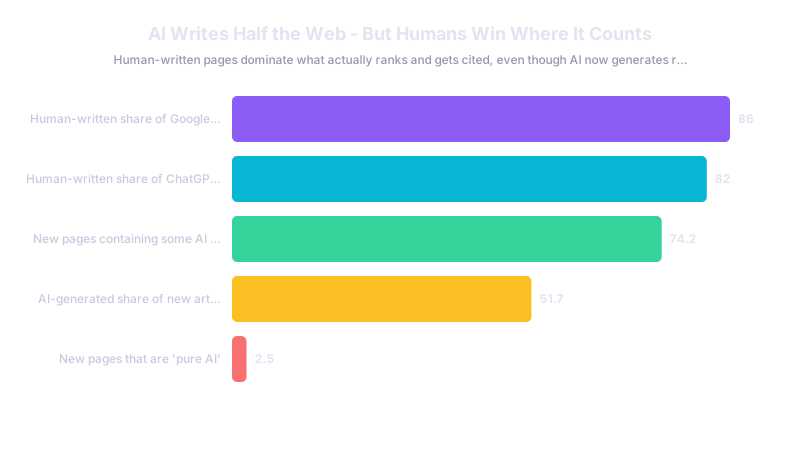
The takeaway is simple and a little uncomfortable for anyone running an AI content farm: producing AI content at scale does not translate into rankings or AI-engine citations. The machines write a huge share of the web, and win almost none of the places people and answer engines actually look.
AI is now half of new content - so why doesn't it rank?
Because "AI touched it" and "AI wrote all of it" are very different things. Ahrefs analyzed 900,000 newly created web pages in April 2025 and found that 74.2% contained some AI-generated content - but only 2.5% were "pure AI" (almost entirely machine-generated). The largest slice, 71.7%, was a human-AI mix, and 25.8% was purely human (Ahrefs, 2025).
That mixed middle is where the winners live: content that started as an AI draft but was shaped by real editing, expertise, and original data. Pure, unedited AI output tends to fail for a structural reason - AI models trained on the same sources produce interchangeable pages. When ten businesses publish the same competent-but-generic answer, none of them stands out, and there's nothing for a search or answer engine to prefer.
What breaks the sameness is exactly what earns citations: original research, real quotes, and hard statistics. In a controlled study of generative-engine visibility ("GEO: Generative Engine Optimization," ACM KDD 2024), adding quotations was the single best-performing tactic, lifting visibility by about 41%, with adding statistics close behind at roughly 32% - an overall boost of up to 40% (Aggarwal et al., 2024). Notably, old-school keyword stuffing actually hurt visibility in that study (about -9%). One caveat worth stating plainly: those figures come from a synthetic academic benchmark, not from live local-business queries, so treat them as directional rather than guaranteed.
How to use AI without tanking your SEO
The practical playbook that follows from this data is short:
- Use AI for drafting, outlining, and research acceleration - not as a publish button. Speed on the first draft is a legitimate win. Publishing that draft untouched is the mistake.
- Add what AI structurally can't: first-hand experience, proprietary data, named sources, and a clear point of view. This is the difference between the 2.5% "pure AI" pages and the human-AI mix that ranks.
- Cite sources, add statistics, and include real quotes. These aren't just credibility signals for readers - they're the tactics shown to lift visibility in AI search (GEO study, ACM KDD 2024).
- Have a subject-matter expert edit every piece. Thin, generic pages are the ones that get demoted under scaled-content policy; an expert pass is what removes that risk.
- Match content to real search and answer-engine intent, not keyword volume alone. The goal is to be the most useful answer to a specific question, not to hit a word count.
What This Means for Your Business
AI is a productivity tool, not a content strategy. The businesses winning search and AI visibility in 2025 aren't the ones publishing the most AI pages - they're the ones pairing AI's speed with human expertise. If you're shipping raw AI output, you're competing inside the roughly half of new content that mostly doesn't rank or get cited.
So spend your editing time where it compounds: original insight, local expertise, and trustworthy sourcing. That's not just the "safe" SEO play anymore - it's the same combination that earns citations in ChatGPT and Perplexity, which means the "don't get penalized" strategy and the "get found by AI" strategy have merged into one. (If you're building your toolkit, our roundup of the best AI tools for small business is a good starting point.)
Want content that ranks and gets cited by AI - not lost in the half of the web that doesn't? See our Generative Engine Optimization services or get in touch.