
Recurring subscriptions drive 74% of total pest control revenue (NPMA/PCO Bookkeepers 2025 Cost Study). That single number should change how you buy, measure, and value every marketing lead.
Short answer: In pest control, recurring plans account for 74% of total revenue (NPMA/PCO Bookkeepers 2025 Cost Study), so the most valuable lead isn't a one-off job, it's a customer who signs a quarterly or monthly plan. The marketing that produces those leads is local and reputation-led: a fully optimized Google Business Profile, a steady flow of fresh reviews (Google is the dominant review platform at 83%, BrightLocal 2025), and local service-area pages that rank for "pest control near me." Measure leads by their recurring-plan conversion and lifetime value, not by raw call volume.
Why recurring revenue changes what a lead is worth
Most pest control marketing is sold and measured like a plumber's: pay for calls, count calls. That's the wrong scoreboard for a business where 74% of revenue is recurring (NPMA/PCO Bookkeepers 2025 Cost Study, based on 246 firms and $584 million in combined revenue). A one-time cockroach treatment pays once. A quarterly plan pays four times a year and compounds across a multi-year customer lifetime.
The economics reinforce it. The same study puts the industry's average gross margin at 58% and operating profit margin at 15%, with revenue growing 9.5% year over year. When margins are that healthy and retention is the growth lever, the dollar that converts a one-off job into a signed plan is worth far more than the dollar that just makes a phone ring.
As Dan Gordon, founder of PCO Bookkeepers & M&A Specialists, put it in the study release: "companies with strong recurring revenue models and disciplined cost management are significantly outperforming their peers." So reframe your core metric. Stop reporting cost per call and start reporting cost per recurring subscriber.
Reviews are the front door to recurring plans
Before a homeowner signs a plan, they check your reputation. In BrightLocal's 2025 Local Consumer Review Survey (1,026 US consumers), only 4% say they never read online business reviews, meaning roughly 96% read them at least occasionally. And they read them where you'd expect: Google is the top review platform at 83%, well ahead of Yelp (44%) and Facebook (40%).
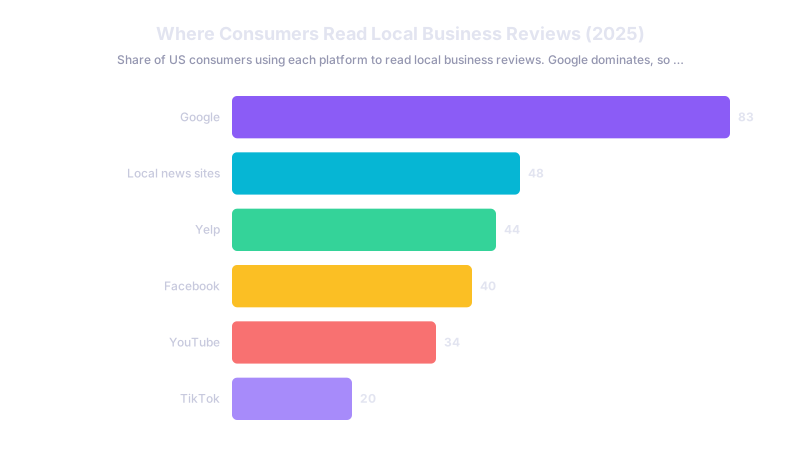
That concentration on Google is good news, because it means one platform carries most of your reputation weight. Build a systematic ask-for-review flow tied to every completed service visit: a text or email with a direct Google review link, sent while the technician's work is fresh. Then respond to reviews publicly, positive and negative. Public responses signal reliability to prospects and give Google fresh, relevant content to associate with your profile. For the mechanics, see our guide on how to get more five-star reviews.
Local search: own the map for every service area
Reviews feed local search, and local search is where "near me" intent turns into booked plans. Start with a single, strong Google Business Profile: correct service categories, real photos, populated Q&A, and consistent hours. Then build dedicated service-area pages for each city or suburb you cover, rather than cramming every location into one generic page.
Target intent that maps to plans, not just emergencies: "termite treatment [city]," "quarterly pest control near me," "rodent control [suburb]." Keep your name, address, and phone (NAP) consistent across citations, and pair each service-area page with the local landing content that supports map-pack visibility. Our local SEO guide for service businesses covers the full build.
Get found by AI search, not just Google's blue links
The next competitive shift is already here: AI summaries are absorbing clicks that used to go to organic listings. Ahrefs' December 2025 data found that the presence of an AI Overview correlates with a 58% lower average click-through rate on the top-ranking result (Ahrefs, 2025). Pew Research Center's July 2025 study found the same pattern from the user side: people clicked a search result in just 8% of visits when an AI summary appeared, versus 15% when it didn't (Google has publicly questioned Pew's methodology).
So how does an AI engine decide which pest control firm to name? Less by backlinks than by how often your brand is mentioned across the web. Ahrefs' May 2025 analysis of 75,000 brands found brand web mentions correlate with AI Overview visibility at 0.664, versus just 0.218 for backlinks, and the most-mentioned quartile of brands averaged roughly 169 AI Overview mentions against about 14 for the next quartile (Ahrefs, 2025).
On the page itself, a few tactics help. The academic "GEO: Generative Engine Optimization" study (Aggarwal et al., ACM KDD 2024) found that citing sources, adding quotations, and adding statistics delivered up to a 30-40% relative improvement in generative-engine visibility, while keyword stuffing was counterproductive. Treat those figures as directional, not gospel: they come from a synthetic academic benchmark, not from local-service queries. But the direction is sound, cite real numbers and sources, and get your brand named across the local web.
Track the metrics that reflect recurring revenue
If recurring revenue is the goal, your reporting has to follow the subscriber, not the call. Replace "leads generated" with two numbers: cost per recurring subscriber and plan-conversion rate (what share of leads become plans). Then model customer lifetime value against acquisition cost across a realistic, multi-year retention curve, that's the only comparison that tells you whether a channel is actually profitable.
Use the industry benchmark as a guardrail: pest control firms spend an average of 6.6% of revenue on marketing and advertising (NPMA/PCO Bookkeepers 2025 Cost Study). Finally, tie every lead source, Google Business Profile, organic search, reviews, and paid ads, to the plans it actually produces, so you fund the channels that sell subscriptions rather than the ones that just generate ringing phones.
What This Means for Your Business
- Spend to acquire subscribers, not calls. Measure lifetime value against acquisition cost, not cost per lead, because 74% of your revenue is recurring.
- Reviews and Google Business Profile are your highest-leverage, lowest-cost levers. Google carries 83% of review reading, so systematize the ask and respond publicly.
- Add GEO basics (real statistics, cited sources, and brand mentions across the local web) so AI search surfaces you as AI Overviews absorb clicks.
- Build local service-area pages that convert "near me" intent into recurring plans, one page per city, not one generic page.
