
You have probably seen the headlines: "8% of businesses use AI," "78% of the workforce is at an AI company," "95% of AI projects fail." A single April 2026 Federal Reserve note reports U.S. AI adoption as 18%, 78%, and 41% - three different numbers, on the same page, all correct (Federal Reserve FEDS Notes, 2026). The gap is not sloppiness. It is measurement.
Short answer: The stats conflict because they count different things. "18% of firms" counts companies (mostly tiny ones). "78%" counts the share of employees who work at an AI-adopting firm, which is dominated by large employers. "41%" counts individual workers who personally use generative AI. All three are accurate; they answer different questions. For a small business owner, the firm-weighted number - roughly 18-20% - is the one that describes companies like yours.
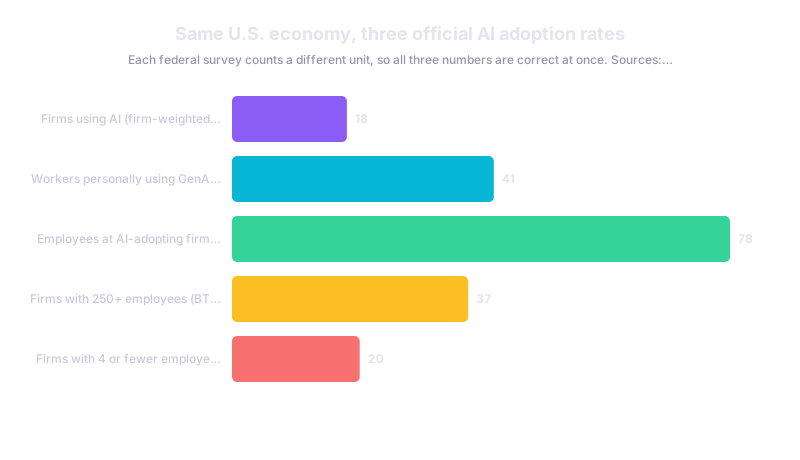
The same economy, measured three ways
In its April 2026 FEDS Note, Federal Reserve economist Jeffrey S. Allen lined up three federal surveys running at the same time. The U.S. Census Bureau's Business Trends and Outlook Survey (BTOS) put firm-weighted AI adoption at 18% in December 2025. The Atlanta Fed's Survey of Business Uncertainty put it at 78% in November 2025. The Real-Time Population Survey put the share of workers personally using generative AI at 41% (Federal Reserve FEDS Notes, 2026).
The reason 78% dwarfs 18% is weighting. As Allen writes, "An employment-weighted firm-level estimate, like the SBU, should generally be higher than an individual-level estimate because the former weights by employee headcount when calculating the average adoption rate across firms" (Federal Reserve FEDS Notes, 2026). In plain terms: one 5,000-person bank that adopts AI moves the employment-weighted number far more than a thousand two-person landscapers who do not. Count companies and you get a low number, because most U.S. companies are very small. Count employees and you get a high one, because most employees work at large firms - and large firms adopt AI first.
Firm size is the hidden variable
Adoption is not spread evenly, and that is what breaks the "one true number." Census BTOS data shows firms with 4 or fewer employees at under 20% adoption, while firms with 250 or more employees sit at 37% (U.S. Census Bureau, 2026). Between December 2025 and May 2026, adoption rose only among firms with 20 or more employees; the smallest firms showed no significant change (U.S. Census Bureau, 2026).
So when a vendor tells you "most businesses are already using AI," ask which businesses. The honest firm-weighted figure hovered between 17% and 20% through early 2026, with 20-23% of businesses expecting to use AI within six months (U.S. Census Bureau, 2026). If you run a shop, clinic, or trade business with a handful of employees, you are the majority that has not deployed AI yet - not a laggard, just an accurate reading of the small-business economy. Our piece on AI vs. hiring an employee walks through when adoption actually pays for a small team.
Industry changes the number too
Sector is the next fork. Census BTOS reported the Information sector at 39.7% current AI use and Finance & Insurance at 33.9%, while Retail Trade sat near 14% (U.S. Census Bureau, 2026). A professional-services or finance firm reading "one third of businesses use AI" sees its own neighborhood; a restaurant or construction firm reading the same line sees a number two to four times its reality. Neither is wrong. They are describing different industries averaged into one misleading headline.
The "95% of AI projects fail" number is folklore
The scariest stat is also the most abused. "95% of AI projects fail" traces to MIT's NANDA "State of AI in Business 2025" report - a preliminary, non-peer-reviewed paper built on 52 interviews and roughly 153 survey responses, which explicitly caveats that its findings are "directionally accurate based on individual interviews rather than official company reporting" (MIT NANDA, 2025). What the report actually found: for custom, task-specific generative-AI tools that companies build themselves, about 60% get evaluated, 20% reach a pilot, and only about 5% reach production. But for general-purpose tools like ChatGPT and Copilot, the pilot-to-implementation rate was roughly 83% (MIT NANDA, 2025).
Read carefully, that is close to the opposite of "AI doesn't work." Buying a proven tool succeeds most of the time; building a bespoke system from scratch usually stalls. The "95% fail" headline quietly swaps one denominator for the other. If you are a small business, the practical lesson is to buy before you build - see our best AI tools for small business guide.
Even "success" means efficiency, not revenue - yet
When adoption does stick, be precise about what it delivers. Deloitte's State of AI in the Enterprise (n=3,235 leaders, surveyed August-September 2025) found 66% of organizations reporting productivity and efficiency gains, but only 20% already achieving revenue growth from AI, while 74% still hope to (Deloitte, 2026). That is enterprise data, not small-business data - but the pattern is worth borrowing: AI reliably saves time before it reliably makes money. Budget for the hours-saved win first.
What This Means for Your Business
Next time a statistic tells you "X% of businesses use AI," run three checks before you believe it. First, what is being counted - firms, employees, or individual workers? A firm-weighted number near 18-20% describes companies; an 78% employment-weighted number describes where the workforce sits. Second, what size and sector the number covers - a 37% figure for 250-plus-employee firms says nothing about your five-person team, and a 34% finance figure says nothing about a restaurant. Third, what "use" and "fail" mean - a bought chatbot and a custom-built model have wildly different odds, and "efficiency gains" is not the same claim as "revenue growth."
For most small and local businesses, the accurate takeaway is calm: fewer than one in five firms your size has adopted AI, the ones that succeed mostly buy rather than build, and the first real payoff is saved time, not new sales. That is a reason to move deliberately, not to panic.
If you want an honest read on whether AI fits your specific business - no inflated stats, no hype - talk to our team or explore our AI and machine learning services. We will tell you which of these numbers actually applies to you.