
Only two-thirds of organizations running enterprise AI report efficiency gains, and just 20% say they are already growing revenue from it - even though 74% hoped to (Deloitte, State of AI in the Enterprise, 2026). That gap is the whole reason to run a small, cheap pilot before you spend on a big one. This guide walks through what a real AI pilot costs, how many weeks it takes, and where the money quietly disappears.
Short answer: For a scoped AI pilot on one use case, US vendor pricing pages put a lightweight proof-of-concept at roughly $15,000-$30,000 and a standard pilot at $50,000-$100,000 (Agentic AI Pricing, 2026); a UK specialist consultancy quotes a fixed-fee proof-of-concept at £15,000-£40,000 over two to four weeks (Winder.AI, 2026). Most of that budget goes to data preparation and integration, not the AI model itself - the API bill is usually the smallest line item. Expect a proper proof-of-concept in weeks, not months, and treat "the pilot worked" as very different from "we're ready for production."
Two different things people call "a pilot"
Before you can price anything, you have to separate two stages that get lumped together.
A proof-of-concept (POC) answers one question: can this work at all on our data? A pilot answers a harder one: does it work in practice, with real users, in a controlled slice of the business? Dr. Phil Winder, CEO of the AI consultancy Winder.AI, puts the scoping discipline bluntly: "A proper POC has a defined scope and a binary success criterion. It is not a demo" (Winder.AI, 2026). If your vendor can't tell you the single yes/no question the POC will answer, you're buying a demo, not a test.
The reason this matters for your budget is that the two stages cost very different amounts. Winder.AI prices a fixed-fee POC - one use case, one real data sample, one model under test, an evaluation harness with at least one quantitative metric, and a written go/no-go recommendation - at "£15,000 to £40,000, fixed fee, two to four weeks." A pilot with real users in a controlled environment runs £40,000-£120,000 over six to ten weeks (Winder.AI, 2026). US vendor pricing pages land in a similar shape in dollars: a lightweight POC around $15,000-$30,000 and a standard pilot around $50,000-$100,000, with comprehensive enterprise pilots quoted at $150,000-$300,000 (Agentic AI Pricing, 2026). Treat those dollar figures as marketing self-reports rather than audited averages - but the pattern across sources is consistent enough to budget against.
Where the money actually goes (hint: not the model)
The single most common budgeting mistake is assuming the AI model is the expensive part. It rarely is. The per-token price of calling a modern language model is typically the smallest line item in a pilot - the cost lives in getting your data ready and wiring the system into the tools you already use.
Winder.AI estimates that data engineering alone represents "30 to 50% of POC effort in data-heavy projects" (Winder.AI, 2026). That tracks with what most operators discover: your customer records, invoices, tickets, and documents are messy, scattered across systems, and not in a form an AI can reliably read. Cleaning and connecting that data is the job. The model is almost an afterthought by comparison.
This has a practical consequence. If a vendor's quote is dominated by "model fine-tuning" or exotic AI engineering, be skeptical. Across production enterprise deployments, the dominant customization technique is simple prompt design, with retrieval (feeding the model your documents at query time) a distant second; fine-tuning and reinforcement learning remain niche (Menlo Ventures, State of Generative AI in the Enterprise, 2025). A pilot that leads with fine-tuning is usually solving a problem you don't have yet. For a plain-language look at what these tools cost to run day to day, see our AI chatbot cost guide for small business.
How long a pilot really takes
Timelines are more predictable than costs. A scoped proof-of-concept is a weeks-long exercise, not a quarter-long one - Winder.AI's "two to four weeks" for a POC and "six to ten weeks" for a pilot are representative of the market (Winder.AI, 2026). US vendor pages describe a similar cadence: discovery and data integration in weeks one to three, initial deployment and testing in weeks four to six, refinement through week nine, and evaluation and scaling decisions by week twelve for a standard engagement (Agentic AI Pricing, 2026).
What blows up a timeline is almost never the AI. It's data remediation (your records aren't ready), scope creep (the one use case quietly becomes three), and integration with legacy systems. If a proposed pilot is scheduled for six months before you see any result, that's a signal the scope is too broad or the data isn't ready - not that AI is inherently slow.
The trap after the pilot: "it worked" is not "it's ready"
Here is the most expensive misunderstanding in the whole process, and it's a budgeting problem, not a technical one. Winder.AI names it directly: "The biggest single budget mistake we see is conflating 'the POC worked' with 'we are close to production'" (Winder.AI, 2026). A demo that works on clean sample data is a long way from a system that runs reliably every day with monitoring, error handling, and security. Winder.AI estimates that production hardening adds another 15-25% on top of build costs (Winder.AI, 2026), and other vendors describe pilots that scale from tens of thousands of dollars into a quarter-million once reliability, monitoring, and scaling layers are added.
The data on how often that leap actually happens should shape your expectations. In MIT NANDA's "State of AI in Business 2025," roughly 60% of organizations evaluated custom, task-specific generative-AI tools, about 20% reached a pilot, and only about 5% reached production. Two important caveats: that report is preliminary and non-peer-reviewed - the authors describe it as "directionally accurate based on individual interviews rather than official company reporting" - and the low number applies specifically to custom-built tools. General-purpose tools people adopt off the shelf, like ChatGPT or Copilot, move from pilot to everyday use far more often. The widely repeated "95% of AI projects fail" headline is a distortion of this narrower finding; don't let it scare you off, but do respect the underlying lesson: custom builds are where projects stall.
Build vs. buy: what the enterprise shift does - and doesn't - mean for you
You'll see a striking statistic quoted everywhere: 76% of enterprise AI use cases are now purchased from vendors rather than built in-house, up from a roughly even 53%-purchased / 47%-built split in 2024 (Menlo Ventures, n=495, 2025). Large companies are increasingly buying rather than building.
Read that carefully: it's enterprise data, not small-business data, and it doesn't mean "never build." For most small and mid-market operators, the honest default is to buy or configure an existing tool for standard jobs - answering phones, scheduling, first-line support - and reserve a custom pilot for a workflow that is genuinely specific to how you make money and that no off-the-shelf product handles. A related caution: the word "agent" is mostly marketing right now. Only about 16% of enterprise AI deployments qualify as true agents that plan and adapt; the rest are fixed workflows wrapped around a single model call (Menlo Ventures, 2025). If you're weighing a custom build against buying, our guides on AI agents for small businesses and when to automate vs. when to hire are useful companions.
A realistic budget checklist
Before you approve any AI pilot spend, get these in writing from your vendor or internal team:
| Line item | What to ask for |
|---|---|
| The one question | The single binary go/no-go criterion the POC will answer |
| Data readiness | Who preps the data, and what share of the budget it is (often 30-50%) |
| Fixed vs. hourly | A fixed-fee POC where possible; US specialist rates run ~$200-$400/hr (Agentic AI Pricing, 2026) |
| Timeline | Weeks to first result, with a named checkpoint |
| Path to production | What "production-ready" adds in cost and time (often +15-25%) |
| Success metric | One quantitative measure tied to efficiency, not vague "AI capability" |
What This Means for Your Business
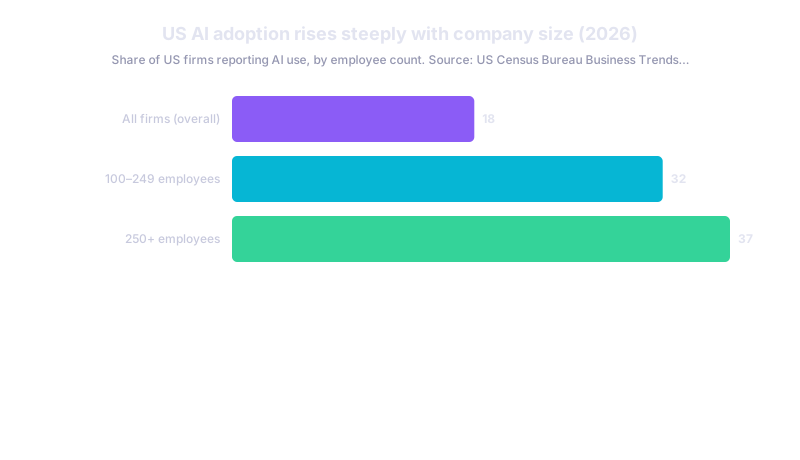
You are not behind. Fewer than 20% of the smallest US firms (four or fewer employees) use AI at all, versus 37% of firms with 250-plus employees - adoption still rises steeply with company size (US Census Bureau BTOS / Federal Reserve, 2026). So a pilot is a deliberate bet, not a race you're losing. Make that bet small and specific: a fixed-fee proof-of-concept, on one painful workflow, answering one yes/no question, in a few weeks, for a mid-five-figure budget. Judge it on a single efficiency metric - because efficiency, not new revenue, is where AI is actually delivering today (Deloitte, 2026). If the POC clears its bar, then - and only then - budget separately for the pilot and the far larger cost of making it production-grade. If it doesn't, you've spent a small, planned amount to avoid a large, unplanned one. That is the entire point.
If you'd like help scoping a pilot down to one honest go/no-go question - and an estimate you can actually budget against - talk to us through our AI & machine learning services or get in touch.