Intercom reports its Fin AI agent now resolves an average of 76% of support conversations across more than 7,000 teams (Intercom, self-reported, 2026) - a figure that sounds like it should cut your support workload by three-quarters. It won't, and understanding the gap between that headline and your reality is the difference between AI support that saves money and AI support that quietly loses customers.
The short version: AI support deflection reliably saves money on repetitive, well-documented questions - password resets, order status, store hours, return policies - but the "deflection rate" most vendors advertise counts customers who simply gave up as successes. The metric that protects your business is resolution rate: the share of issues the AI actually solved without a human. Optimize for deflection alone and you cut staffing costs while quietly raising repeat contacts, bad reviews, and churn.
Deflection and resolution are not the same number
This is the single most important distinction in the category, and most buyers miss it. Zendesk defines ticket deflection as routing customers "away from human support queues through options like FAQ links, help center articles, chatbots, or self-service portals," while resolution means "the issue is fully completed during the interaction" - a refund processed, an order changed, an accurate answer given (Zendesk, 2026).
Zendesk's own worked example makes the trap concrete. Imagine 1,500 password-reset tickets "deflected" by a self-service flow. Within that 1,500, "1,200 employees reset their passwords successfully, but 200 contacted IT within 24 hours, and 100 abandoned the flow" (Zendesk, 2026). Every one of those 1,500 counts as deflected. Only 1,200 - 80% - were actually resolved. The other 300 didn't vanish; 200 came back through a more expensive channel and 100 walked away unhappy.
That is the mechanism behind what practitioners call false deflection: a customer who abandons a chat because the bot gave a useless answer has been "deflected" by most measurement conventions, even though nothing was solved. Zendesk is explicit that a real resolution rate should exclude "contained" interactions "where the user gives up" or where the AI gives "vague, incomplete, or irrelevant answers that respond without fixing the issue" (Zendesk, 2026). A deflection number that hides those cases isn't measuring savings - it's hiding cost.
What deflection actually saves: cost, not revenue
When AI support does pay off, it pays off as efficiency, not growth. In Deloitte's enterprise survey, 66% of organizations reported that generative AI has already delivered efficiency and productivity gains, but only 20% said it was already increasing revenue - against 74% who hope it eventually will (Deloitte State of AI in the Enterprise, 2026 report, n=3,235).
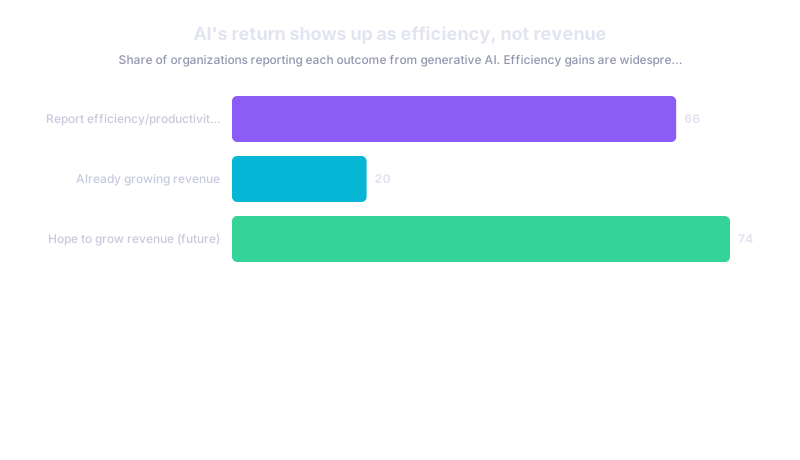
Read that as a warning against the wrong business case. Deflection is a cost-avoidance play: it lets a fixed support team absorb more volume, cover nights and weekends without overtime, and stop paying human agents to answer the same five questions all day. Those are real savings. What deflection does not do is grow revenue on its own - and if the AI frustrates customers on the way to "saving" you a ticket, it can quietly cost you the far larger lifetime value of the account. Size the investment against the payroll hours you genuinely remove, not against a revenue story. Our AI chatbot cost guide for small business walks through that math.
The vendor headline versus your reality
That 76% Intercom figure is a self-reported average across thousands of accounts, and averages hide enormous spread. Simpler, well-documented products with heavy repeat-question volume sit well above it; businesses with complex, account-specific, or judgment-heavy tickets sit well below. The right question isn't "what does the vendor's average customer get" - it's "what percentage of my actual tickets are answerable from documentation I already have."
Two more industry realities keep expectations honest. First, most tools marketed as autonomous "AI agents" are closer to scripted workflow automation: Menlo Ventures found only 16% of enterprise generative-AI deployments are true agents (Menlo Ventures State of Generative AI in the Enterprise, n=495, December 2025). Second, the widely repeated "95% of AI projects fail" line is folklore - it comes from a preliminary, non-peer-reviewed MIT NANDA write-up whose actual finding was more nuanced: general-purpose tools like ChatGPT and Copilot reached implementation in roughly 83% of cases, while custom, task-specific builds stalled far more often (MIT NANDA, State of AI in Business 2025). The lesson for support: buy a proven, configurable tool for a narrow job rather than commissioning a bespoke agent and hoping.
It also helps to remember how early most businesses still are. Fewer than 20% of U.S. firms with four or fewer employees report using AI at all (U.S. Census Bureau BTOS, 2026). If you deploy support AI thoughtfully, you're ahead of most of your local competition - which is exactly why doing it well, not just fast, matters.
What breaks when you chase deflection
Customers are far less forgiving of a broken bot than the deflection dashboard suggests. In Zendesk's 2026 research, 85% of CX leaders said customers will drop a brand that can't resolve their issue on the first contact - regardless of channel (Zendesk CX Trends 2026). Push people into a deflection flow that doesn't actually solve their problem and you're not saving a ticket; you're manufacturing a churn risk and, often, a public review.
Trust is the other casualty. 95% of consumers say they want to understand why an AI made the decision it did, and 88% of customers now expect faster responses than they did just a year ago (Zendesk CX Trends 2026). A bot that stonewalls, loops, or hides the path to a human violates all of that at once. The fix is not more aggressive deflection - it's a visible, fast escape hatch to a person the moment the AI is out of its depth, plus honest measurement of how often it needs one. If you're weighing where a human still beats automation, when to automate versus when to hire lays out the tradeoff.
Where deflection genuinely works for a small business
None of this argues against AI support. It argues for pointing it at the right tickets. Deflection earns its keep when three things are true: the questions are high-volume and repetitive, the answers live in documentation you can keep current, and being wrong is low-stakes. Order status, hours and location, return and shipping policy, appointment booking, basic account changes, and "how do I…" product questions are the sweet spot - and covering them 24/7 matters, since 74% of consumers now expect service to be available around the clock (Zendesk CX Trends 2026).
The inverse is just as important. Anything requiring judgment, empathy, negotiation, or access to messy account history - billing disputes, cancellations, complaints, anything a regulator or a lawyer might read later - belongs with a human, or with an AI that hands off cleanly and early. For phone-heavy service businesses, the same logic applies to voice; see can AI replace my receptionist for where the line sits there. And if you're evaluating whether "AI agent" claims from vendors are real, what AI agents actually are separates the marketing from the mechanism.
Here's what that looks like in practice. Say you run a 12-person online homeware store fielding 400 support messages a week. Roughly 250 of them are "where's my order," "how do I start a return," and "do you ship to my state" - questions whose answers already live in your shipping and returns pages. Point an AI at exactly those three intents, connected to your order-tracking system, and it can close most of them at any hour without a human touching the queue. That is a clean efficiency win: your two support staff stop retyping the same tracking-lookup 250 times a week and spend that time on the 150 messages that actually need a person. Now suppose the AI also tries to handle "I was charged twice" or "this arrived broken and I'm furious." Those need account judgment and a calm human tone. If the bot fumbles them to protect a deflection score, you don't save a ticket - you turn a recoverable problem into a one-star review. The store that wins isn't the one that deflects all 400; it's the one that resolves the right 250 and routes the other 150 fast. For a broader map of which tasks to automate first, see simple AI automations for small business.
What This Means for Your Business
AI support deflection is a genuine efficiency tool and a bad vanity metric wearing the same name. To capture the savings without the damage:
- Measure resolution, not deflection. Track the share of AI conversations that ended with the customer's problem actually solved - and subtract repeat contacts within 24-48 hours. In Zendesk's own example, that adjustment turned a 100%-deflected batch into an 80% real-resolution rate (Zendesk, 2026); expect a similar gap in your own numbers.
- Scope it narrowly first. Start with your top handful of repetitive, well-documented questions. Expand only as verified resolution stays high.
- Build the escape hatch in from day one. With 85% of leaders saying one failed first contact loses the customer, an easy, fast route to a human isn't a fallback - it's the product.
- Justify it on hours removed, not revenue. Deflection saves payroll and after-hours coverage; it does not, by itself, grow sales.
Want help scoping support automation to the tickets it can genuinely resolve - and measuring it honestly? Semark builds and evaluates AI support systems for small and mid-market operators. See our AI and machine learning services or book a consultation.