
What Is Brand Identity Design?
Brand identity design is the process of creating the visual elements that represent your business. It is how your brand looks, feels, and communicates visually - across every touchpoint from your website to your business cards.
If branding is the strategy (positioning, voice, values), then brand identity is the execution - the tangible design system that makes that strategy visible.
Done well, brand identity creates instant recognition, builds trust, and makes every piece of marketing you produce feel cohesive and professional.
The Elements of Brand Identity
Here is a brand identity completeness scorecard - rate yourself on each element:
| Element | Not Started | Basic | Professional | Best-in-Class |
|---|---|---|---|---|
| Logo (primary + variations) | No logo | DIY/Canva logo | Professional design | Full logo system with guidelines |
| Color palette | No defined colors | 1-2 colors chosen | Full palette with codes | Palette with accessibility ratios |
| Typography | Default system fonts | 1 chosen font | Heading + body fonts | Full type scale with hierarchy |
| Photography style | Random stock photos | Consistent stock | Directed photography | Custom branded photography |
| Brand guidelines | None | Logo usage only | Visual identity guide | Comprehensive brand book |
| Templates | None | 1-2 templates | Social + presentation | Full template library |
| Brand voice | Undefined | General idea | Written guidelines | Voice with examples per channel |
1. Logo Design
Your logo is the cornerstone of your visual identity. It appears on everything - website, social profiles, email signatures, invoices, presentations, merch.
Types of Logos:
| Type | Description | Best For | Example |
|---|---|---|---|
| Wordmark | Business name in a custom typeface | Simple, memorable names | Google, FedEx |
| Lettermark | Initials or abbreviation | Long business names | IBM, HBO |
| Icon/Symbol | Abstract or representational graphic | Established brands | Apple, Nike |
| Combination | Icon + wordmark together | Most businesses | Spotify, Airbnb |
| Emblem | Text inside an icon or badge | Traditional, authoritative | Starbucks, Harley-Davidson |
What Makes a Great Logo
Simplicity - The best logos are deceptively simple. If you cannot describe it in one sentence, it is too complex.
Scalability - It must look good at 16x16 pixels (browser tab) and on a 10-foot banner. Test every logo at extreme sizes.
Versatility - Works in color, black and white, on dark backgrounds and light backgrounds, in print and on screen.
Relevance - Connects to your industry or values without being literal. A web development agency does not need a logo shaped like a computer.
Timelessness - Avoid design trends that will feel dated in 2-3 years. Gradients, heavy shadows, and overly detailed illustrations come and go. Clean, geometric, and purposeful designs last.
Logo Deliverables You Should Receive
From any professional designer, expect:
- Primary logo (full color)
- Secondary/simplified version
- Icon mark (standalone)
- Monochrome versions (black, white, grayscale)
- File formats: SVG (vector), PNG (transparent background), PDF, and source files (AI or Figma)
- Size variations for different use cases
2. Color Palette
Color is the most emotionally impactful element of your brand identity. Studies show color increases brand recognition by up to 80%.
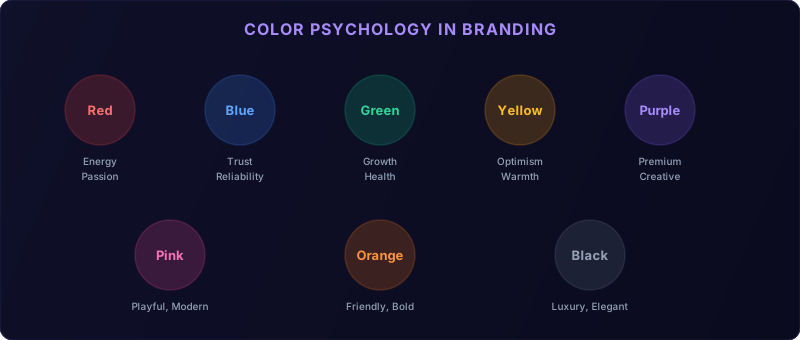
The Psychology of Color in Business:
- Blue - Trust, reliability, professionalism. Most popular for B2B, finance, tech, healthcare.
- Green - Growth, nature, health, wealth. Popular for sustainability, finance, health brands.
- Red - Energy, passion, urgency. Used in food, entertainment, and retail. Use sparingly in B2B.
- Orange - Creativity, friendliness, enthusiasm. Good for brands that want to feel approachable and energetic.
- Purple - Luxury, creativity, wisdom. Used by creative agencies, premium brands.
- Yellow - Optimism, warmth, attention. Best as an accent, not a primary color.
- Black - Sophistication, authority, luxury. Works for premium and fashion brands.
- White/Gray - Simplicity, cleanliness, modernity. Essential as neutral space in any palette.
A complete brand color palette includes:
- Primary color (1-2) - Your main brand color. The one people associate with you.
- Secondary colors (2-3) - Supporting colors for variety and visual hierarchy.
- Accent color (1) - A contrasting color for CTAs, highlights, and drawing attention.
- Neutrals (2-4) - Backgrounds, text, dividers. Usually shades of gray, off-white, or dark tones.
- Hex codes for digital (#1A73E8)
- RGB values for screen (26, 115, 232)
- CMYK values for print (89, 56, 0, 0)
- Pantone codes for premium printing
3. Typography
Typography sets the tone of your brand before anyone reads a word. The font you choose communicates personality instantly.
Font Categories:
Serif (small decorative strokes on letters)
- Feels: Traditional, trustworthy, editorial, established
- Best for: Law firms, financial services, publishing, luxury brands
- Examples: Playfair Display, Lora, Merriweather
- Feels: Modern, clean, approachable, tech-forward
- Best for: Tech companies, startups, agencies, health brands
- Examples: Inter, Plus Jakarta Sans, DM Sans
- Feels: Bold, confident, industrial
- Best for: Construction, manufacturing, bold brands
- Examples: Roboto Slab, Zilla Slab
- Use only for headlines or logos. Never for body text.
- Best as an accent that adds personality
- Heading font - Used for titles, headlines, and section headers
- Body font - Used for paragraphs, descriptions, and long text (must be highly readable)
- Accent font (optional) - For special callouts, quotes, or signature elements
- Maximum 2-3 fonts in your entire brand system
- Ensure fonts are available on Google Fonts or Adobe Fonts for web use
- Test readability at small sizes on mobile screens
- Maintain consistent font sizes and weights across your site and materials
4. Imagery and Photography Style
Your brand needs a defined visual style for images:
Photography Direction:
- Subject matter (people, workspaces, abstract, product)
- Color treatment (bright and airy, dark and moody, muted tones)
- Composition style (editorial, candid, minimalist)
- Line art vs filled
- Color palette alignment
- Level of detail
- Consistent style (outlined, filled, duotone)
- Consistent weight and proportions
- Aligned with brand color palette
5. Supporting Visual Elements
Beyond the core elements, a complete identity system includes:
Patterns and Textures - Repeating motifs that can be used as backgrounds or accents
Graphic Devices - Shapes, lines, or treatments used consistently (like a diagonal slash, a dot pattern, or a color overlay)
Layout Principles - Consistent spacing, grid systems, and visual hierarchy rules
UI Elements - Button styles, form styles, card styles for your website and digital products
Putting It All Together: Brand Guidelines
A brand guidelines document (or brand book) codifies all of the above into a reference that anyone can follow. At minimum, it should include:
- Brand story and positioning (1-2 pages)
- Logo usage - Variations, minimum size, clear space, incorrect usage examples
- Color palette - All colors with codes for digital and print
- Typography - Fonts, sizes, hierarchy, and usage rules
- Imagery guidelines - Photography and illustration direction
- Application examples - How the brand looks on a business card, social post, website, email
Brand Identity and Your Website
Your website is the most visible application of your brand identity. When you update your brand, your website should be updated to match.
A professional web developer will translate your brand identity into:
- Color-coded UI components
- Proper typography implementation with web fonts
- Consistent imagery treatment
- Responsive layouts that maintain brand consistency across devices
Brand Identity and Marketing
Your brand identity directly impacts marketing performance:
- Recognition - Consistent visuals across channels make your brand memorable
- Trust - Professional design signals competence and reliability
- Conversion - Cohesive branding improves landing page conversion rates by up to 33%
- Premium pricing - Strong brands command higher prices because perceived value increases
DIY Brand Identity: When It Works and When It Doesn't
Cost comparison - DIY vs professional for each brand element:
| Brand Element | DIY Tools | DIY Cost | Professional Cost | Quality Difference |
|---|---|---|---|---|
| Logo | Canva, Looka | $0-100 | $500-5,000 | Significant |
| Color palette | Coolors, Adobe Color | Free | Included in identity | Moderate |
| Font pairing | Google Fonts | Free | Included in identity | Low |
| Social templates | Canva Pro | $13/mo | $500-1,500 | Moderate |
| Business cards | Canva, Vistaprint | $30-80 | $200-500 | Moderate |
| Brand guidelines | Google Docs | Free | $1,000-3,000 | Significant |
| Total | $50-300 | $2,500-10,000 |
Reasonable DIY Steps:
- Color palette selection using tools like Coolors or Adobe Color
- Font pairing using Google Fonts
- Basic social media templates in Canva
- Simple logo concepts with a tool like Looka
When to Hire a Professional:
- Logo design (this is the one element worth professional investment)
- Brand strategy and positioning
- Complete visual system development
- Brand guidelines creation
Your brand identity should align with your marketing goals. See how visual consistency impacts performance in our complete digital marketing guide. And when it is time to implement your brand on the web, decide between custom development and templates based on your needs.
Common Brand Identity Mistakes
- Too many colors - 2-3 primary colors max. A rainbow palette feels chaotic.
- Too many fonts - Stick to 2-3. More looks cluttered.
- Inconsistent usage - Using slightly different shades, sizes, or logo versions across channels.
- Following trends blindly - That trendy gradient or 3D effect will look dated in a year.
- Designing for yourself, not your audience - Your favorite color does not matter. What resonates with your target customers does.
- Skipping the guidelines - Without documentation, brand consistency is impossible to maintain.
Want professional help with your brand identity? Start a conversation with our design team and we will discuss what your brand needs to stand out.
Your Brand Identity Checklist
Core Elements:
- [ ] Logo (primary, secondary, icon, monochrome versions)
- [ ] Color palette (primary, secondary, accent, neutrals with all codes)
- [ ] Typography (heading font, body font, size hierarchy)
- [ ] Photography/imagery direction
- [ ] Website aligned with brand identity
- [ ] Social media profiles and templates
- [ ] Email signature
- [ ] Business cards and stationery
- [ ] Presentation template
- [ ] Proposal/invoice template
- [ ] Brand guidelines document
- [ ] Logo file package (SVG, PNG, PDF)
- [ ] Font files or Google Fonts links
- [ ] Color codes reference sheet
Ready to build or refresh your brand identity? Explore our branding and creative services or start a conversation about your brand.
Frequently Asked Questions
How many colors should a brand have? Two to three primary colors maximum, plus two to four neutrals for a clean, cohesive palette.
What makes a good business logo? Simplicity, scalability, versatility across sizes and backgrounds, and timeless rather than trendy design.
How many fonts should a brand use? Maximum two to three: one for headings, one for body text, and optionally one accent font.
Do I need brand guidelines? Yes. Without documented guidelines, your brand will become inconsistent as more people create content.
Should I design my own logo? For early-stage businesses on tight budgets, maybe. Professional logo design is worth the investment once revenue allows.
