When Ahrefs analyzed 75,000 brands, branded web mentions correlated with Google AI Overview visibility at 0.664 - while backlinks correlated at just 0.218 (Ahrefs, May 2025). For visibility in AI answers, being talked about beats being linked to by roughly three to one.
Short answer: For AI search visibility, brand mentions beat backlinks. Ahrefs' study of 75,000 brands found branded web mentions correlate with Google AI Overview visibility at 0.664, while backlinks correlate at just 0.218 (Ahrefs, May 2025). AI models learn what your brand is and whether it can be trusted from how often and where you are talked about across the web, not from your link count. So the highest-leverage off-page work in 2026 is earning mentions on the listicles, comparisons, and review pages that AI engines actually cite - while keeping quotable, stat-backed content on your own site for them to pull from.
Brand mentions vs. backlinks: what the data actually says
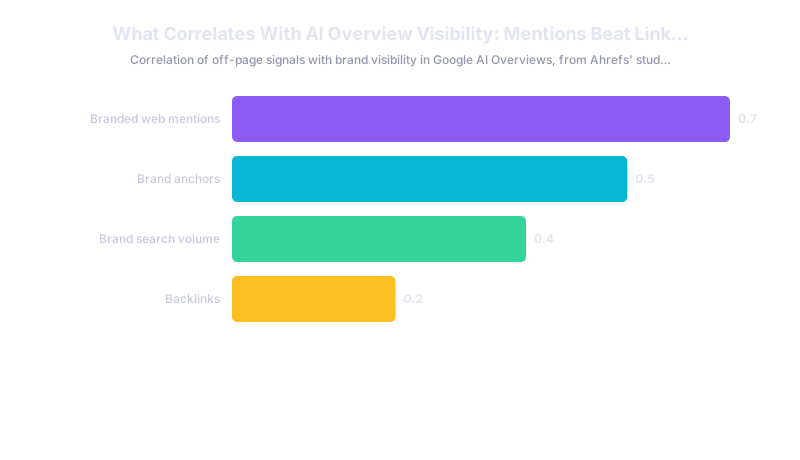
The headline number comes from Ahrefs' study of 75,000 brands, which measured how different off-page signals correlate with a brand's presence in Google's AI Overviews. Branded web mentions came out on top at 0.664, followed by branded anchors at 0.527 and brand search volume at 0.392. The number of backlinks trailed at 0.218 (Ahrefs, May 2025).
The gap shows up in raw visibility, too. Brands in the top quartile for web mentions averaged about 169 AI Overview mentions, versus roughly 14 for the quartile below them - more than a tenfold difference (Ahrefs, May 2025).
Two honest caveats. First, correlation is not causation: mentions and visibility rise together, but the study does not prove one causes the other. Still, the gap between the two signals is large and consistent, which is hard to ignore. Second, backlinks are not dead - they still move classic organic rankings. This is specifically about who gets named and cited inside AI answers, which is a different game.
Why AI engines weight mentions over links
The reason is mechanical. A language model reads text; it does not traverse a link graph the way Google's classic crawler does. It infers what your brand is, and whether it is credible, from how you are described and what you are mentioned alongside.
As Ryan Law, Director of Content Marketing at Ahrefs, puts it: "LLMs derive their understanding of a brand's authority from words on the page, from the prevalence of particular words, the co-occurrence of different terms and topics, and the context in which those words are used" (Ahrefs, May 2025).
Ahrefs' December 2025 follow-up reinforced this across ChatGPT, Google's AI Mode, and AI Overviews. YouTube mentions were the single strongest signal at roughly 0.737, and branded web mentions ranged from about 0.656 to 0.709 depending on the engine. Link metrics - number of backlinks and URL Rating - showed very weak correlations across all three (Ahrefs, December 2025).
A separate study from AirOps makes the off-site point concrete. Across 21,311 brand mentions in ChatGPT, Claude, and Perplexity, 85% came from external domains and only 13.2% directly from a brand's own site - making brands about 6.5x more likely to be mentioned through third-party sources than through their own content (AirOps, October 2025).
Where the mentions that get cited actually come from
If most mentions come from other people's sites, the practical question is: which sites? AirOps found that nearly 90% of those third-party brand mentions originated from listicles, comparison pages, and review roundups (AirOps, October 2025).
Ranking is not the gatekeeper it used to be, either. In AirOps' 2026 State of AI Search report, about 59.6% of AI Overview citations came from URLs that were not ranking in the top 20 organic results (AirOps, 2026). In other words, a page can be cited by the AI without ever appearing on page one of a normal search.
For a local or small business, that turns into a concrete target list:
- "Best [service] in [city]" roundups and "top [category]" listicles
- Reputable industry directories and comparison sites
- Review platforms your customers already use
- Podcasts and, especially, YouTube - where a single mention carries outsized weight
On-page still matters - pair mentions with extractable content
Off-site mentions get you into the conversation. Clear, quotable on-page content is what gets you cited once the AI is considering you.
The foundational research here is the "GEO: Generative Engine Optimization" study from Princeton and collaborators (KDD 2024). Its top-performing on-page tactics - citing sources, adding quotations, and adding statistics - raised generative-engine visibility by up to roughly 40% on the study's Position-Adjusted Word Count metric, with quotation and statistic additions being the strongest individual levers (Aggarwal et al., 2024). In the authors' words, "our top-performing methods, Cite Sources, Quotation Addition, and Statistics Addition, achieved a relative improvement of 30-40% on the Position-Adjusted Word Count metric" (Aggarwal et al., 2024).
Write for extraction - clear claims, real numbers, named sources - not for keyword density. One note of caution: these figures come from a synthetic academic benchmark, not from live local-service queries, so treat the "up to" number as a ceiling, not a promise.
If you want the on-page half of this laid out step by step, see our guide to generative engine optimization for small businesses.
What This Means for Your Business
The backlinks-versus-mentions debate is often framed as an either/or, usually by someone selling a link package. It is not. Backlinks still help your classic organic rankings. But when a customer asks ChatGPT or Google's AI "who's the best plumber in Austin," the engine is reading language on roundups and review pages - not counting your links.
Three moves follow from the data:
- Reallocate some link-building budget toward earning brand mentions on the pages AI engines actually cite: "best of" local roundups, comparison articles, and review platforms.
- Claim one owned channel where mentions carry extra weight - start with YouTube, the single strongest signal in Ahrefs' December 2025 study, and keep your on-site content quotable and stat-backed so there is something clean to cite.
- Track brand mentions in AI answers, not just rankings. Visibility increasingly lives inside the answer, not the blue links - and it is worth defending, given AI Overviews now correlate with a 58% lower click-through rate on the top-ranking result (Ahrefs, December 2025).
For related tactics, see how to get your business recommended by ChatGPT and how to get cited in Perplexity AI.
Want to be the brand AI recommends? Semark builds off-page AI visibility and GEO strategies for small and local businesses. Get a plan through our GEO services or reach us directly.