
When an AI summary appears above Google's results, users click a traditional search result just 8% of the time, versus 15% when there's no summary (Pew Research Center, July 2025). The click is disappearing. What replaces it is the citation inside the answer, and a landmark study shows exactly which content earns it.
Short answer: AI search engines cite businesses whose content is easy to trust and easy to lift, pages that cite their own sources, quote authorities, and back claims with statistics. The landmark GEO study (Aggarwal et al., Princeton/Georgia Tech, ACM KDD 2024) found these tactics raised a source's visibility in AI answers by up to roughly 40% on its core metric, while keyword stuffing pushed it down. Separately, an Ahrefs study of 75,000 brands found brand web mentions correlate with AI Overview visibility far more strongly (0.664) than backlinks (0.218). So the businesses that get cited are the ones that are both quotable on-page and widely mentioned off-page.
What the GEO study actually found
The research everyone cites is "GEO: Generative Engine Optimization" by Pranjal Aggarwal, Vishvak Murahari, Tanmay Rajpurohit, Ashwin Kalyan, Karthik Narasimhan, and Ameet Deshpande (Princeton, Georgia Tech, IIT Delhi, and Allen AI), published at ACM KDD 2024 (arXiv 2311.09735). The team built a benchmark of thousands of queries and tested content edits to see which ones raised a source's visibility inside a generative engine's answer, measured mainly by a "Position-Adjusted Word Count" score that rewards being quoted prominently and at length.
Three edits won. In the authors' words: "our top-performing methods, Cite Sources, Quotation Addition, and Statistics Addition, achieved a relative improvement of 30-40% on the Position-Adjusted Word Count metric... the efficacy of these strategies varies across domains, underscoring the need for domain-specific optimization methods" (Aggarwal et al., ACM KDD 2024). Against a baseline score of 19.5, Quotation Addition scored 27.8 (about +43%), Statistics Addition 25.9 (about +33%), and Cite Sources 24.9 (about +28%).
The most-quoted number in the whole paper is the +115%. For a page already sitting fifth in the underlying search ranking, adding source citations lifted its visibility by 115.1% (Aggarwal et al., ACM KDD 2024). That is a real result, but read the fine print: it is the gain for one starting position in a controlled benchmark, not a promise for any page.
At the other end, keyword stuffing backfired. For top-ranked sites, stuffing keywords reduced visibility by about 6.0% (Aggarwal et al., ACM KDD 2024). The old density trick that once nudged blue links now reads as noise to a model that is trying to summarize, not rank.
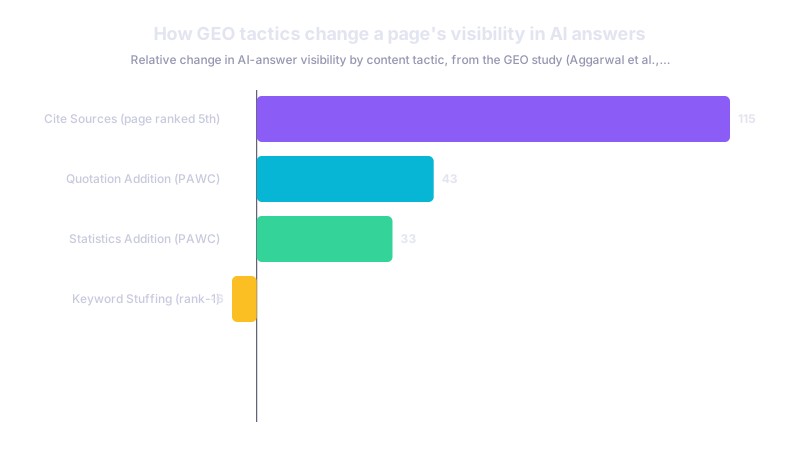
One honest caveat before you treat these as laws of physics: every figure above comes from a synthetic academic benchmark. Nobody has demonstrated a +115% lift on "plumber near me." Take the directions as reliable and the exact percentages as upper bounds.
Why "quotable" beats "keyword-optimized" for AI
The reason these three tactics work is mechanical. A generative engine does not rank ten links and walk away; it writes a paragraph and attributes pieces of it. To do that safely, it needs sentences it can lift and stand behind. A claim with a named source attached is defensible. A verbatim quote from a recognized expert is defensible. A concrete statistic the model can point at is checkable. All three hand the model a ready-made, low-risk building block for its answer.
Keyword stuffing does the opposite. It signals manipulation to a system whose entire job is to distill trustworthy meaning, which is why it measured negative in the study rather than merely neutral. The practical translation: write the way a careful journalist would, with attribution and specifics, not the way a 2012 SEO would, with repeated exact-match phrases.
Off-page: why brand mentions now matter more than backlinks
On-page quotability gets you into the running. Off-page reputation often decides the race. Ahrefs analyzed 75,000 brands and found that the number of websites mentioning a brand correlated with its AI Overview visibility at 0.664, while backlinks correlated at just 0.218, the strongest single relationship in the dataset ("An Analysis of AI Overview Brand Visibility Factors," Louise Linehan and Xibeijia Guan, Ahrefs, 2025).
The gap between the mentioned and the ignored is stark. Brands in the top quartile for web mentions averaged 169 AI Overview appearances, versus 14 for the next quartile down, roughly a 12x difference (Ahrefs, 2025). As Ahrefs' Ryan Law puts it: "Unlinked mentions-text written about your brand on other websites-have very little impact on SEO, but a much bigger impact on GEO" (Ahrefs, 2025).
For a local or service business, this is the most actionable finding in this whole article. You do not need a link-building campaign to move the needle on AI visibility; you need to be named. Get listed in local directories and review platforms, featured in local press and industry roundups, and cited by name in the places your customers already read. A link is a bonus. The mention is the point.
AI answers don't reward AI slop, so write for humans first
If cheap AI content got cited, everyone would already have won. It doesn't. Graphite analyzed which articles AI engines actually cite and found that 82% of the articles cited by ChatGPT and 82% cited by Perplexity were written by humans, as were 86% of the articles ranking in Google Search ("AI Content In Search & LLMs," Graphite, data collected June 2025). Mass-produced text is not what these systems pull from; sourced, specific, expert-reviewed content is.
That is not a moral point, it's a mechanical one. The same qualities that make a passage citable, real attribution, real numbers, a real named expert behind the words, are the qualities AI slop lacks. Putting a genuine expert on the page is not overhead; it is the ranking factor.
The stakes: clicks are collapsing, citations are the new visibility
Here is why none of this is optional. When an AI Overview appears, it now correlates with a 58% lower average click-through rate for the top-ranking page, with position-one CTR on informational queries falling from 0.076 to 0.039 ("AI Overviews Reduce Clicks by 58%," Ahrefs, December 2025 data). Pew's browsing-behavior study found the same collapse from the user side: a click on a traditional result just 8% of the time when an AI summary is present, versus 15% without (Pew Research Center, July 2025).
If fewer people click through, the visibility that survives is being the source named inside the answer. That is the shift GEO responds to. It is not a growth hack; it is defense of the ground you are already losing to the summary box.
A practical GEO checklist for your business pages
You can act on all of the above without a research budget. Focus on a handful of high-intent pages, your top services, your best FAQs, and make them quotable:
- Cite your sources inline with named attribution and a link on every factual claim, exactly the edit that scored highest in the GEO study.
- Add a real statistic and one verbatim quote from a credible expert or your own licensed data, so the model has something concrete and defensible to attribute to you.
- Put a concise, extractable "short answer" near the top of service and FAQ pages, two or three plain sentences a model can lift whole.
- Build off-page mentions: local directories, review platforms, guest features, and local press. Chase the mention, not just the link.
- Keep it human-written and expert-reviewed, and skip keyword stuffing entirely, since it measured negative in the study.
| Tactic | GEO study result | Effort for a local business |
|---|---|---|
| Cite sources inline | Up to +115% for a lower-ranked page | Low |
| Add quotations | Top method, ~+43% on PAWC | Low |
| Add statistics | ~+33% on PAWC | Low |
| Earn brand mentions | 0.664 correlation vs 0.218 for links | Medium, ongoing |
| Keyword stuffing | About -6% (avoid) | N/A |
What This Means for Your Business
The GEO tactics are proven directionally, but the headline percentages are benchmark upper bounds, so treat them as a playbook rather than a guarantee. On-page work, citing sources, quoting experts, and adding real statistics, is cheap and worth doing on your key pages this week. For a local or service business, though, the heavier lever is usually off-page: Ahrefs' data shows brand mentions out-predict backlinks by roughly three to one for AI visibility, so getting named everywhere your customers and the models both look matters more than any single edit.
The winning move is not gaming a model. It is being genuinely quotable on your own pages and genuinely mentioned everywhere else, with a real expert behind the words, because AI slop doesn't get cited. This compounds with, rather than replaces, your local SEO and Google Business Profile work. If you want to go deeper, see our guides on how ChatGPT chooses which businesses to recommend, generative engine optimization for small businesses, and how to get cited in Perplexity AI.
Want your business to be the source AI cites, not the one it skips? Get a GEO audit from Semark, see our generative engine optimization service, or book a call at /contact.