
When an AI Overview appears above the search results, the click-through rate on the #1 organic result drops by 58% (Ahrefs, 2026, 300,000 keywords via aggregated Google Search Console data). Ranking first no longer earns the traffic it used to, and the trend is accelerating rather than leveling off.
Short answer: AI Overviews are measurably cutting organic clicks. Ahrefs found the click-through rate on the #1 result falls 58% when an AI Overview is present (2026), and Pew Research found users click a traditional link only 8% of the time on searches with an AI summary versus 15% without (July 2025; Google disputes Pew's methodology). The survival move is not to fight the summary but to become the source it cites and to shift toward queries and channels AI can't fully answer - a defense built on brand mentions, cited statistics, and bottom-of-funnel intent.
The -58% headline is real, but it is also being used to scare small businesses into panic-buying "AI SEO." The honest read is more useful: AI Overviews are eating the top-of-funnel informational traffic that rarely converted for a plumber or a med spa in the first place. The searches that actually pay your bills - "near me," "cost," "book," branded, and review-driven queries - are far more insulated. This playbook shows you exactly where the damage lands and how to rebuild visibility instead of chasing rankings Google now answers itself.
The damage, quantified: what -58% actually means
Ahrefs analyzed 300,000 keywords using aggregated Google Search Console data - 150,000 with an AI Overview present and 150,000 without - and measured how click-through rates changed by SERP position (Ahrefs, 2026). The top of the page takes the biggest hit:
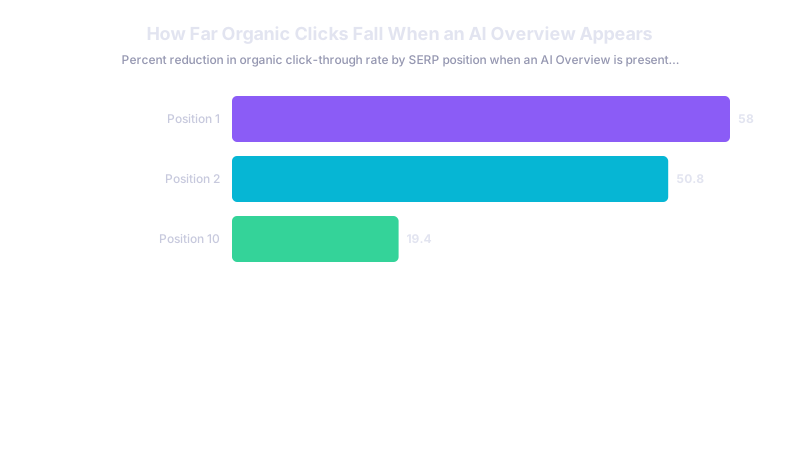
| SERP position | CTR reduction when an AI Overview appears |
|---|---|
| Position 1 | -58.0% |
| Position 2 | -50.8% |
| Position 10 | -19.4% |
This is not a one-time shock, either. Ahrefs' earlier analysis in April 2025 estimated a 34.5% reduction in clicks to top-ranking content on informational queries (Ahrefs, 2025). The deterioration from -34.5% to -58% in under a year shows the impact is widening as AI Overviews roll out across more countries and languages. Ryan Law, Director of Content Marketing at Ahrefs, predicted exactly this in the April study: "As the novelty wears off and the law of shitty clickthroughs kicks in, I would expect to see clicks reduce further" (Ahrefs, 2025). It did.
It's not just Google's numbers: the Pew reality check
Independent data tells the same story from the user's side. The Pew Research Center studied the actual browsing behavior of 900 U.S. adults across 68,879 Google searches and found that "Users who encountered an AI summary clicked on a traditional search result link in 8% of all visits. Those who did not encounter an AI summary clicked on a search result nearly twice as often (15% of visits)" (Pew Research Center, July 2025).
Two more findings from the same study matter for planning:
- Only 1% of the time did users click a link inside the AI summary itself. The citation is seen but rarely clicked, so "get cited in the Overview" does not automatically mean "get the click."
- 26% of searches with an AI summary ended the browsing session entirely, versus 16% without - the "answer and leave" pattern in hard numbers (Pew Research Center, July 2025).
Which queries actually bleed (and which are safe)
Averages hide the most important detail: the loss is not evenly distributed across your pages. Informational, top-of-funnel queries - "what is," "how does," "why" - trigger AI Overviews most often and lose the most clicks, because those are exactly the questions a summary can answer completely.
Transactional and local-intent queries behave differently. Searches like "plumber near me," "book," "cost to," and "hire a" carry intent to act that a paragraph of summary text can't satisfy, so they trigger Overviews less often and still convert when they do. Branded and comparison searches stay relatively protected as well - which is a strategic argument for building brand demand rather than only ranking for generic terms.
The practical takeaway: don't read the -58% number as "we're down 58% across the board." Audit your own top pages and separate the traffic that was informational (at risk) from the traffic that was commercial or local (defensible). For most local and service businesses, the exposed traffic is the traffic that was least likely to turn into a call or a booking anyway.
Defense 1: Become the source the AI cites
If Google is going to summarize the answer, the winning position is to be the brand it names inside that summary. And the biggest lever there is not what most SEOs expect.
In a study of 75,000 brands, Ahrefs found that brand web mentions correlate with AI Overview visibility at 0.664, versus just 0.218 for backlinks (Ahrefs, May 2025). Being talked about across the web - not just being linked to - is what AI Overviews draw on when deciding whether to mention you. The gap is dramatic at the top: the most-mentioned quartile of brands averaged roughly 169 AI Overview mentions, compared with about 14 for the next quartile down - more than a tenfold difference (Ahrefs, May 2025).
How you structure the page matters too. In the academic "GEO: Generative Engine Optimization" study (Aggarwal et al., Princeton / Georgia Tech / IIT Delhi / Allen AI, ACM KDD 2024), the most effective on-page tactics were adding quotations, adding statistics, and citing sources - lifting visibility by up to ~40% in generative-engine responses. Quotation Addition was the single strongest method (+42.6% on the study's position-adjusted word-count metric), with Statistics Addition close behind (+32.8%). One honest caveat: these are upper bounds from a synthetic academic benchmark, and efficacy was domain-specific - they have not been proven on local-business queries.
Put together, the practical program is straightforward:
- Publish original data and statistics that others want to quote.
- Get named in local press, industry roundups, and reputable directories to grow brand mentions.
- Structure content for extraction - clear answers, cited sources, and quotable stats near the top.
Defense 2: Shift the mix toward what AI can't take
The second move is to rebalance where your effort goes. Prioritize the bottom-of-funnel and local pages - service-area pages, pricing, booking - where intent to act survives the summary. A page that answers "what causes a slab leak" is exposed; a page built around "slab leak repair cost in [city]" is far more defensible.
Then build channels you actually own, so your demand isn't fully mediated by a Google summary: an optimized Google Business Profile, a steady flow of reviews, an email list, and the repeat and referral business that never touches a SERP at all.
Diversify your citations, too. Google is not the only answer engine your customers use. Well-sourced, human-written content still dominates AI citations everywhere: an analysis by Graphite (data June 2025) found that 82% of articles cited by ChatGPT and Perplexity, and 86% of top Google-ranking articles, are written by humans rather than AI. The lesson is that genuinely useful, well-sourced writing is still what gets cited - see our guide on how to get cited in Perplexity AI.
Finally, change what you measure. Appearing inside an Overview still builds brand recognition even without the click, so track impressions and citations alongside clicks - not clicks alone.
Defense 3: Fix your measurement before you panic
Before you conclude that a page is failing, make sure you're measuring the right thing. Segment Google Search Console by query type so you can see where clicks actually dropped versus where impressions held steady. A page can lose CTR while still doing its job.
Watch keywords where an AI Overview is present separately from clean SERPs, so a traffic dip on informational terms doesn't get blamed on the wrong pages. And treat branded search volume and direct traffic as leading indicators - if Overview visibility is quietly building recognition, it shows up downstream as branded searches and direct calls, not as clicks on the exposed page.
Set expectations accordingly. A page can lose click-through rate while its business value - leads, calls, bookings - holds steady, as long as it targets the right intent. That is the difference between a measurement problem and a real revenue problem, and most businesses are conflating the two right now.
What This Means for Your Business
The -58% headline is real, but it hits generic informational traffic hardest - the traffic that was least likely to convert for a local or service business anyway. As HubSpot CEO Yamini Rangan put it, "AI overviews are giving answers, and fewer people are clicking through to websites" (diginomica, August 2025). That is true, and it is survivable.
For local and service businesses, the winning play is brand mentions plus local intent plus reviews - not chasing top-of-funnel rankings Google now answers itself. Treat AI Overviews and answer engines as a new distribution channel to be cited in, not just a threat to be measured. Start by auditing which of your pages are exposed, then rebalance toward defensible, high-intent content and owned channels. For the bigger picture on where to spend your effort, see what actually moves the needle in SEO in 2026.
Worried an AI Overview is quietly draining your best pages? Semark's team audits which of your pages are exposed and rebuilds your visibility across Google and AI answer engines. Get a free AI-search visibility review at /services/digital-marketing-ads/generative-engine-optimization.