
Thought-leadership SEO campaigns built mostly on blog content average a 748% return over three years (First Page Sage, self-reported), and 82% of the articles AI engines actually cite are human-written (Graphite, 2025). So the short version is yes - but with a catch most agencies won't say out loud.
Short answer: Blogging is still worth it in 2026, but only when you treat it as a compounding, expertise-driven asset instead of a volume play. Thought-leadership SEO campaigns - roughly 65% blog content - average 748% ROI over three years, though First Page Sage reports that as self-reported vendor data, and 82-86% of the articles AI engines and Google actually cite and rank are human-written (Graphite, 2025). The catch: most posts never earn their cost back. A small share of "compounding" posts drives the majority of traffic, so quality, consistency, and measurement decide whether your blog makes money or wastes it.
What the ROI numbers actually say
First Page Sage's own campaign data (Q1 2021 through Q3 2025) puts the average return on a thought-leadership SEO program at 748% over 36 months, with a 9.10 ROAS and a break-even point around nine months (First Page Sage, self-reported). Roughly 65% of that content is blog posts; the rest is landing pages. Treat those numbers as an interested vendor's self-reported figures, not an audited industry average - but the shape of the curve holds up across the field: content ROI is back-loaded. The returns don't show up in month three. They accelerate into years two and three as posts accumulate rankings, links, and citations.
That timing is exactly where businesses get burned. If you start a blog expecting payback by the next quarter, you'll kill it right before it starts working. Plan for a 6-to-18-month runway, and if you can't fund it that long, don't start.
Strategy and measurement are what separate the winners. In the Content Marketing Institute's 2026 research, 97% of B2B marketers say they have a content strategy and 89% now use AI tools to help create content - yet only 39% report that AI actually improved their content's performance (CMI, 2026). Volume isn't the differentiator. Measurement is.
Why blogging compounds (and why most posts don't)
The single most useful fact about blogging ROI comes from HubSpot: about 10% of posts are "compounding" - their organic traffic keeps growing a year or more after publishing - and those posts generate 38% of all blog traffic (HubSpot, 2016). Everything else mostly spikes on publish day and decays.
That 10%-drives-38% pattern is the whole game. A handful of deep, intent-matched posts will out-earn a firehose of thin ones, every time. The practical move isn't "publish more." It's to build topical hubs around questions your customers actually search, and to update your winners instead of chasing a bigger backlog.
Blogging in the AI-search era: human content still wins
The 2026 fear is that AI-generated content has flooded search and made blogging pointless. The data says the opposite. Graphite analyzed content across roughly 31,000 keywords in June 2025 and found that 82% of the articles cited by ChatGPT and Perplexity, and 86% of the articles ranking on Google, are human-written (Graphite, 2025). For context, Ahrefs found that 74.2% of newly published pages now contain some AI-generated content, but only about 2.5% are "pure AI" (Ahrefs, 2025). Human-led work - often AI-assisted, rarely AI-only - is still what gets cited and ranked.
What has changed is the payoff for being cited versus clicked. Ahrefs found that when an AI Overview appears, the top organic result sees roughly a 58% lower click-through rate (Ahrefs, 2025). Being the source an AI engine quotes now matters as much as being the blue link someone clicks. And what earns those citations looks less like classic link-building: brand mentions across the web correlate with AI Overview visibility at 0.664, versus just 0.218 for backlinks (Ahrefs, 75,000-brand study, 2025).
As Robert Rose, Chief Strategy Advisor at the Content Marketing Institute, put it: "Marketing has a meaning crisis. And only humans can fix it." That's not a slogan - it's the competitive edge. A model can remix what already exists; it can't run your last job, interview your customer, or report a result nobody has published yet.
What separates blogs that make money from blogs that don't
Three things, consistently.
Genuine expertise and first-hand experience. Google's E-E-A-T signals and AI engines both reward content that demonstrably comes from doing the work. This is the one input a competitor can't fake and a model can't scale.
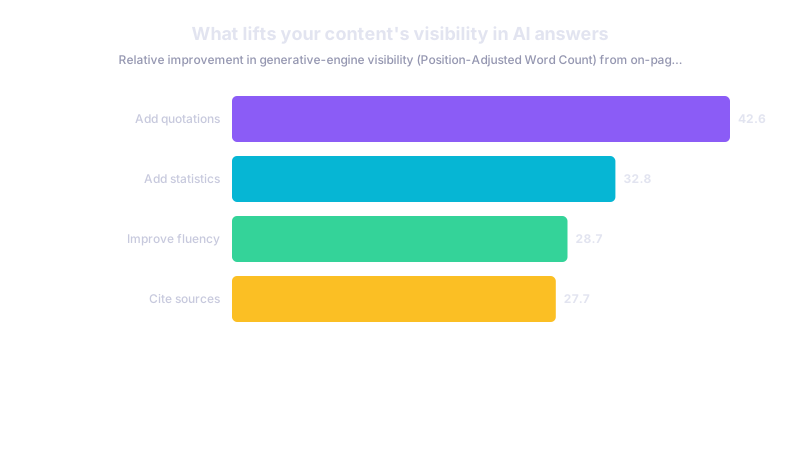
On-page structure AI engines can lift. The academic "GEO" study (Aggarwal et al., KDD 2024) tested optimization tactics on a synthetic benchmark and found that adding quotations, statistics, and cited sources raised content's visibility in generative-engine answers by up to roughly 40% on their scoring metric - with cited sources helping lower-ranked pages the most. Keyword stuffing actually hurt visibility. Treat those as upper bounds from a lab benchmark, not a promise on local-business queries - but the direction is clear and free to act on.
Measurement. If you can't trace a lead or a pipeline dollar back to a post, you can't prove ROI - and you'll cut the wrong things. Track assisted conversions, not just last-click. This is where a documented process on how to measure digital marketing ROI in 2026 pays for itself.
What This Means for Your Business
For most local and growing businesses, blogging is still one of the highest-ROI channels available - but only if you fund it past the 6-to-18-month payback window and measure it honestly. The 2026 playbook is straightforward:
- Publish fewer, deeper, expertise-led posts and update your compounding winners instead of chasing volume.
- Write for humans and AI engines at once: real first-hand experience, cited sources and statistics, and clear structured answers to real questions.
- Instrument everything so you can point to the posts that actually generate leads.
Want a blog that actually earns its cost back? Semark builds measurable, expertise-led content programs engineered to compound in both Google and AI search. See our digital marketing and ads services or book a strategy call.