
Most PPC agencies charge 10% to 20% of your monthly ad spend to manage Google Ads campaigns (WebFX, 2026) - and on a small budget, that percentage can quietly cost you more than a flat fee for the same work.
Short answer: Most PPC agencies charge 10-20% of your monthly ad spend to manage Google Ads, or a flat retainer of roughly $500-$2,000/month for small-to-midsized accounts (WebFX and OuterBox, 2026). That fee doesn't buy ad clicks - it buys the labor and expertise behind them: keyword research, ad and landing-page testing, bid and budget management, conversion tracking, and monthly reporting. Below about $10,000 in monthly ad spend, a flat fee is usually the cleaner deal, because percentage-of-spend minimums often push the effective rate higher at small budgets.
What PPC management fees cost in 2026
The dominant benchmark is straightforward: 10% to 20% of monthly ad spend, with the percentage typically dropping as your total spend grows (WebFX, 2026). OuterBox reports the same band - "percentage-of-spend models commonly land around 10% to 20% of monthly media spend, often with a minimum management fee" (OuterBox, 2026).
For small and mid-sized accounts, many agencies price as a flat retainer instead. OuterBox's 2026 tier table shows $500-$2,000/month to manage $1,000-$5,000 in ad spend, rising to $1,500-$5,000 for $5,000-$25,000 in spend and higher from there (OuterBox, 2026). WebFX cites a slightly higher flat range of $1,000-$3,000/month for typical management (WebFX, 2026). Some agencies quote a wider 15% to 30% of ad spend, a figure CallRail reports for businesses overall (via HawkSEM, 2026) - a broader band than the 10-20% headline, usually reflecting smaller accounts where a minimum fee is a bigger share of spend.
The number is easy to underestimate. On a $5,000/month budget, a 15% fee is $750 - not an extra line item most owners plan for, but a real slice of what you're already spending.
The pricing models - and who each one fits
Agencies price PPC management in a handful of ways, and percentage-of-spend and flat or hybrid fees are the most common; performance-based and hourly arrangements are less common (OuterBox, 2026).
- Percentage of ad spend. Scales automatically with your budget. Simple, but it ties the agency's pay to how much you spend rather than what you earn.
- Flat monthly fee. Predictable and transparent - you know the number before the invoice. Best for steady small-to-mid budgets under roughly $10,000/month.
- Hybrid (flat base plus a percentage above a threshold). OuterBox notes that "flat monthly fee plus a percentage of ad spend is still one of the most common PPC management pricing models" (OuterBox, 2026). It suits accounts that are actively scaling.
- Hourly or pure performance-based. These exist but are the least common; performance deals in particular can be hard to structure fairly.
What the fee actually buys you
This is the part owners most often misread. Your ad spend is a pass-through cost that goes straight to Google. The management fee buys skilled human labor and testing discipline on top of it.
That work breaks into three buckets:
- Setup. Campaign build, conversion tracking, GA4 configuration, and call tracking so leads are attributed correctly.
- Ongoing management. Keyword research, negative-keyword pruning, ad-copy and landing-page testing, and continuous bid and budget optimization.
- Reporting and strategy. Monthly reviews tied to leads and revenue - not just clicks and impressions.
Flat fee vs. percentage: how to pick
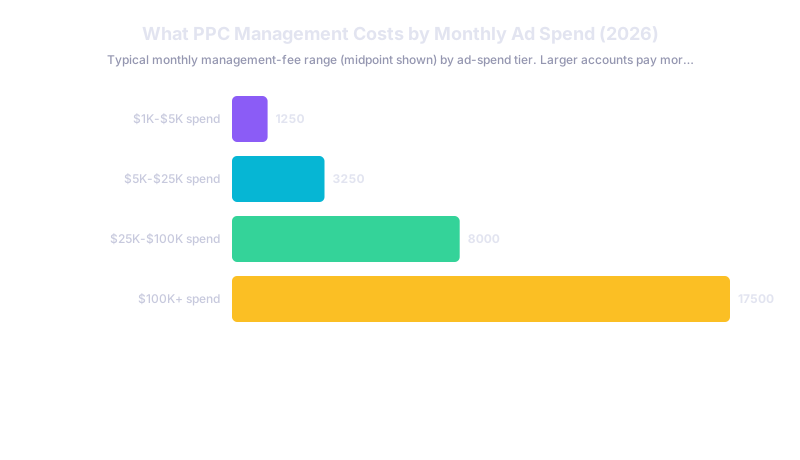
The chart above shows why account size changes the math. Larger accounts pay far more in dollars but a smaller effective percentage, because a $100,000/month campaign doesn't take ten times the labor of a $10,000 one.
A few rules of thumb:
- Under ~$10K/month spend: a flat fee usually wins, because percentage-of-spend minimums inflate the effective rate at small budgets.
- Above ~$25K/month: percentage or tiered pricing can be fair, since bigger accounts don't need proportionally more labor.
- Fluctuating or seasonal budgets favor percentage; steady budgets favor a flat fee.
Red flags and hidden costs to watch
The percentage-of-spend model carries a quiet conflict of interest: if the agency's pay is a slice of your budget, its incentive is to spend more of your money, not to hit your target cost-per-lead with less. That's not a reason to avoid it - good agencies cap it or scale it down - but it is the reason we steer small local businesses toward a transparent flat fee. Watch for:
- Percentage-only pricing with no cap, which can reward the agency for spending more rather than for results.
- Bundled vs. billed-separately extras. Ask whether the fee includes landing pages, call tracking, and creative, or bills them on top.
- Lock-in and account ownership. Make sure the Google Ads account stays in your name, so you keep your history and data if you leave.
- Vague reporting. If you can't see cost-per-lead and conversions, you can't judge whether the fee is worth it.
What This Means for Your Business
Budget the management fee as part of your total investment, not a surprise. Ad spend plus management typically runs $1,000-$10,000/month for most small and mid-sized businesses (WebFX, 2026), and the fee is only worth it if the campaign returns more than it costs.
Three things to hold onto:
- Judge the fee against outcomes - leads, revenue, and cost-per-acquisition - not the raw percentage.
- For small local budgets, a transparent flat fee usually beats percentage-of-spend.
- Get every quote in effective-percentage terms so you're comparing apples to apples.
Not sure whether a flat fee or percentage-of-spend deal is right for your budget? Get a straight answer - see our paid ads and PPC management services or book a no-pressure review at /contact.