
The number everyone quotes is a 748% average ROI for SEO (First Page Sage, 2026). It's a real figure - and it's also one of the most misused stats in marketing, because it describes a single, well-funded campaign type sitting in the same dataset where basic content marketing returns just 16%.
Short answer: For most established local and B2B businesses, SEO is worth it - but not automatically. First Page Sage's proprietary data (Q1 2021-Q3 2025) puts thought-leadership SEO at a 748% average ROI with a roughly 9-month break-even, yet that same dataset shows returns swing from 317% (eCommerce) to 1,389% (real estate), while basic content marketing returns only 16%. SEO pays off when your customers actually search for what you sell, your margins can absorb a 6-14 month payback, and you fund a real content program - not a $300/month "SEO package."
The headline number: 748% ROI - and what it actually measures
First Page Sage reports a 748% average ROI and a roughly 9-month break-even for what it calls "thought-leadership SEO," drawn from proprietary campaign data spanning Q1 2021 to Q3 2025 (First Page Sage, 2026). Two things matter before you anchor on that number.
First, it's self-reported vendor data. First Page Sage is an agency that sells this exact service, and the campaigns behind the average are not typical small-business budgets - they averaged about $120,000 per year, split roughly 65% blog content and 35% landing pages (First Page Sage, 2026). That is not a $300/month result, and reading it as one is how businesses talk themselves into disappointment.
Second, "SEO" is not one number even inside this single report. In the same dataset, technical-SEO-only work returns 117% and basic content marketing returns just 16% ROI (First Page Sage, 2026). So the 748% figure isn't "SEO's ROI" - it's the return on one specific, heavily resourced approach. We lead with that caveat on purpose: a vendor's average is directional marketing until you model your own numbers. For the mechanics of doing that, see our guide on how to measure digital marketing ROI.
The spread nobody quotes: 317% to 1,389% by industry
The average also hides an enormous range across verticals. In the same First Page Sage report, self-reported SEO ROI runs from 317% for eCommerce up to 1,389% for real estate, with Legal Services at 526%, HVAC at 678%, B2B SaaS at 702%, and Financial Services at 1,031% (First Page Sage, 2026).
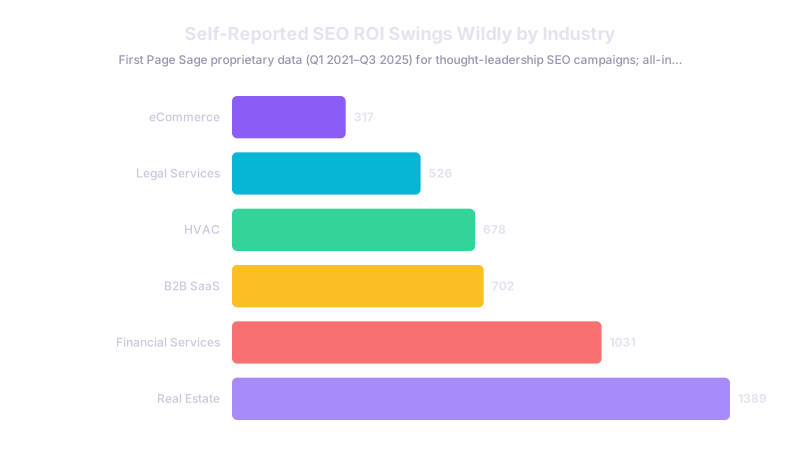
The pattern is intuitive once you see it. High-ticket, long-sales-cycle verticals - real estate, financial services - see the biggest returns because a single organic lead is worth so much that even a modest volume of them dwarfs the campaign cost. Low-margin, high-competition verticals like eCommerce sit at the bottom: the same effort, a very different payoff, because each incremental organic sale carries thin margin and the search results are crowded.
The takeaway is not "pick a good industry." It's that your industry, deal size, and margin determine whether 748% is optimistic or conservative for you. A real estate brokerage and a discount eCommerce store running identical SEO programs should expect wildly different outcomes - and any forecast that ignores that is guessing.
Break-even is slow: budget for 5 to 14 months before profit
Even when the math clears, it clears slowly. First Page Sage's break-even timelines run from about 5 months for Construction to 6 for HVAC and 7 for B2B SaaS, with most industries landing around 9-10 months and Legal Services at roughly 14 months (First Page Sage, 2026). SEO is an accrual investment: the cost is front-loaded, and the returns compound in year two and beyond.
That collides head-on with owner expectations. In HigherVisibility's small-business study, 68.8% of SMB owners expect significant SEO results within three months or less (HigherVisibility, 2025) - a setup for disappointment when the realistic floor is closer to two to three times that. If you sign a contract expecting quarter-one results against a vertical that breaks even at month fourteen, you'll likely cancel right before the returns arrive.
The practical rule: if you need leads next month to keep the lights on, that's a paid-search problem, not an SEO one. Most local businesses actually need both - paid search for immediate pipeline while SEO compounds underneath it. We break that trade-off down in Google Ads vs SEO for local business.
The 2026 fine print: AI is shrinking the clicks SEO delivers
There's a newer wrinkle that changes the calculus. AI Overviews now correlate with a 58% lower click-through rate on the top-ranking organic result, up from an earlier 34.5% estimate (Ahrefs, Dec 2025). And Pew Research found that when Google shows an AI summary, users click a traditional search result just 8% of the time, versus 15% when no summary appears - roughly half as often (Pew Research Center, 2025). Google disputes Pew's methodology, and this is a single-quarter snapshot, so treat it as a trend signal rather than a settled law.
This doesn't kill SEO ROI - it changes what "ranking" is worth. Being the source an AI answer cites can now matter more than owning the classic blue link, because a share of your would-be clicks are being answered on the results page itself. So "is SEO worth it" in 2026 quietly includes a second question: "is my content structured to get cited by AI?" That's a different discipline than chasing position #1, and we cover it in our guide to get found by AI search (GEO).
When SEO is NOT worth it (the honest answer)
There are businesses for which the honest answer is no, or not yet:
- Almost nobody searches for what you sell. Brand-new categories with no established search demand, or pure outbound and referral businesses, can't harvest intent that doesn't exist. SEO captures demand; it rarely creates it from zero.
- Your margins can't survive the payback. If a 6-14 month break-even would starve the business, or you need revenue this quarter to make payroll, SEO is the wrong tool for that job - even if it would win over two years.
- You'll only fund a token effort. The data is blunt here: the 748% figure came from ~$120,000/year programs, while basic content marketing in the same dataset returned 16% (First Page Sage, 2026). A $300-$500/month "package" is far more likely to produce the 16% outcome than the 748% one.
"An SEO effort could be very unprofitable from a revenue standpoint but still beneficial for the company."
The flip side is equally true: an SEO effort can be revenue-positive and still be the wrong use of cash if paid, brand, or product investment would return more, faster. "Worth it" is always relative to your next-best option, not just to zero.
What This Means for Your Business
Run your own ROI math before you sign anything. The formula is simple: (organic leads per month × close rate × average deal value × margin) versus total monthly SEO cost - then apply your industry's realistic break-even, not a three-month fantasy. If the annualized return doesn't clear your cost of capital, don't start.
Match the tool to the timeline. SEO is for compounding pipeline; paid search is for this month's leads. Most local businesses need both, and pretending SEO will deliver next-week results is the fastest way to cancel a program right before it pays off.
Treat every vendor ROI stat - including 748% - as directional, not guaranteed. Demand a forecast tied to your keywords, your close rate, and your deal size, and be skeptical of any pitch that quotes the headline average without the fine print behind it.
And fund it properly or don't start. A real program beats a cheap "package" that quietly returns 16%, and an underfunded SEO effort is one of the more common ways local businesses waste a year of marketing budget.
Not sure if the SEO math clears for your business? Get an honest ROI forecast tied to your keywords, close rate, and deal size - talk to Semark at /contact or see /services/digital-marketing-ads.